Facts
The appellant-defendant and his mother entered into a written agreement to sell Survey No. 14, admeasuring 0.809 hectare at Village Dudhiya, Indore, in favour of the respondent-plaintiff on 27 May 2021.
Source reference: p. 1, para. 2The respondent paid ₹25 lakhs against the total consideration of ₹5.30 crores. He subsequently instituted a suit for specific performance, asserting that the balance consideration was not paid because of disputes among the appellant’s family members, while maintaining that he was ready and willing to perform his part of the contract.
Source reference: p. 1, para. 3Along with the suit, the respondent sought temporary injunction under Order 39 Rules 1 and 2 of the Code of Civil Procedure, 1908. The appellant opposed the application, contending that the respondent had failed to pay or tender the balance consideration within the stipulated time and that no family dispute existed.
Source reference: p. 1, para. 3The trial court held that the question as to which party was at fault could be determined only after evidence and restrained the appellant from selling, alienating, transferring, or encumbering the suit property during the pendency of the suit.
Source reference: p. 1, para. 4The appellant challenged that order under Order 43 Rule 1(r) CPC.
Source reference: p. 1, para. 1Issues
Whether the trial court was justified in granting a temporary injunction restraining the appellant from alienating or encumbering the suit property pending adjudication of the specific-performance suit?
Source reference: p. 1, paras. 1, 4; p. 3, para. 7Whether, having regard to the disputed performance of the agreement and the prolonged operation of the injunction, the injunction should continue for the entire duration of the suit or be limited for a specified period?
Source reference: p. 3, paras. 7–8Law Applied
The appeal was governed by Order 43 Rule 1(r) CPC, which permits an appeal against an order granting or refusing an injunction under Order 39 Rules 1 and 2 CPC.
Source reference: p. 1, para. 1Order 39 Rules 1 and 2 CPC empower the court to grant temporary injunctive relief where protection of the subject matter is necessary during the pendency of the suit.
Source reference: no citationThe court also applied the principle that disputed questions concerning breach, readiness and willingness, and the parties’ respective default ordinarily require adjudication on the basis of evidence and cannot finally be determined at the interlocutory stage.
Source reference: p. 1, para. 4; p. 3, para. 7Reasoning
The High Court found that execution of the agreement to sell was not disputed, but that there was a serious dispute regarding which party had failed to perform its contractual obligations.
Source reference: p. 3, para. 7The respondent claimed that non-payment of the balance consideration resulted from disputes within the appellant’s family, whereas the appellant asserted that the respondent had simply failed to pay the balance amount as agreed.
Source reference: p. 2, para. 6; p. 3, para. 7Since this issue required evidence, the trial court was justified in granting interim protection rather than conclusively deciding the merits at that stage.
Source reference: p. 1, para. 4However, the High Court considered that the injunction had remained in force since 7 March 2023 and that the respondent had paid only approximately 5% of the total sale consideration.
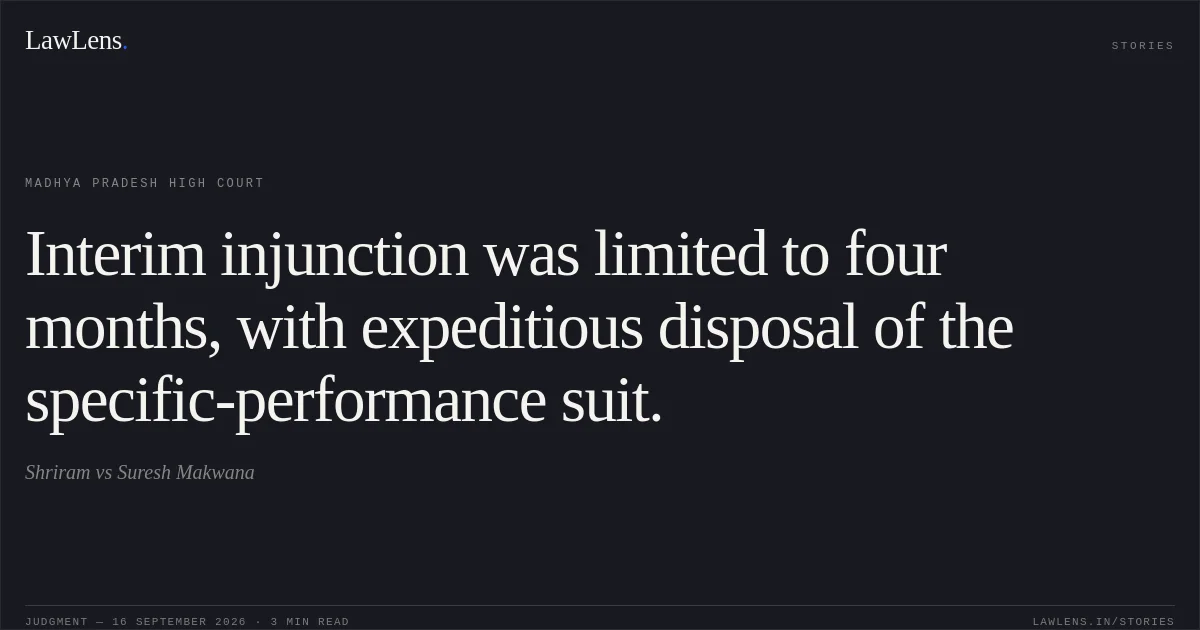
Source reference: p. 3, para. 8It therefore held that the appellant’s property should not remain indefinitely immobilised during the pendency of the suit and directed an expedited trial while limiting the injunction to four months.
Source reference: p. 3, para. 8Holding
The High Court did not completely set aside the temporary injunction.
It modified the trial court’s order by directing that the injunction restraining the appellant from selling, transferring, alienating, or encumbering the suit property would operate for four months only.
Source reference: p. 3, para. 8The trial court was directed to conclude the specific-performance suit on merits as expeditiously as possible, preferably within four months from receipt of the certified copy of the High Court’s order.
Source reference: p. 3, para. 8The miscellaneous appeal was accordingly disposed of.
Source reference: p. 4, para. 9Original Court PDF
ShriramvsSuresh Makwana
Click to open original judgment
Original judgment, available to read, download and summarize on LawLens.in