Facts
The parties executed a Binding Term Sheet and Addendum for the proposed acquisition of 100% of Respondent No. 4’s share capital, subject to staged payments, due diligence, regulatory approvals and other preconditions.
Source reference: para. 2–6The Petitioner acquired 9.5% of the shares and claimed to have advanced ₹23.45 crore towards the transaction; the Respondents contended that those advances were loans under a separate Inter-Corporate Loan Agreement.
Source reference: para. 2–6After Respondent No. 4 issued a notice purporting to terminate the transaction and seeking release of escrowed shares, the Petitioner disputed termination and sought interim protection under Section 9 of the Arbitration and Conciliation Act, 1996, including restraints concerning the shares and Respondent No. 4’s assets and operations.
Source reference: para. 2–6The Court considered the parties’ competing accounts of their payment and performance obligations and the status of the transaction.
Source reference: para. 26, 58Issues
1. Whether the Term Sheet and Addendum created binding obligations, and what payment obligations they imposed on the parties.
Source reference: para. 27–31, 582. Whether the ₹23.45 crore advanced by the Petitioner could be treated as performance of its obligations under the Term Sheet, rather than as loan advances.
Source reference: para. 32–363. Whether the Petitioner had established a sufficient basis for the interim and ad-interim protections sought under Section 9, including preservation of the escrowed shares and restraints affecting Respondent No. 4’s operations.
Source reference: para. 41, 46–52, 59–61Law Applied
Section 9 of the Arbitration and Conciliation Act, 1996 empowers the Court to grant interim measures of protection in aid of arbitration; the relief must be justified by the rights shown and the need to protect the subject matter of the dispute.
Source reference: no citationSections 51–54 of the Indian Contract Act, 1872 concern reciprocal promises and the circumstances in which a party’s performance may depend on the other party’s performance or readiness and willingness to perform; their application turns on the particular contractual obligation.
Source reference: para. 10, 51The Court also applied the governing transaction documents according to their terms: a binding term sheet may create enforceable obligations while making completion conditional on specified preconditions, and amounts advanced under a separate loan agreement do not become share-purchase consideration merely because the documents form part of an overall transaction.
Source reference: para. 28, 36No judicial precedents were cited.
Source reference: no citationReasoning
The Court held that the Term Sheet was binding, but did not itself complete an unconditional transfer of all shares: completion remained dependent on due diligence, approvals, escrow arrangements and other preconditions.
Source reference: para. 28–29, 58The Addendum contemplated specified funding obligations, but did not impose an unconditional obligation to meet all of Respondent No. 4’s liabilities.
Source reference: para. 29–31, 51The contemporaneous Loan Agreement and related communications supported treating the ₹23.45 crore as loan advances, not as payment of the ₹5 crore purchase price.
Source reference: para. 32–36The Petitioner had also failed to show that it paid the separate ₹52.50 lakh instalment by the contractual deadline; disputed defaults by the Respondents did not, on the material before the Court, establish that this payment was conditional on their performance.
Source reference: para. 37–43, 51Although the validity of termination and the parties’ respective performance remained disputed, the Court found that the Petitioner had not established an immediate right to completion or the necessity for the broad restraints sought.
Source reference: para. 41–48, 59–60Respondent No. 4’s later request that the escrow shares remain in status quo reduced the asserted immediate risk, while the wider prayers would interfere with Respondent No. 4’s corporate and operational affairs.
Source reference: para. 41–48, 59–60Holding
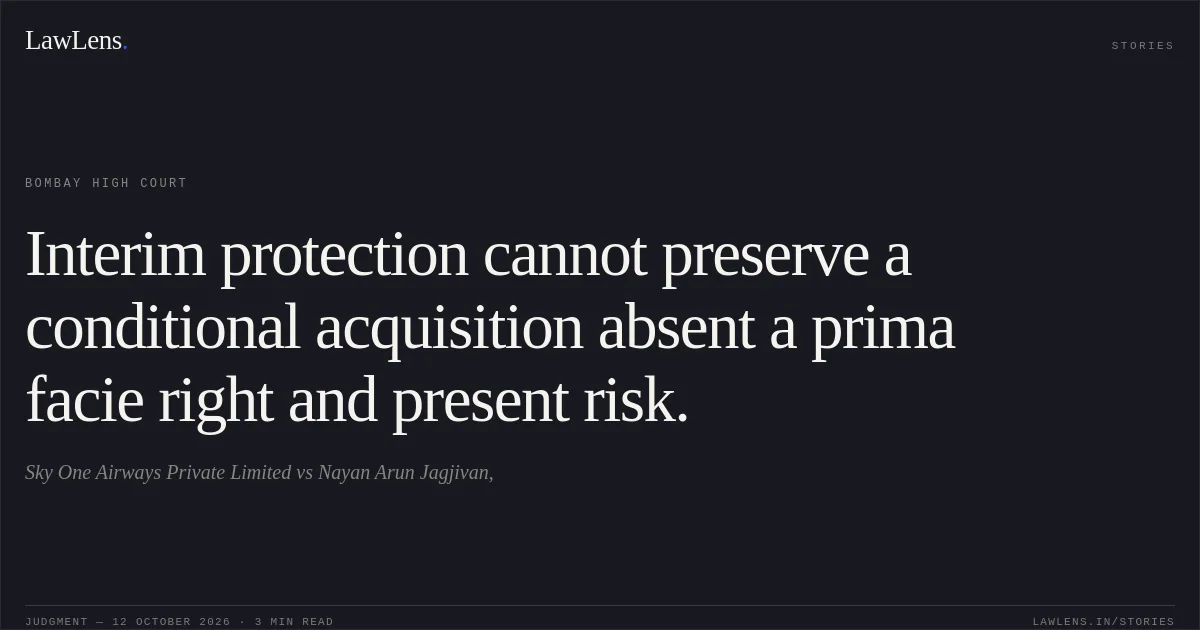
The Court dismissed the Section 9 petition, finding that the Petitioner had not established sufficient grounds for the interim or ad-interim reliefs sought, including mandatory directions concerning additional shares or restraints on Respondent No. 4’s operations.
The Court clarified that its observations were confined to the Section 9 petition, kept all contentions open, and left the parties at liberty to seek appropriate interim relief before the arbitral tribunal; there was no order as to costs.
Source reference: para. 62Acts & Sections Cited
5 provisions across 2 statutes referred to in this judgment. Each provision opens on LawLens.
Arbitration and Conciliation Act, 19961
Indian Contract Act, 18724
Original Court PDF
Sky One Airways Private LimitedvsNayan Arun Jagjivan,
Click to open original judgment
Original judgment, available to read, download and summarize on LawLens.in