Facts
The Petitioner (GCD Prime), a real estate firm, entered into a Joint Development Agreement (JDA) dated 11.08.2022 with the Respondent (DCM Limited) to develop 68.35 acres of land in Hisar
Source reference: para. 3-6Under the JDA, GCD was to procure and maintain licenses, while revenue was to be shared at 55:45 in favor of the Respondent
Source reference: para. 5, 7, 64In April 2023, the Directorate of Town and Country Planning suspended the project license due to alleged unauthorized land use by the Respondent
Source reference: para. 10On 31.10.2025, the Respondent issued a termination notice alleging GCD failed to rectify the license suspension
Source reference: para. 13GCD approached the Court under Section 9 of the Arbitration and Conciliation Act, 1996, seeking a stay on the termination and a restraint on third-party rights
Source reference: para. 1Issues
1. Whether the Joint Development Agreement is "determinable" in nature, thereby barring specific performance under the Specific Relief Act
Source reference: para. 552. Whether the Petitioner satisfied the "triple test" (prima facie case, balance of convenience, and irreparable injury) required for interim relief under Section 9 of the Arbitration Act
Source reference: para. 49, 61Law Applied
The court applied Section 9 of the Arbitration and Conciliation Act, 1996, noting that interim measures are intended to preserve the subject matter of the dispute
Source reference: para. 47-48It relied on Arcelormittal Nippon Steel (India) Ltd. v. Essar Bulk Terminal Ltd. regarding the triple test for injunctions
Source reference: para. 47Regarding contract enforceability, the court applied Section 14(d) of the Specific Relief Act (SRA), which prohibits specific performance of "determinable" contracts, and Section 41(e), which bars injunctions for non-enforceable contracts
Source reference: para. 54It further applied the classification of determinable contracts from K.S. Manjunath v. Moorasavirappa Muttanna Chennappa Batil, distinguishing between contracts terminable at will and those terminable only for cause with a cure period
Source reference: para. 56, 58Reasoning
The Court first determined that the JDA was non-determinable because it did not allow for "termination without cause"; rather, it required a specific event of default and a 30-day cure period
Source reference: para. 58-59However, it held that GCD failed to establish a prima facie case because Clause 4.4.1 of the JDA explicitly placed the "sole responsibility" on GCD to keep all approvals "valid and subsisting," regardless of the cause of suspension
Source reference: para. 64-66Furthermore, the court noted that GCD had performed "as is where is" due diligence and could not claim ignorance of the land's legal status
Source reference: para. 69-72On balance of convenience, the court found the JDA yielded only a 45% profit-sharing entitlement rather than possessory rights in the land; therefore, any potential loss was purely financial and could be compensated via damages in the pending arbitration
Source reference: para. 76-77, 82Holding
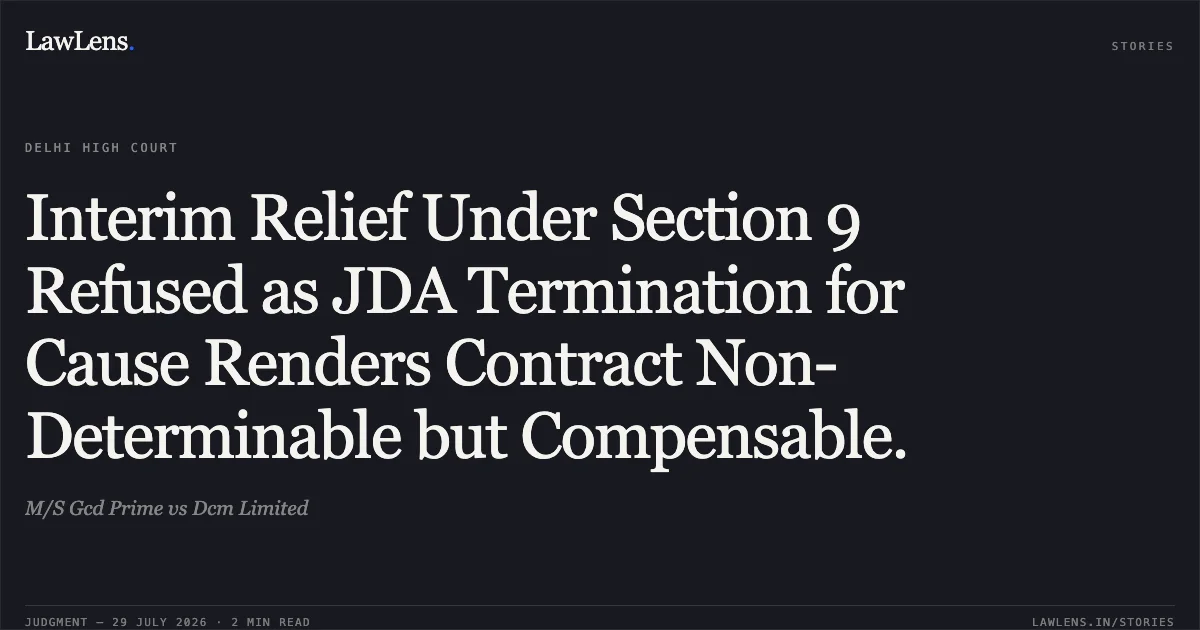
The Court held that while the JDA was non-determinable, the Petitioner failed to meet the equitable requirements for an injunction
The Court concluded that since the Petitioner’s rights were limited to revenue sharing and not land ownership, no "irreparable injury" existed that could not be remedied by monetary damages
Source reference: para. 77, 82The Court dismissed the petition and vacated the previous interim protection
Source reference: para. 84All parties were remitted to the Sole Arbitrator for final adjudication
Source reference: para. 85Acts & Sections Cited
6 provisions across 2 statutes referred to in this judgment. Each provision opens on LawLens.
Arbitration and Conciliation Act, 19963
Specific Relief Act, 19633
Original Court PDF
M/S Gcd PrimevsDcm Limited
Click to open original judgment
Original judgment, available to read, download and summarize on LawLens.in