Facts
The Appellant/Plaintiff was employed by the Respondent Company from 1996 until his resignation on April 14, 2004.
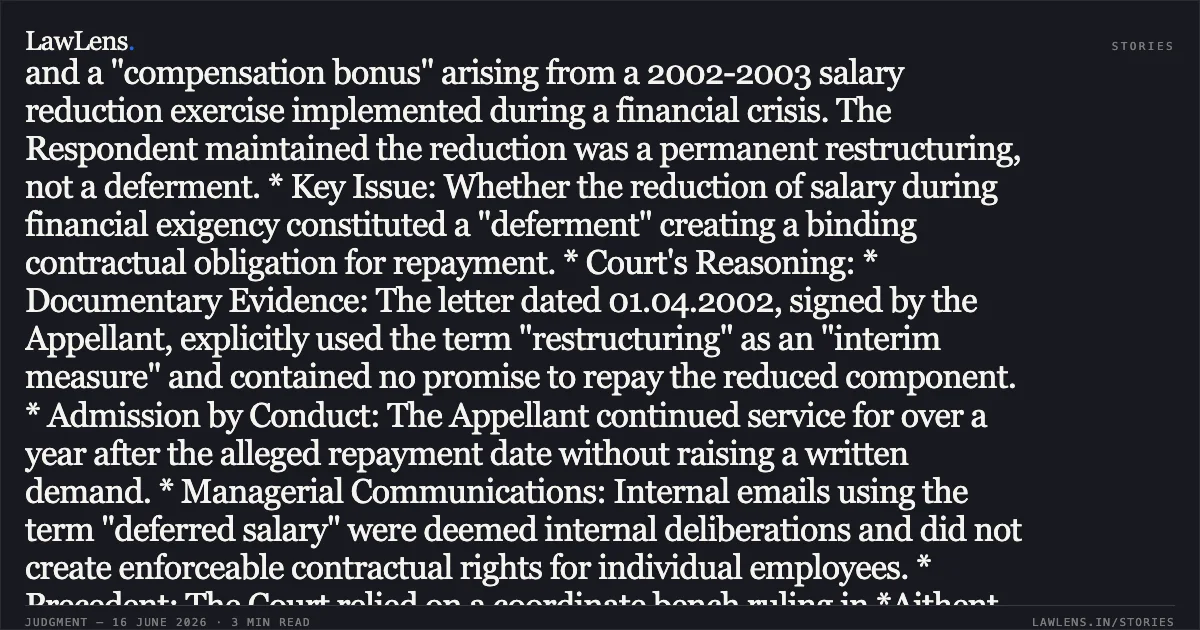
Source reference: p. 2; 9Due to financial difficulties in 2002-2003, the Respondent issued a letter dated April 1, 2002, "restructuring" the remuneration of employees on a graded scale.
Source reference: p. 9-10The Appellant’s salary was reduced by 25% (amounting to Rs. 14,750 per month) for one year.
Source reference: p. 2The Appellant contended that this was a "deferment" of salary and that a "compensation bonus" of one month’s salary was also promised.
Source reference: p. 3After resigning, the Appellant filed CS DJ No. 257/2016 for recovery of Rs. 6,14,220.
Source reference: p. 2The Trial Court partly decreed the suit, awarding Rs. 2,38,198 for statutory dues (Gratuity, Leave Encashment, etc.) but rejected the claim for deferred salary and bonus.
Source reference: p. 6The Appellant challenged this rejection in the present Regular First Appeal under Section 96 of the CPC.
Source reference: p. 1-2Issues
Whether the reduction in salary between April 2002 and March 2003 constituted a "deferment" creating a contractual obligation for repayment or a permanent "restructuring" due to business exigencies.
Source reference: p. 9/para. 43Whether the Appellant established a binding contractual right to receive a one-month "compensation bonus".
Source reference: p. 12/para. 52Law Applied
The court applied the principles of the Indian Contract Act, 1872, regarding the formation of binding contracts and the burden of proof under the Indian Evidence Act, 1872.
Source reference: p. 15The court emphasized that an enforceable claim for recovery must be based on a concluded contractual obligation.
Source reference: p. 15The court relied on the documentary evidence rule, prioritizing the "restructuring letter" signed by both parties over oral testimonies or internal communications.
Source reference: p. 11Precedent set by a Coordinate Bench of the Delhi High Court in M/s Aithent Technologies Pvt. Ltd. v. Archana Verma (RFA 608/2014), which held that the same 2002-03 salary exercise did not constitute a "deferment" in the absence of written proof.
Source reference: p. 16Reasoning
The Court found that the material document, the letter dated April 1, 2002 (Ex. PW-1/D1), explicitly used the term "re-structure" as an "interim measure" and contained no stipulation for repayment of the reduced component.
Source reference: p. 11The Appellant admitted in cross-examination that he signed this document without protest and never raised a written demand for the allegedly deferred salary while in service.
Source reference: p. 11-12While internal e-mails (Ex. PW-2/1) used the term "deferred salary," the Court classified these as "internal managerial communications" that did not create enforceable rights in favor of the employee.
Source reference: p. 14-15The CEO's letter of 2005 (Ex. PW-1/23) was deemed insufficient as an acknowledgment of debt because it failed to quantify the dues or specifically reference the 2002-03 salary reduction as a contractual liability.
Source reference: p. 14The court noted that discussions regarding loyalty bonuses did not crystallize into a binding contract.
Source reference: p. 15Holding
The Court held that the Appellant failed to discharge the burden of proving a contractual agreement for the repayment of deferred salary or the payment of a compensation bonus.
The Appeal was dismissed, confirming that the salary reduction was a valid restructuring accepted by the employee through his conduct and the signed letter.
Source reference: p. 16-17The Court affirmed the Trial Court's decision, noting that the Respondent had already satisfied the decree regarding the undisputed dues of Rs. 2,38,198 (salary, HRA, and gratuity).
Source reference: p. 8Acts & Sections Cited
1 provisions across 1 statute referred to in this judgment. Each provision opens on LawLens.
Code of Civil Procedure, 19081
Original Court PDF
Praveen MalikvsAithent Technologies Pvt. Ltd.
Click to open original judgment
Original judgment, available to read, download and summarize on LawLens.in


![Authorities must decide pensionary and retiral-benefit claims through a reasoned order within eight weeks.. Habibullah khan vs HOME DEPARTMENT. CAT - ['Srinagar']. LawLens](/stories/thumbnails/authorities-must-decide-pensionary-and-retiral-benefit-claims-through-a-reasoned-order-wit-d0cbe8a8119c48fbabe7df9f2d353488.webp)