Facts
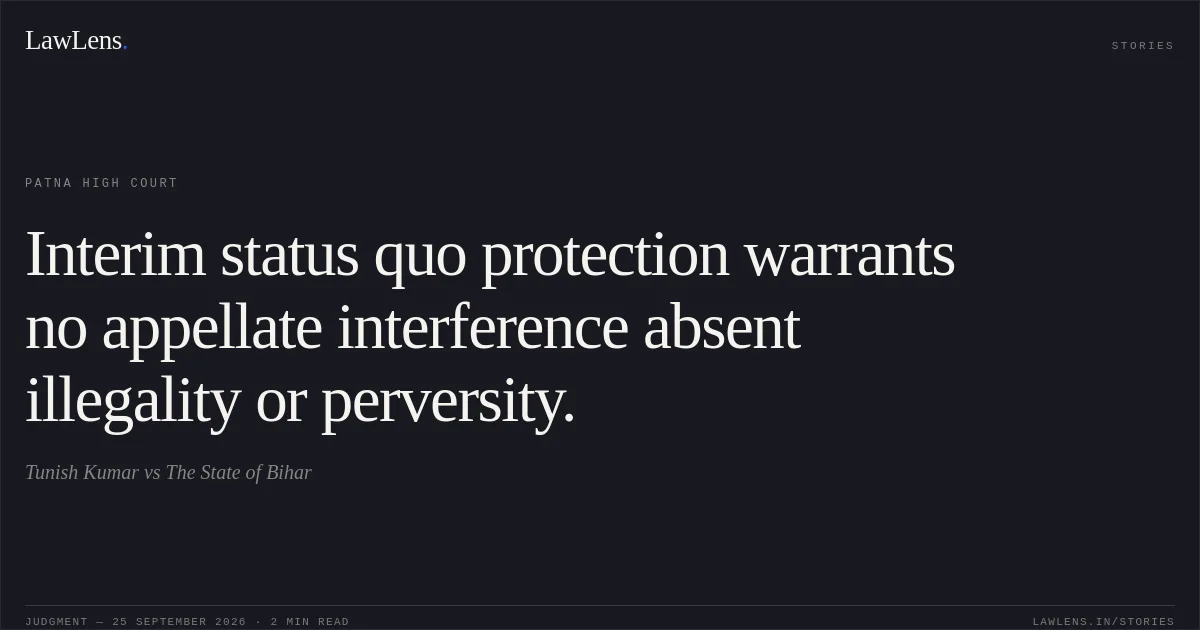
The appellant, Tunish Kumar, challenged an interim order dated 21 November 2025 passed by the learned Single Judge in CWJC No. 11507 of 2025.
Source reference: no citationThe writ petitioner, Rajpal Ray, claimed that his residential house stood on his raiyati land comprising Khata No. 69, Plot No. 228, at Mauza Chakchanarpat, Begusarai, but that the authorities had declared the land as an Anganwadi Centre and treated him as an encroacher.
Source reference: p.2, para.3He further asserted that his father had donated separate land comprising Khata No. 4, Plot No. 5, by gift deed dated 1 August 2014 in favour of the Governor of Bihar for construction of an Anganwadi Centre.
Source reference: p.2, para.3The learned Single Judge directed maintenance of status quo and restrained the authorities from taking coercive steps against the writ petitioner.
Source reference: p.2, para.2; p.2, para.4The appellant, claiming to be a “Vigilant Social Activist,” alleged that public funds had been misappropriated and used for constructing an Anganwadi building on private land, despite the availability of another Anganwadi building.
Source reference: p.3, para.5The State submitted that the Anganwadi Centre had already been constructed and that the writ petition remained pending.
Source reference: p.3–4, paras.6–7Issues
1. Whether the interim order dated 21 November 2025 directing maintenance of status quo and restraining coercive action suffered from illegality or perversity warranting interference in intra-court appellate jurisdiction.
Source reference: p.4, para.82. Whether the pendency of the writ petition and the disputed status of the land justified continuation of the interim protection granted by the learned Single Judge.
Source reference: p.4, para.9Law Applied
The Court applied the settled principle governing appellate interference with interlocutory orders: an intra-court appellate court should not interfere with an interim order unless it is shown to be illegal, perverse, or otherwise unsustainable.
Source reference: no citationThe Court also applied the principle that, where the underlying writ petition concerning disputed facts and property rights remains pending, interim status quo and protection against coercive action may appropriately be continued to preserve the subject matter of the dispute.
Source reference: no citationReasoning
The Court confined its examination to whether the Single Judge’s interim order suffered from illegality or perversity.
Source reference: p.4, para.8It noted that the dispute concerned construction of an Anganwadi Centre on a disputed parcel of land and that the authorities had already taken cognizance of the issue and referred it to the Public Grievance Redressal forum.
Source reference: p.4, para.9In view of the State’s submission that the Anganwadi Centre had already been constructed, the pendency of the writ petition, and the absence of demonstrated illegality or perversity in the interim protection, the Court found no basis to disturb the order of status quo or the restraint against coercive action.
Source reference: p.3–4, paras.6, 8–9Holding
The Court held that the interim order dated 21 November 2025 did not warrant appellate interference.
The Letters Patent Appeal was accordingly dismissed, thereby maintaining the direction to preserve status quo and the protection against coercive steps during pendency of the writ petition.
Source reference: p.5, para.10The Court clarified that its observations and findings would not prejudice the learned Single Judge while finally deciding the writ petition.
Source reference: p.5, para.11Any pending applications were also disposed of.
Source reference: p.5, para.12Original Court PDF
Tunish KumarvsThe State of Bihar
Click to open original judgment
Original judgment, available to read, download and summarize on LawLens.in