Facts
The respondent, a government employee posted in Delhi, was transferred to Chennai on October 1, 2025.
Source reference: p. 2He complied with the order but sought a representation to remain in Delhi to avoid disrupting his son’s education, who was in Class XI at the time.
Source reference: p. 2The petitioner rejected this representation on April 23, 2026, leading the respondent to file OA 1770/2026.
Source reference: p. 2, 4The Central Administrative Tribunal (Tribunal), via order dated May 22, 2026, directed the petitioner to reconsider the case sympathetically as the son had since entered Class XII, making the employee "protected" under the transfer policy.
Source reference: para. 16, 17The petitioner issued a "speaking order" on May 29, 2026, again rejecting the request on the grounds that the son was only in Class XI when the original transfer was issued.
Source reference: p. 4The respondent sought interim relief in a second OA (2210/2026), which the Tribunal granted on June 2, 2026.
Source reference: p. 1The Union of India challenged this interim order via the present writ petition.
Source reference: p. 1Issues
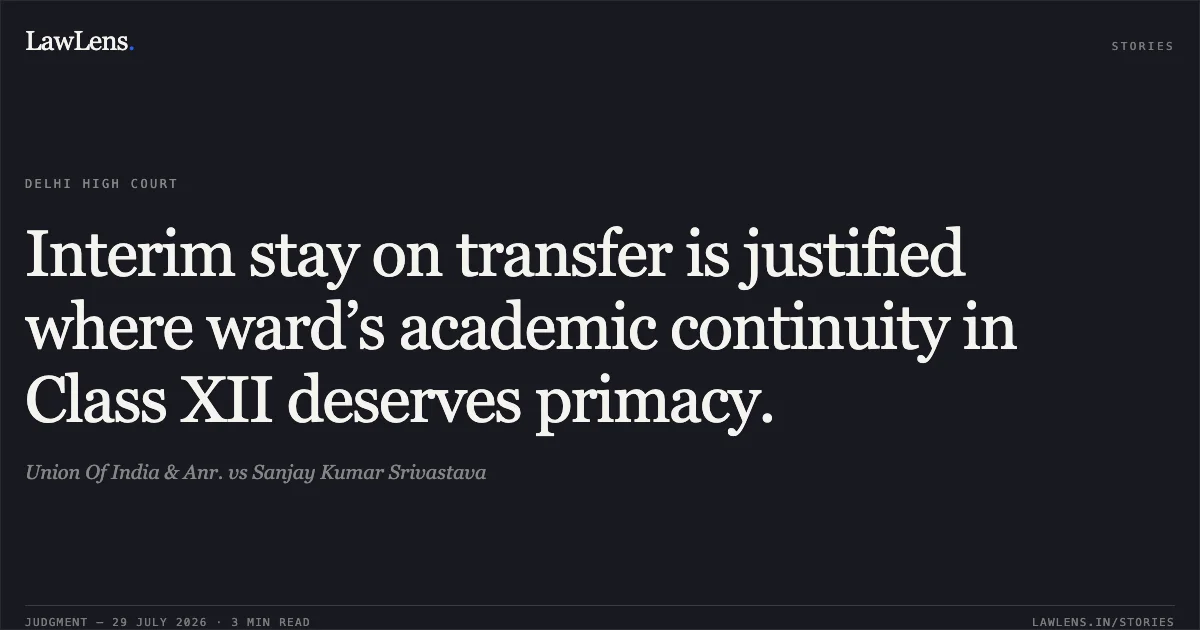
1. Whether the educational interests of an employee's child in Class XII justify staying a transfer order under the applicable transfer policy and judicial precedents.
Source reference: para. 7, 142. Whether the High Court, under Article 226, should interfere with a discretionary interim order passed by a Tribunal when the underlying directions of the Tribunal remained unchallenged.
Source reference: para. 9, 11, 12Law Applied
The principle established in Director of School Education v. O. Karuppa Thevan (1994) mandates that the educational interests of children must be accorded primacy, and transfers during a mid-academic session are generally unfair.
Source reference: para. 7Regarding the scope of judicial review, the court relied on Syed Yakoob v. K.S. Radhakrishnan (1964) to define the limits of certiorari jurisdiction, emphasizing that it is supervisory, not appellate, and limited to correcting errors of law apparent on the face of the record.
Source reference: para. 11The court applied the doctrine from Wander Ltd. v. Antox India (P) Ltd. (1990), which stipulates that an appellate court should not interfere with the exercise of discretion by a lower court in interlocutory matters unless the discretion was exercised arbitrarily, capriciously, or perversely.
Source reference: para. 12Reasoning
The Court observed that the Tribunal's original order dated May 22, 2026, which directed a sympathetic consideration of the respondent's case due to his son being in Class XII, was never challenged by the petitioners and thus attained finality.
Source reference: para. 8, 15The Court reasoned that moving the respondent from Delhi at this stage would undoubtedly prejudice the academic continuity of his son during the critical Board examination year.
Source reference: para. 7It rejected the petitioners' technical argument that the son was in Class XI at the time of the initial transfer, noting that the Tribunal had already applied a beneficial construction to the policy in light of the current Class XII status.
Source reference: para. 6, 9Applying the Syed Yakoob and Wander Ltd. standards, the High Court held that the Tribunal’s interim order was a reasonable exercise of discretion intended to protect the child's education and did not suffer from any patent illegality or jurisdictional error that would warrant the issuance of a writ of certiorari.
Source reference: para. 11, 17Holding
The High Court held that since the interim order was passed specifically to protect the educational interests of the respondent’s son, there was no justification for judicial interference under Article 226.
The High Court dismissed the writ petition in limine, upholding the Tribunal’s interim relief in favor of the respondent, and clarified that these observations are limited to the interim stage and shall not influence the final adjudication of the OA on its merits by the Tribunal.
Source reference: para. 18, 19Acts & Sections Cited
1 provisions across 1 statute referred to in this judgment. Linked provisions open on LawLens.
the Act (alias, unresolved)1
Original Court PDF
Union Of India & Anr.vsSanjay Kumar Srivastava
Click to open original judgment
Original judgment, available to read, download and summarize on LawLens.in