01Facts
The Appellant, Info Edge India Ltd, operates 'AmbitionBox', a platform hosting third-party reviews and salary insights regarding various employers
¶ 3The Respondent, SynapseIndia Outsourcing Pvt Ltd, filed a suit alleging trademark and copyright infringement, passing off, and defamation due to negative, allegedly fake reviews posted anonymously on the platform
¶ 2On 15.01.2026, the District Judge granted an ad-interim injunction restraining the Appellant from using the Respondent's trade name and directing the removal of reviews within 36 hours of a request
¶ 1The Appellant challenged this order, asserting its status as an "intermediary" entitled to safe harbor under Section 79 of the IT Act, 2000, and arguing that the injunction constituted a pre-trial gag order
¶ 3-4During the appellate proceedings, the parties agreed to settle the suit based on a series of undertakings provided by the Appellant
¶ 502Issues
i.1. Whether the ad-interim injunction granted by the Trial Court was sustainable in light of the Appellant's claim of being a neutral intermediary
¶ 3ii.2. Whether the suit could be disposed of and decreed based on the voluntary undertakings of the Appellant regarding content moderation and user data disclosure
¶ 5, 9, 13iii.3. Whether the question of the Appellant's status as an intermediary should be finalistically determined in this proceeding
¶ 7, 1403Law Applied
Section 79 of the Information Technology Act, 2000, which provides "safe harbor" protection to intermediaries
¶ 4Information Technology (Intermediary Guidelines and Digital Media Ethics Code) Rules, 2021, specifically Rule 3(1)(b) regarding the removal of problematic content
¶ 5(6)Section 72A of the IT Act, 2000, regarding the disclosure of information in breach of lawful contract
¶ 6.2Procedural standards for interim injunctions under Order XXXIX Rules 1 2 of the CPC
¶ 1Provisions in the judgment · 3 · Linked ones open on LawLens
Code of Civil Procedure, 1908 Section 151Section 39
Information Technology Act, 2000 Section 79
04Reasoning
The Court did not adjudicate upon the merits of the "intermediary" status, instead opting to resolve the dispute through a consent-based decree.
The analysis focused on the Appellant’s ten-point undertaking, which balanced the Respondent's proprietary rights with the platform's functionality.
¶ 5The Appellant agreed to use the Respondent's marks solely as identifiers
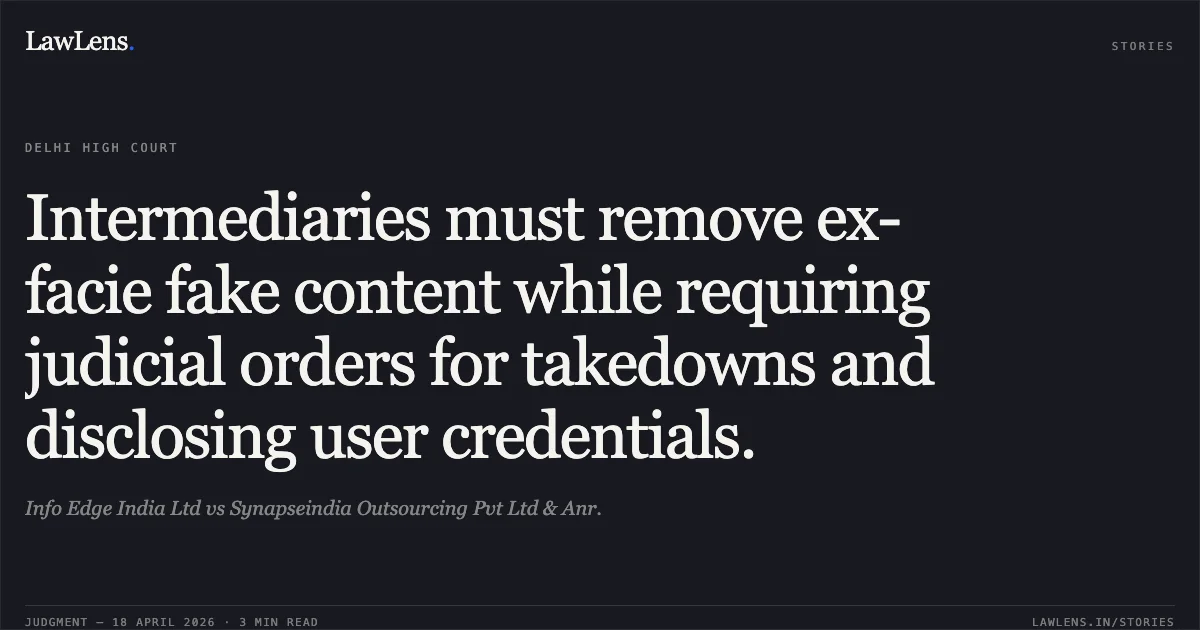
¶ 5(3)The Appellant established a two-tier removal process: (i) immediate removal of "ex-facie fake" reviews or confidential information (e.g., source codes), and (ii) removal of other content only upon court orders or government notifications
¶ 5(6)-(8)Regarding anonymity, the Court accepted the Appellant’s submission that user credentials (IP addresses and timestamps) would be provided to the Respondent only upon an order from an Executing Court
¶ 6.1, 11The Court found this arrangement sufficient to protect the Respondent's reputation while preserving the Appellant’s operational model.
¶ 1105Holding
The High Court set aside the Trial Court's interim injunction dated 15.01.2026
¶ 12With the consent of the parties, the suit was decreed in favor of the Respondent in terms of the Appellant’s undertakings
¶ 13The Appellant was directed to start the Respondent’s page on a "clean slate"
¶ 12The Court held that the Respondent is entitled to seek execution of the decree in the event of a breach or to obtain user credentials for "at-issue content"
¶ 11, 13The Court left the legal question of the Appellant’s status as an "intermediary" open, ensuring no issue estoppel would apply in future disputes
¶ 14The Appellant was directed to file a formal affidavit from its senior management affirming these undertakings within two weeks
¶ 16Original Court PDF
Info Edge India LtdvsSynapseindia Outsourcing Pvt Ltd & Anr.
Click to open original judgment
Original judgment, available to read, download and summarize on LawLens.in