01Facts
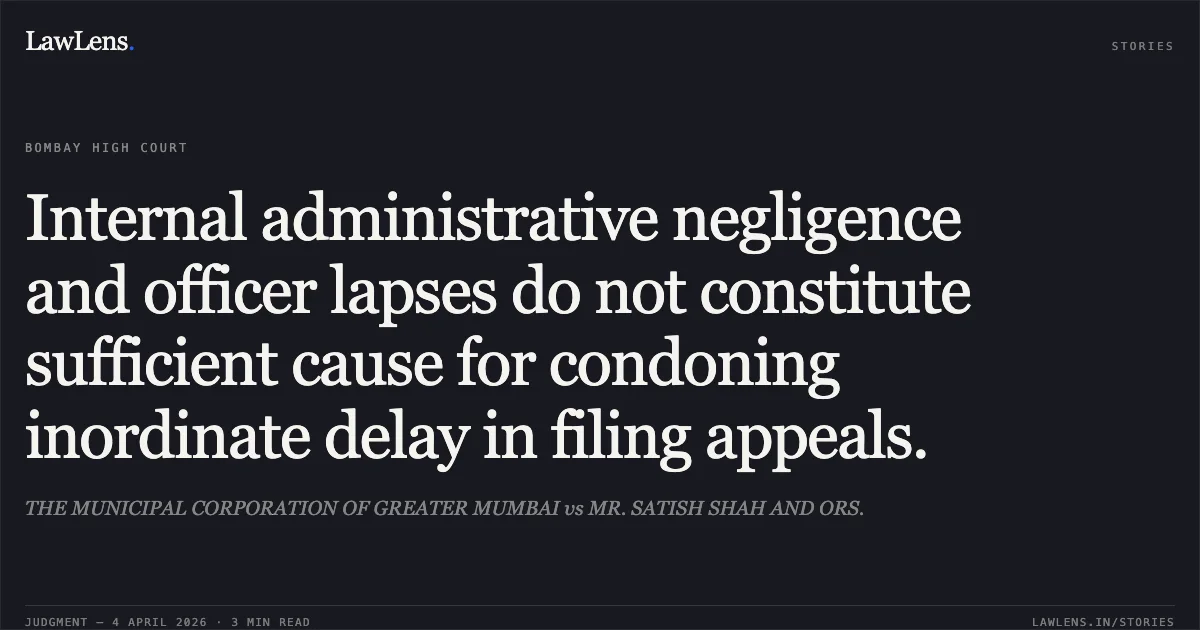
The Municipal Corporation of Greater Mumbai (MCGM) filed a group of 26 Civil Applications seeking to condone delays in filing First Appeals ranging from one to approximately nine years.
¶ 1In the lead matter, the MCGM sought to challenge an order passed by the City Civil Court on 12th October 2009, which had quashed a demolition notice issued under Section 351 of the Mumbai Municipal Corporation Act, 1888.
¶ 2Under Section 15 of the Bombay City Civil Court Act, 1948, the appeal should have been filed within 30 days; however, it was filed on 29th June 2018, resulting in a delay of 8 years and 230 days.
¶ 3The MCGM contended that the delay was due to internal administrative failures discovered only after an inquiry following the 2017 Kamla Mills Compound fire. They alleged that sub-ordinate officers failed to report the progress of matters or the passing of adverse judgments to their superiors.
¶ 502Issues
i.1. Whether internal administrative negligence and the subsequent discovery of adverse orders following an unrelated tragedy constitute "sufficient cause" for condoning a delay of over eight years.
¶ 8, 10ii.2. Whether the Court can permit the Corporation to initiate fresh proceedings against alleged illegal structures despite dismissing the time-barred appeals.
¶ 1303Law Applied
The court applied the principle of "sufficient cause" required for the condonation of delay under the law of limitation.
¶ 8It relied significantly on the Supreme Court’s ruling in Delhi Development Authority v. Tejpal and Others (2024) 7 SCC 433, which holds that subsequent events or man-made disasters do not entitle a party to challenge an order after the limitation period has expired.
¶ 11The court also emphasized the statutory limitation period prescribed under Section 15 of the Bombay City Civil Court Act, 1948.
¶ 3Provisions in the judgment · 2 · Linked ones open on LawLens
Mumbai Municipal Corporation Act. Section 351
Bombay City Civil Court Act, 1948. Section 15
04Reasoning
The court held that the reasons provided—specifically the Kamla Mills incident and the failure of officers to inform superiors—did not constitute "sufficient cause".
¶ 10It reasoned that a subsequent event in an unrelated matter cannot revive a right to appeal that was lost nearly a decade prior.
¶ 8The court noted that the lis (litigation) between the parties reached finality once the limitation period expired, and internal communication gaps are an internal municipal matter that cannot prejudice the successful party.
¶ 8The court criticized the Corporation’s lack of a monitoring system and stated that superiors were equally responsible for dereliction of duty.
¶ 10However, to ensure that actual illegalities do not go unpunished due to officer inaction, the court observed that since the original notices were from 2005, a fresh inspection and cause of action could be initiated in the larger interest of public safety.
¶ 12-1305Holding
The High Court dismissed all 26 Civil Applications for condonation of delay, finding no sufficient cause.
¶ 14, 17Consequently, the associated First Appeals were also dismissed.
¶ 14, 17The court granted the MCGM liberty to carry out fresh inspections and initiate fresh actions in accordance with the law if current illegalities are found, clarifying that the 2009 order would not bar such fresh actions.
¶ 13Finally, the court directed the MCGM to file a report by 12th August 2026 regarding disciplinary actions taken against the negligent officers and their superiors.
¶ 15, 22Original Court PDF
THE MUNICIPAL CORPORATION OF GREATER MUMBAIvsMR. SATISH SHAH AND ORS.
Click to open original judgment
Original judgment, available to read, download and summarize on LawLens.in