Facts
The assessee was a Chinese company engaged in erection, testing, installation and commissioning services for a power project undertaken for Adani Power Private Limited. It established a project office/permanent establishment in India and recorded the project’s revenues and expenses in its Indian books
Source reference: p.12, para. 6.1–6.2The Assessing Officer found that the assessee had reimbursed its Chinese head office for shipping expenses and referred the transaction to the Transfer Pricing Officer (TPO).
Source reference: p.13–14, para. 6.3The TPO rejected the assessee’s Comparable Uncontrolled Price (CUP) approach, applied the Transactional Net Margin Method (TNMM), and proposed transfer-pricing adjustments. The Assessing Officer also rejected the books under Section 145(3), applied Section 44BBB(1), and estimated income at 10% of gross receipts.
Source reference: p.15–17, para. 6.4The Commissioner (Appeals) accepted the assessee’s supporting shipping documents, held that the reimbursements represented actual costs, accepted the internal CUP method, rejected the TPO’s comparables, and deleted the additions.
Source reference: p.18–20, para. 6.5–6.6The Income Tax Appellate Tribunal affirmed those findings for the relevant assessment years, including 2009–10 and 2010–11, principally relying on its decision for assessment year 2008–09. The Revenue challenged the Tribunal’s common order before the Gujarat High Court.
Source reference: p.38–72, paras. 6.8–6.10Issues
1. Whether the Assessing Officer was justified in rejecting the assessee’s audited books under Section 145(3) and applying the presumptive profit rate under Section 44BBB(1), despite the assessee claiming lower profits under Section 44BBB(2).
Source reference: p.2–5, para. 4(a)–(e)2. Whether the alleged non-recognition of closing work-in-progress, non-compliance with Accounting Standards 7 and 9, non-production of certain contracts, and alleged mismatch between revenue and expenditure justified rejection of the books of account.
Source reference: p.3–5, para. 4(aa)–(d)3. Whether the reimbursement of shipping expenses between the Indian project office/permanent establishment and the Chinese head office constituted an international transaction requiring an arm’s-length-price adjustment.
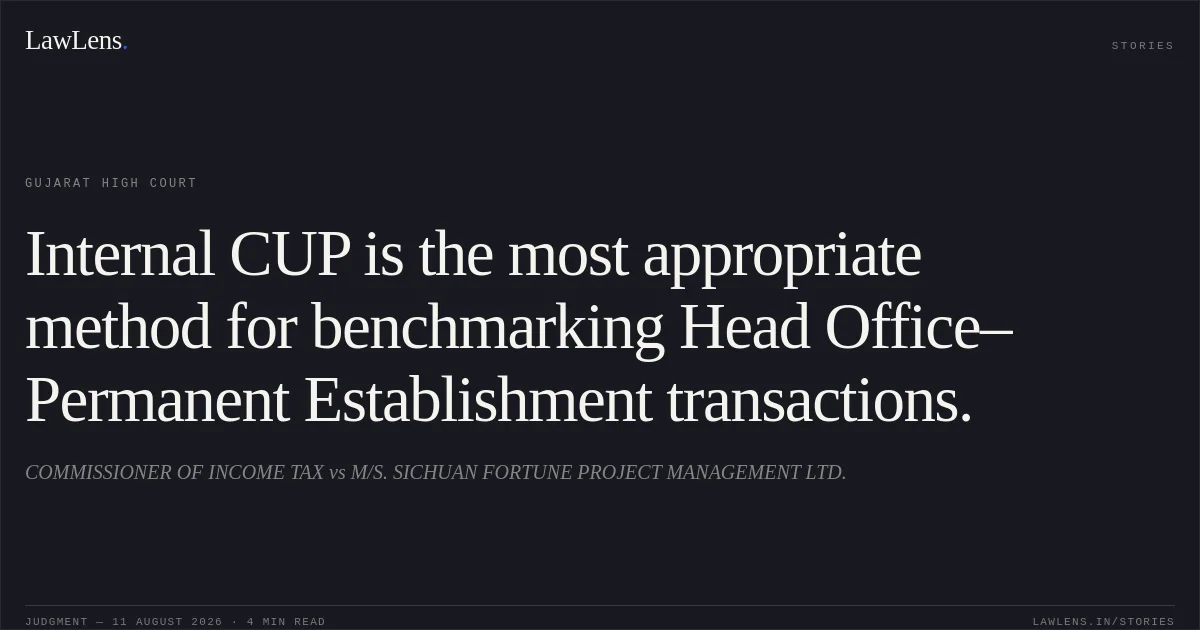
Source reference: p.6–7, para. 4(g)–(gg)4. Whether the internal CUP method, based on the contract between the Chinese head office and Adani Power, was the most appropriate method for determining the arm’s length price, instead of TNMM.
Source reference: p.7–10, para. 4(h)–(l)5. Whether the Tribunal erred in rejecting the TPO’s comparables and deleting the transfer-pricing adjustment of ₹12,07,74,334.
Source reference: p.7–10, para. 4(gg)–(m)Law Applied
Section 44BBB(1) of the Income-tax Act, 1961 deems 10% of specified receipts as profits of a foreign company engaged in civil construction, erection, testing or commissioning in connection with an approved turnkey power project; however, Section 44BBB(2) permits the assessee to claim lower profits where it maintains the prescribed books and documents, obtains an audit, and furnishes the audit report.
Source reference: p.25–29, para. 10.3Section 145(3) permits rejection of books only where the Assessing Officer is not satisfied about their correctness or completeness, or where the notified accounting standards are not regularly followed. Sections 92C, 92A, 92B and 92F, read with Rule 10B, require international transactions between associated enterprises to be benchmarked at arm’s length, with the most appropriate prescribed method being selected.
Source reference: p.25–29, para. 10.3The Court relied on CIT (IT & TP) v. Shandong Tiejun Electric Power Engineering Co., 86 Taxmann.com 274 (Gujarat), for the principle that Section 44BBB(1) cannot be applied to determine profits where the assessee has maintained audited books and no material defects have been established.
Source reference: p.24–31, para. 10.3It also approved the principle in Clear Plus India (P.) Ltd. v. Deputy Commissioner of Income-tax, 10 taxmann.com 249 (Delhi), that the CUP method is a direct and preferable method where reliable comparable transaction data is available.
Source reference: p.65–71, paras. 27.1–27.2Cost-to-cost reimbursements, unsupported by evidence of any markup or profit element, do not justify an artificial transfer-pricing adjustment.
Source reference: p.31–37, para. 10.5Reasoning
The High Court held that the CIT (Appeals) and the Tribunal had concurrently found that the assessee maintained audited books and that the Assessing Officer had not identified any major or specific defect demonstrating that the accounts were incorrect or incomplete. A loss, discrepancies attributable to increased ocean-freight costs, or the accounting treatment of project expenditure, without more, could not justify rejection of the books under Section 145(3) or automatic application of the 10% presumptive rate under Section 44BBB(1).
Source reference: p.22–31, paras. 10.1–10.4On transfer pricing, the Court accepted that the head office and Indian project office were to be treated as functionally separate for profit attribution and that the transaction was subject to arm’s-length scrutiny; however, the contract price agreed between the head office and the independent customer, Adani Power, provided a direct internal CUP.
Source reference: p.73–81, paras. 17–25Since the project was substantially executed in India, the risks and rewards were recorded in the Indian project office, the customer treated the head office and project office as one contracting entity, and no separate assignment agreement between them was produced, the internal CUP was more reliable than the TPO’s TNMM analysis.
Source reference: p.73–81, paras. 17–25The TPO also failed to demonstrate that the shipping reimbursements contained any markup by the head office; the underlying third-party invoices and related documents supported reimbursement on an actual-cost basis.
Source reference: p.18–20, 31–37The rejection of the TPO’s comparables was a fact-based determination with which the Court found no legal infirmity.
Source reference: p.80–81, paras. 24–25Holding
The Gujarat High Court answered the proposed questions against the Revenue and held that no substantial question of law arose from the Tribunal’s order.
The concurrent findings that the books could not be rejected under Section 145(3), that Section 44BBB(1) could not be invoked to substitute the assessee’s audited results, and that the internal CUP method was the appropriate basis for determining the arm’s length price were upheld.
Source reference: p.81–82, paras. 25–26Tax Appeal Nos. 129 and 130 of 2024 were accordingly dismissed.
Source reference: p.82, para. 26Acts & Sections Cited
58 provisions across 1 statute referred to in this judgment. Linked provisions open on LawLens.
Income Tax Act, 1961
Original Court PDF
COMMISSIONER OF INCOME TAXvsM/S. SICHUAN FORTUNE PROJECT MANAGEMENT LTD.
Click to open original judgment
Original judgment, available to read, download and summarize on LawLens.in