Facts
The 2nd respondent, a former Joint Secretary of the Kerala Public Service Commission (KPSC), was subjected to disciplinary proceedings for cash irregularities. Following a punishment of barred increments and recovery of loss, which she remitted, her subsequent review petitions were rejected.
Source reference: para. 2.1In 2017, she filed an RTI application seeking the complete "Note File" (internal deliberations and opinions of officers/members) related to her disciplinary case.
Source reference: para. 2.1The KPSC denied the information under Sections 8(1)(e) and 8(1)(j) of the RTI Act. On appeal, the State Information Commission (SIC) ordered disclosure through Ext.P5, holding that such records are not confidential, do not invade privacy when sought by the subject individual, and are subject to the proviso of Section 8(1)(j) regarding the Legislature.
Source reference: para. 2.2-2.3The KPSC challenged this order via writ petition.
Source reference: no citationIssues
1. Whether internal file notings and deliberative materials in disciplinary proceedings constitute "personal information" exempt under Section 8(1)(j) of the RTI Act.
Source reference: para. 8 / 132. Whether the proviso to Section 8(1)(j) creates an absolute right to information if such information could theoretically be sought by Parliament or a State Legislature.
Source reference: para. 17 / 273. Whether the initiation of penal proceedings under Section 20(1) against the Public Information Officer was justified.
Source reference: para. 30Law Applied
The court applied Section 8(1)(j) of the RTI Act, 2005, which exempts personal information lacking public interest or causing unwarranted invasion of privacy.
Source reference: para. 9It relied on Girish Ramchandra Deshpande v. CIC [(2013) 1 SCC 212] and Canara Bank v. C.S. Shyam [2017 (4) KHC 784], establishing that service records and disciplinary matters are "personal information".
Source reference: para. 12, 22It also applied the principle from CBSE v. Aditya Bandopadhyay [2011 KHC 4686] regarding the balance between transparency and administrative efficiency.
Source reference: para. 13Finally, it considered the "Doctrine of Candour" as recognized in CPIO, Supreme Court of India v. Subhash Chandra Agarwal [2019 (5) KHC 499] concerning internal governmental deliberations.
Source reference: para. 15Reasoning
The Court reasoned that internal Note Files are qualitatively different from final orders; they contain evaluative comments and opinions protected by the "Doctrine of Candour" to ensure frankness in governance.
Source reference: p. 28Applying C.S. Shyam, the Court held that disciplinary proceedings are matters primarily between employee and employer, constituting "personal information" with no nexus to public activity.
Source reference: p. 34Regarding the Section 8(1)(j) proviso, the Court rejected the SIC’s "mechanical" interpretation. It clarified that the proviso does not nullify the substantive exemption; rather, it must be read alongside Parliamentary rules which actually restrict members from seeking information on private personnel grievances or "day-to-day administration".
Source reference: p. 38-39Since the 2nd respondent failed to demonstrate any "larger public interest" outweighing privacy, the exemption stood.
Source reference: p. 34The Court further noted that the recent amendment via the DPDP Act, 2023, while prospective, confirms a legislative shift toward stronger privacy protections.
Source reference: p. 40-41Holding
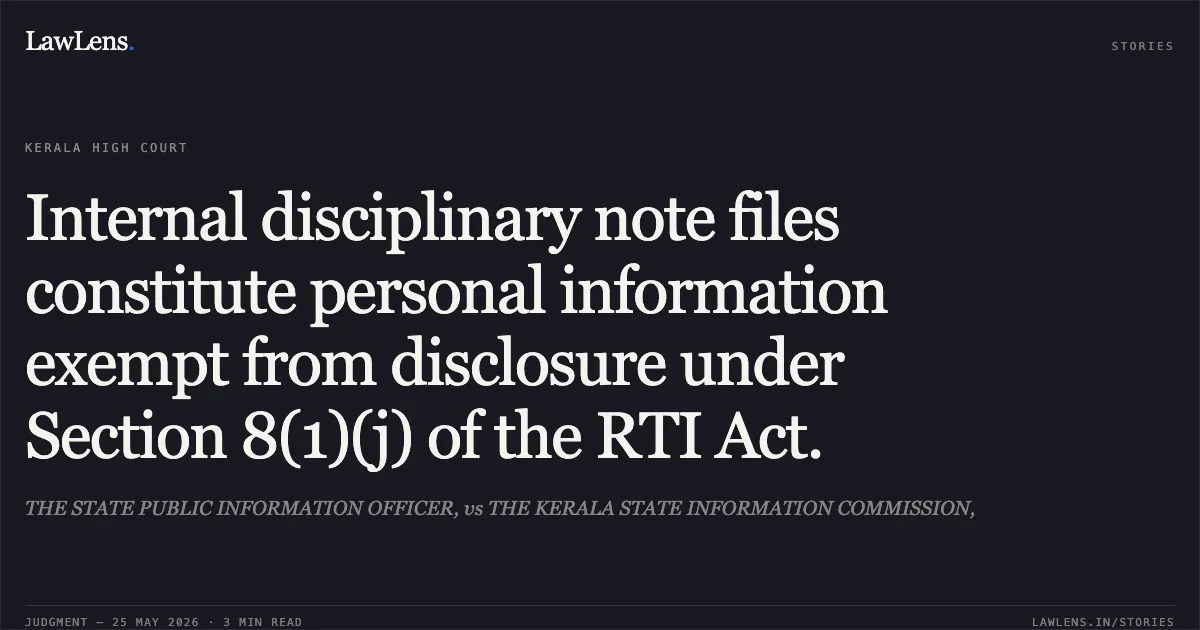
The Court held that internal file notings in disciplinary cases are exempt under Section 8(1)(j) as personal information, and the proviso does not override this exemption in the absence of a larger public interest.
It further held that penal proceedings under Section 20(1) were unwarranted as the KPSC's denial was based on a plausible legal interpretation.
Source reference: para. 30The Court allowed the writ petition and quashed the SIC's order (Ext.P5).
Source reference: para. 31Acts & Sections Cited
6 provisions across 2 statutes referred to in this judgment. Each provision opens on LawLens.
Right to Information Act, 20055
Digital Personal Data Protection Act, 2023.1
Original Court PDF
THE STATE PUBLIC INFORMATION OFFICER,vsTHE KERALA STATE INFORMATION COMMISSION,
Click to open original judgment
Original judgment, available to read, download and summarize on LawLens.in