Facts
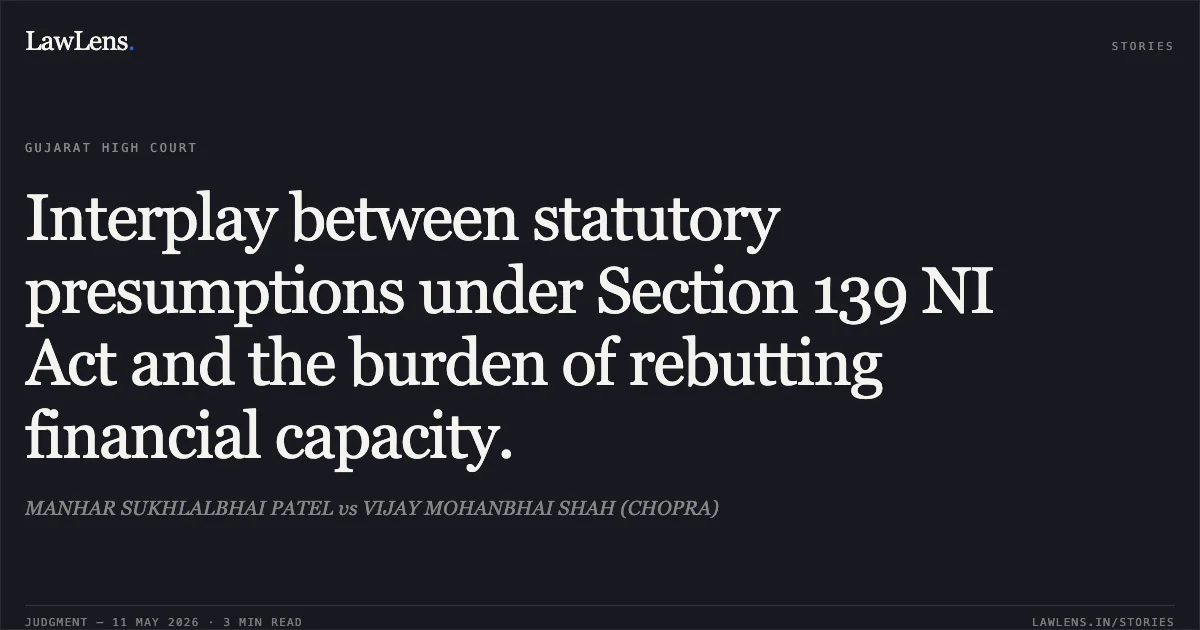
The applicant (complainant) advanced a loan of ₹4,70,000 to the respondent (accused) in September 2003 for business purposes, against which the accused executed a promissory note
Source reference: p. 2To discharge the debt, the accused issued a cheque dated 04/09/2004 from his firm, Shri Bhavani Jewellers
Source reference: p. 2The cheque was returned on 06/09/2004 with the memo "Today’s Opening Balance Insufficient"
Source reference: p. 2Despite a statutory notice sent via Registered A.D. on 20/09/2004, the accused failed to repay the amount
Source reference: p. 2The Metropolitan Magistrate convicted the accused under Section 138 of the NI Act, sentencing him to one year of simple imprisonment and a ₹5,000 fine
Source reference: p. 3On appeal, the City Sessions Judge, Ahmedabad, reversed the conviction and acquitted the accused on 22/11/2010, citing a lack of legally enforceable debt and non-service of notice
Source reference: p. 3The complainant then filed this revision application.
Source reference: no citationIssues
1. Whether the learned Sessions Court erred in overturning the conviction by failing to apply the statutory presumptions under Sections 118 and 139 of the NI Act
Source reference: p. 6, 122. Whether the non-disclosure of the loan amount in Income Tax returns and the dispute over handwriting are sufficient to rebut the presumption of a legally enforceable debt
Source reference: p. 10, 123. Whether the statutory notice was deemed served under Section 27 of the General Clauses Act when sent to the correct address
Source reference: p. 13Law Applied
The court applied Section 138 of the Negotiable Instruments (NI) Act, 1881 regarding the dishonour of cheques for insufficiency of funds
Source reference: p. 8It relied on the statutory presumptions under Sections 118 and 139 of the NI Act, which mandate that a cheque is presumed to be issued for consideration and discharge of debt once the signature is admitted
Source reference: p. 9The court cited Kalamani Tex v. P. Balasubramanian and Rajesh Jain v. Ajay Singh regarding the burden of the accused to raise a "probable defence" through a preponderance of probabilities.
Source reference: p. 9, 10Section 27 of the General Clauses Act, 1897 and C.C. Alavi Haji v. Palapetty Muhammed were applied to establish the presumption of service of notice sent to a correct address
Source reference: p. 13Reasoning
The High Court found that the Sessions Court failed to re-appreciate the evidence and ignored the reasoning of the Trial Court
Source reference: p. 6Since the accused admitted his signature on the cheque, the legal presumption under Section 139 was triggered, shifting the burden to the accused to prove the non-existence of debt
Source reference: p. 9-10The accused’s defence—that the cheque was given only to show a bank balance for his wife’s travel—was deemed improbable as the cheque was deposited in the complainant’s account
Source reference: p. 12The Court held that the absence of the transaction in Income Tax returns does not automatically negate the existence of a debt, nor does the claim that the complainant filled the body of the cheque, provided the signature is genuine (citing Bir Singh v. Mukesh Kumar)
Source reference: p. 10-11Furthermore, because the notice was sent to the same address the accused used in court proceedings, the Sessions Court erred in concluding the notice was not served
Source reference: p. 13Holding
The High Court held that the Sessions Court’s judgment was perverse as it ignored statutory presumptions and failed to properly appreciate the evidence
The court quashed and set aside the acquittal order dated 22/11/2010. The matter was remanded to the Additional Sessions Judge to pass a fresh order in the Criminal Appeal within two weeks, in accordance with the legal principles discussed
Source reference: p. 16Acts & Sections Cited
10 provisions across 3 statutes referred to in this judgment. Each provision opens on LawLens.
Code of Criminal Procedure, 19734
Negotiable Instruments Act, 18815
General Clauses Act, 18971
Original Court PDF
MANHAR SUKHLALBHAI PATELvsVIJAY MOHANBHAI SHAH (CHOPRA)
Click to open original judgment
Original judgment, available to read, download and summarize on LawLens.in