Facts
The Plaintiffs (BALCO and Vedanta Ltd.) filed a suit for a permanent injunction to restrain the Defendants from entering their premises, protesting within 500 meters of their staff, and publishing defamatory allegations on social media.
Source reference: p. 2, para 5The dispute originated from a transaction between Defendant No. 3 and a third party, JP Engineers; the Plaintiffs acted as facilitators in a "Without Prejudice Meeting" to resolve financial grievances.
Source reference: p. 3, para 6(iii)The Defendants subsequently launched a campaign against the Plaintiffs, alleging they were defrauded of substantial sums and seeking ₹21 crores in compensation.
Source reference: p. 4-5, para 6(vii-viii)During proceedings, the Defendants filed I.A. 9232/2024 seeking leave to deliver 14 interrogatories to the Plaintiffs regarding the constitution of internal grievance committees and settlement offers.
Source reference: p. 5-7, para 9The Joint Registrar allowed the application on 24.12.2025.
Source reference: p. 1-2, para 4The Plaintiffs challenged this order via the present Chamber Appeal (O.A. 48/2026).
Source reference: p. 1Issues
1. Whether the delay of 11 days in filing the Chamber Appeal ought to be condoned.
Source reference: p. 1, para 12. Whether the interrogatories sought by the Defendants are relevant and necessary for the fair disposal of the suit or fall outside the scope of the injunction proceedings.
Source reference: p. 8, para 12-13Law Applied
The Court applied Section 5 of the Limitation Act, 1963, for condonation of delay.
Source reference: p. 1, para 1Regarding discovery, the Court relied on Section 30 of the CPC, which grants the court power to order discovery and the delivery of interrogatories.
Source reference: p. 9, para 16It further applied Order XI, Rules 1 and 2 of the CPC, which allow interrogatories that relate to any matters in question in the suit, provided they are necessary for disposing of the suit fairly or saving costs.
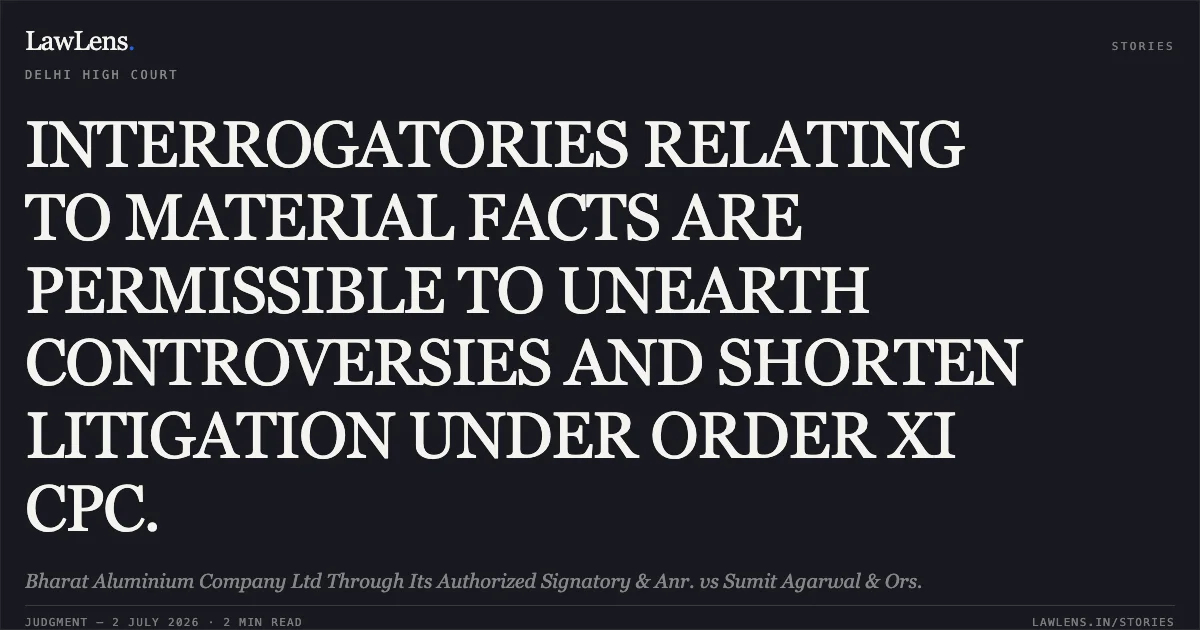
Source reference: p. 9The Court also followed the precedent set in Sharda Dhir v. Ashok Kumar Makhija, which established that administering interrogatories should be encouraged to obtain admissions, shorten litigation, and unearth the nature of the opponent's case.
Source reference: p. 10, para 17Reasoning
The Court first condoned the 11-day delay in filing the appeal, citing the reasons stated in the application.
Source reference: p. 1, para 2On the merits, the Court rejected the Plaintiffs' contention that the interrogatories were beyond the scope of an injunction suit. It reasoned that the primary purpose of Order XI is to allow a party to know the opponent's case beforehand and to extract facts in the exclusive knowledge of the other party.
Source reference: p. 12, para 18The Court observed that while the Plaintiffs sought to stop the Defendants' protests by labeling them as "tarnishing their image," the Defendants argued their actions were protected free speech based on legitimate grievances.
Source reference: p. 12, para 19The Court concluded that questions regarding the internal committee's findings and settlement offers were "germane to the nature of the controversy" as they would help determine if the Plaintiffs’ claim for an injunction was justified.
Source reference: p. 12, para 20Holding
The Court dismissed the Chamber Appeal and upheld the Joint Registrar's order.
It held that the interrogatories are necessary to unearth the truth of the underlying controversy and to decide whether the Plaintiffs are entitled to the injunction.
Source reference: p. 12, para 20The Court directed the Plaintiffs to answer the interrogatories by filing an affidavit in terms of Order XI Rule 8 and 9 of the CPC within four weeks.
Source reference: p. 13, para 22Acts & Sections Cited
4 provisions across 2 statutes referred to in this judgment. Each provision opens on LawLens.
Code of Civil Procedure, 19083
Limitation Act, 19631
Original Court PDF
Bharat Aluminium Company Ltd Through Its Authorized Signatory & Anr.vsSumit Agarwal & Ors.
Click to open original judgment
Original judgment, available to read, download and summarize on LawLens.in