Facts
Shahinabanu, daughter of the complainant, married Satar approximately six months before the incident and resided with her in-laws in a joint family at Dhoraji.
Source reference: pp. 2–3; paras. 3, 11The prosecution alleged that her mother-in-law, sisters-in-law, brother-in-law and sister-in-law’s husband subjected her to physical and mental cruelty, taunting her that she was unwanted and unfortunate.
Source reference: pp. 2–3; paras. 3, 11On 12 June 2001, Shahinabanu allegedly poured kerosene on herself and sustained extensive burn injuries.
Source reference: pp. 2–3; paras. 3, 11She was treated successively at hospitals in Dhoraji, Junagadh and Bhavnagar and died on 16 June 2001.
Source reference: pp. 2–3; paras. 3, 11The complainant lodged an FIR alleging offences under Sections 498-A, 306 and 114 of the IPC; notably, no allegation was made against the deceased’s husband.
Source reference: pp. 2–3, 7–8; paras. 3, 11The prosecution examined six witnesses and produced documentary evidence.
Source reference: pp. 9–13; paras. 13–20However, the Executive Magistrate who recorded the dying declaration, the treating doctors, the post-mortem doctor, panch witnesses, FSL personnel, neighbouring witnesses and the officer who initially recorded the accidental-death entry were not examined.
Source reference: pp. 9–13; paras. 13–20The dying declaration stated that Shahinabanu accidentally caught fire while preparing tea and did not attribute any misconduct to her family members.
Source reference: p. 10; para. 15The Additional Sessions Court, Dhoraji, acquitted the accused on 29 May 2012.
Source reference: pp. 1, 5–6; paras. 2, 7.1The State preferred an appeal under Section 378 of the Code of Criminal Procedure.
Source reference: pp. 1, 5–6; paras. 2, 7.1During the proceedings, respondent No. 1 died and the appeal abated against her.
Source reference: pp. 1, 5–6; paras. 2, 7.1Issues
Whether the Trial Court was justified in acquitting the accused of the offences alleged under Sections 498-A, 306 and 114 of the IPC?
Source reference: p. 7; para. 10(1)Whether the Trial Court properly appreciated the oral and documentary evidence led by the prosecution?
Source reference: p. 7; para. 10(2)Whether the acquittal suffered from illegality, irregularity or perversity warranting appellate interference?
Source reference: p. 7; para. 10(3)Whether the prosecution proved cruelty, abetment or instigation sufficient to establish the offences under Sections 498-A and 306 read with Section 107 of the IPC beyond reasonable doubt?
Source reference: pp. 14, 17; paras. 21–22, 27–28Law Applied
The Court applied Sections 498-A and 306 of the IPC, requiring proof of cruelty and abetment of suicide respectively; Section 107 IPC, which requires proof of instigation, conspiracy or intentional aid; and Sections 113-A and 113-B of the Indian Evidence Act, under which statutory presumptions may arise in appropriate cases involving a woman’s suicide or dowry death, but only when their foundational facts are established.
Source reference: pp. 14, 17; paras. 21–22The Court held that an unnatural death or suicide, by itself, does not establish abetment, instigation or cruelty connected with the death.
Source reference: p. 14; paras. 21–22On appeals against acquittal, the Court relied on Chandrappa v. State of Karnataka, (2007) 4 SCC 415; Rajesh Prasad v. State of Bihar, (2022) 3 SCC 471; Babu Sahebagouda Rudragoudar v. State of Karnataka, (2024) 8 SCC 149; and Ramesh v. State of Karnataka, (2024) 9 SCC 169, for the principles that an appellate court may reappreciate evidence but must recognise the double presumption of innocence and should not disturb an acquittal where two reasonable views are possible.
Source reference: pp. 15–17; paras. 23–26Reasoning
The Court found that the prosecution evidence was materially deficient.
Source reference: pp. 8–13; paras. 12–20The Investigating Officer failed to collect medical records, examine the treating doctors, investigate the circumstances of the deceased’s hospital transfers, examine neighbouring witnesses, or properly document the accidental-death entry and FSL evidence.
Source reference: pp. 8–13; paras. 12–20The prosecution also failed to examine the Executive Magistrate who recorded the dying declaration.
Source reference: p. 10; para. 15Consequently, the declaration was not properly proved, although its contents did not implicate the accused and instead suggested an accidental fire while Shahinabanu was preparing tea.
Source reference: p. 10; para. 15The allegations of harassment were primarily supported by close relatives, while several proposed witnesses were not examined and some examined witnesses did not support the prosecution.
Source reference: pp. 11–12; para. 18There was no reliable evidence of a proximate act of cruelty, instigation, provocation or intentional aid linking the accused to Shahinabanu’s suicide.
Source reference: pp. 14, 17; paras. 21–22, 27–28The fact that the death occurred within six months of marriage could not, without foundational evidence, justify the statutory presumptions under Sections 113-A or 113-B of the Evidence Act.
Source reference: p. 14; para. 22Applying the principles governing appeals against acquittal, the Court held that the Trial Court’s view was reasonable and neither perverse nor manifestly erroneous.
Source reference: pp. 13–17; paras. 20, 23–28Holding
The High Court answered all issues against the State.
It held that the prosecution failed to prove beyond reasonable doubt that respondents Nos. 2 to 5 had subjected Shahinabanu to cruelty or abetted her suicide.
Source reference: pp. 17–18; paras. 27–29The Trial Court’s acquittal was therefore affirmed, and the State’s appeal was dismissed.
Source reference: pp. 17–18; paras. 27–29The bail bonds were cancelled and the record and proceedings were directed to be returned to the Trial Court.
Source reference: p. 18; para. 29In view of the serious investigative lapses, the Court further directed that, if the Investigating Officer remained in service, his superior officer should consider appropriate action in accordance with law.
Source reference: p. 18; para. 30Acts & Sections Cited
6 provisions across 2 statutes referred to in this judgment. Each provision opens on LawLens.
Code of Criminal Procedure, 19733
Indian Penal Code, 18603
Original Court PDF
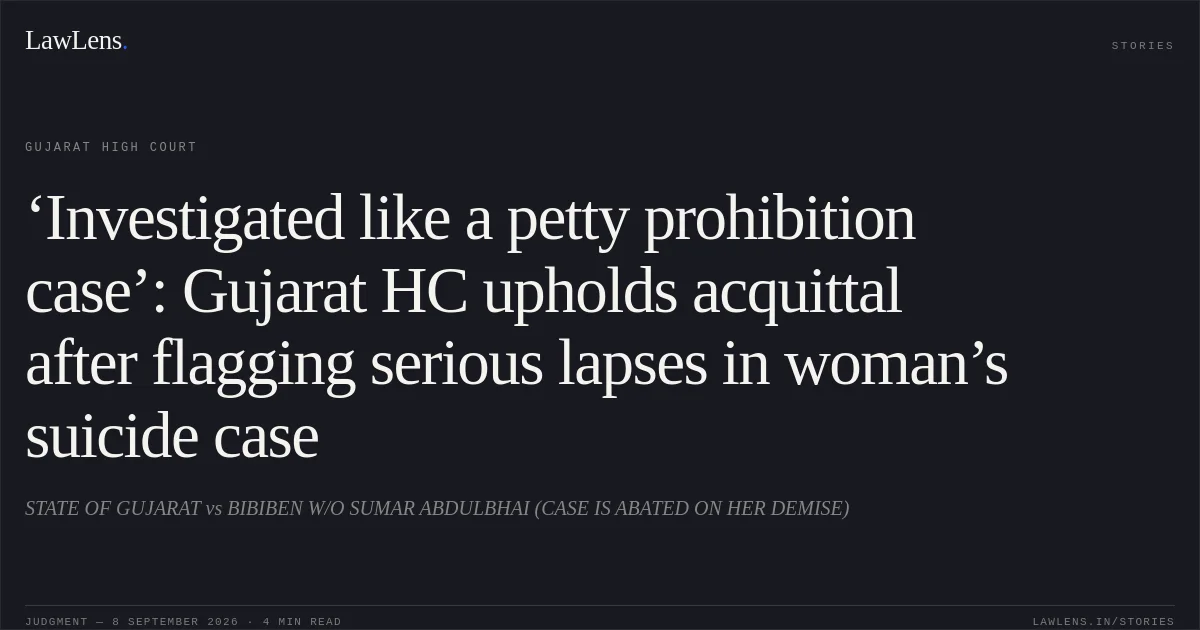
STATE OF GUJARATvsBIBIBEN W/O SUMAR ABDULBHAI (CASE IS ABATED ON HER DEMISE)
Click to open original judgment
Original judgment, available to read, download and summarize on LawLens.in