Facts
The Petitioner, State Bank of India, challenged a composite show-cause notice (SCN) dated June 25, 2025, issued by the Additional Commissioner under Section 74 of the CGST Act, 2017
Source reference: para. 1The SCN clubbed multiple financial years (2018-19 to 2023-24) into a single notice
Source reference: para. 10Despite the Petitioner providing calculation worksheets and 56 inter-branch invoices, the authorities issued an Order-in-Original on December 12, 2025, confirming a total liability (tax, interest, and penalty) of approximately ₹10.97 Crores, alleging that the Petitioner's reply lacked supporting details
Source reference: para. 2, 4, 5, 8The Petitioner moved the High Court via writ jurisdiction, contending that clubbing multiple years was illegal and that the demand for several years was barred by limitation
Source reference: para. 9, 14Issues
1. Whether a single, consolidated show-cause notice can be issued for multiple financial years under Section 74 of the CGST Act, 2017
Source reference: para. 282. Whether the writ petition is maintainable despite the existence of an alternative statutory appellate remedy under Section 107 of the Act
Source reference: para. 21Law Applied
Section 74 of the CGST Act, 2017, which provides a five-year limitation period for determining tax short-paid by reason of fraud or suppression
Source reference: para. 29Section 2(106), which defines "tax period" based on the period for which a return is furnished, and Section 2(97) regarding the definition of "return"
Source reference: para. 37, 38The Supreme Court’s decision in State of Jammu and Kashmir v. Caltex (India) Ltd., which held that assessment years must be split and taxed separately
Source reference: para. 35Godrej Sara Lee Ltd. v. Excise and Taxation Officer, which established that writ petitions are maintainable despite alternative remedies when the issue is purely legal or the order is without jurisdiction
Source reference: para. 49Reasoning
The court reasoned that under Section 74(10), the limitation period of five years is anchored to the "due date for furnishing of annual return for the financial year"
Source reference: para. 30, 32The use of the singular expression "the financial year" signifies that the legislature intended each year to be a separate unit for assessment
Source reference: para. 32By clubbing multiple years into one notice, the Revenue effectively attempted to enlarge the limitation period for earlier years that were otherwise time-barred, which is impermissible under a strict construction of taxing statutes
Source reference: para. 40, 41Since returns are filed monthly or annually for a specific year, there is no statutory basis for a consolidated "tax period" spanning multiple financial years
Source reference: para. 38, 39Regarding maintainability, the court held that since the impugned notice was issued in violation of statutory limitation and procedural requirements, it constituted a jurisdictional error apparent on the face of the record, justifying the exercise of writ jurisdiction without requiring the Petitioner to exhaust appellate remedies
Source reference: para. 48, 50Holding
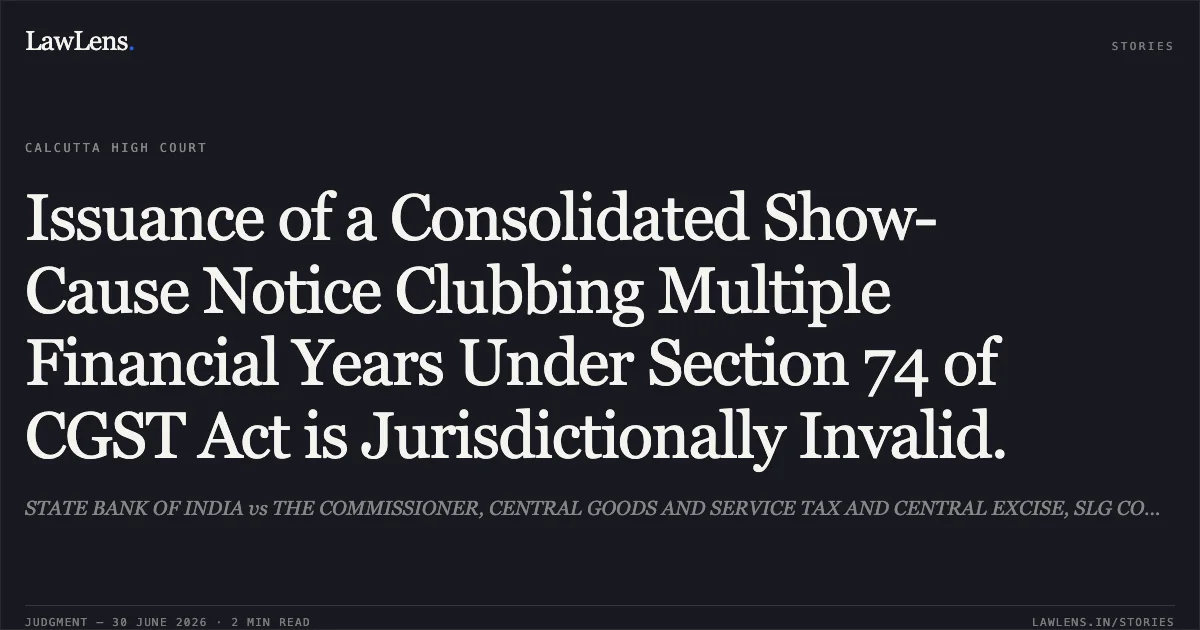
The court answered the first issue in the negative, holding that Section 74 does not permit clubbing multiple financial years in a single SCN
The court held the writ petition maintainable as the Revenue’s action was without jurisdiction
Source reference: para. 50The court quashed the impugned SCN dated June 25, 2025, and the consequential Order-in-Original dated December 12, 2025, granting liberty to the Revenue to proceed afresh strictly in accordance with the law
Source reference: para. 51, 53, 55Acts & Sections Cited
11 provisions across 2 statutes referred to in this judgment. Each provision opens on LawLens.
Central Goods and Services Tax Act, 2017
Integrated Goods and Services Tax Act, 20172
Original Court PDF
STATE BANK OF INDIAvsTHE COMMISSIONER, CENTRAL GOODS AND SERVICE TAX AND CENTRAL EXCISE, SLG COMMISSIONERSTE AND ORS.
Click to open original judgment
Original judgment, available to read, download and summarize on LawLens.in


![Subsequent exoneration does not retrospectively invalidate a finalized promotion select list.. UNNIKRISHNAN M vs M/o Environment And Forests. CAT - ['Ernakulam']. LawLens](/stories/thumbnails/subsequent-exoneration-does-not-retrospectively-invalidate-a-finalized-promotion-select-li-ce80a0e84f2f4887857271e8b4341c42.webp)