01Facts
The petitioner had filed SWP No. 28/2016 seeking, inter alia, placement in higher pay scales under SRO 18 of 1998 and SRO 93 of 2009, promotion to the post of Assistant Work Manager/Foreman, and consequential monetary benefits.
pp. 1–2 · ¶ 1The writ petition was disposed of on 15 October 2024 by declaring the earlier rejection order ineffective and directing the respondents to pass a fresh order regarding the petitioner’s placement in the relevant pay scales and payment of differential arrears.
p. 2 · ¶ 2The petitioner thereafter sought review, contending that the judgment had not considered his claim for two higher grades on account of stagnation for approximately 25 years, allegedly payable after 12 years and again after 24 years of service without promotion.
pp. 2–3 · ¶ 3During the pendency of the review petition, the petitioner’s contempt petition was disposed of after the respondents filed a consideration order dated 12 November 2025, stating that the applicable benefits had already been extended to him under the relevant rules and Government Orders.
pp. 4–5 · ¶ 9–1002Issues
i.Whether the petitioner was entitled to review of the judgment dated 15 October 2024 on the ground that his claim for two higher pay grades after 12 and 24 years of stagnation had not been considered?
pp. 2–3 · ¶ 3 · p. 3 · ¶ 5–6ii.Whether the subsequent consideration order dated 12 November 2025 rendered the review petition infructuous?
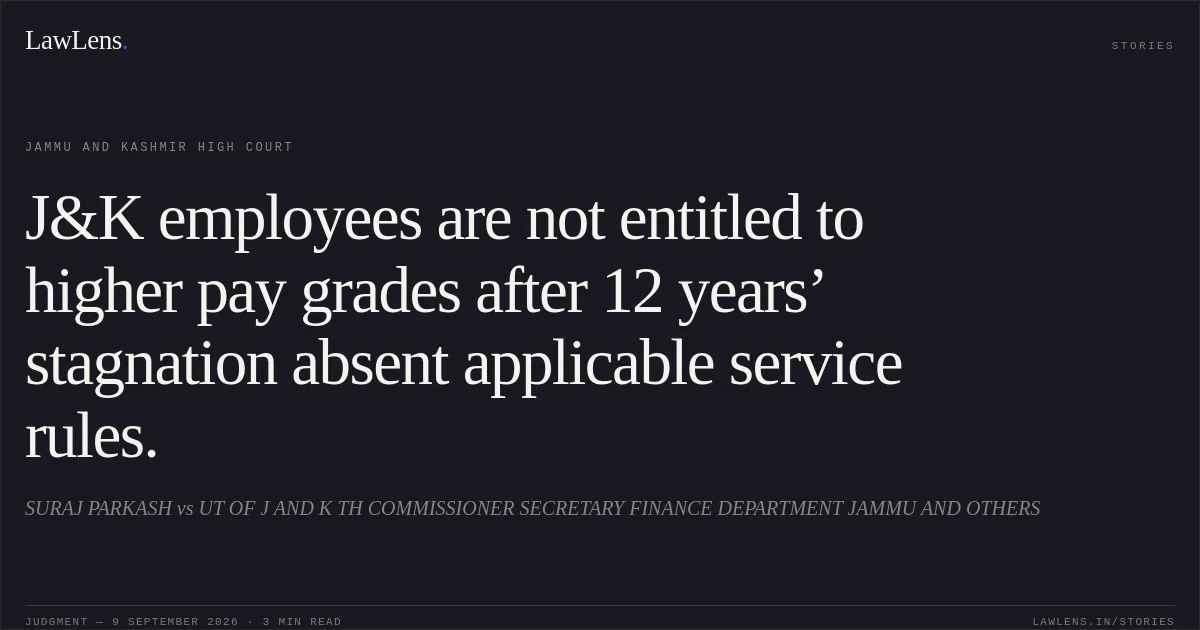
pp. 4–5 · ¶ 9–11iii.Whether, under the applicable service framework in the Union Territory of Jammu & Kashmir, the petitioner was entitled to higher pay grades after every 12 years of stagnation, notwithstanding the grant of in-situ promotions after every nine years?
p. 5 · ¶ 12–1303Law Applied
The Court applied the directions contained in SRO 18 of 1998 and SRO 93 of 2009 concerning placement in revised/relevant pay scales.
p. 2 · ¶ 2It recognised the applicable Jammu & Kashmir service arrangement under which in-situ promotions or higher pay grades are available upon stagnation after every nine years.
p. 5 · ¶ 12The Court held that the judgments in State of Himachal Pradesh v. Surender Kumar Parmar and State of Tripura v. K. K. Roy, which concerned the service rules applicable in Himachal Pradesh and Tripura and recognised entitlement to successive higher grades after 12 years of stagnation, could not be automatically applied in the absence of a corresponding rule in the Union Territory of Jammu & Kashmir.
p. 3 · ¶ 5 · p. 5 · ¶ 13A review petition cannot succeed merely to introduce a claim unsupported by the applicable service rules, particularly where the claim has subsequently been considered by the competent authority.
p. 5 · ¶ 11–1404Reasoning
The Court found that the petitioner’s claim had already been considered by the respondents pursuant to the original judgment, resulting in the consideration order dated 12 November 2025.
pp. 4–5 · ¶ 9–11Since the contempt proceedings were closed after the Court found apparent compliance with the judgment, the review petition had become infructuous to the extent it challenged non-consideration of the petitioner’s claim.
pp. 4–5 · ¶ 9–11In any event, the Court held that the petitioner had already received in-situ promotions in the form of higher pay grades for stagnation after every nine years, as reflected in the record.
p. 5 · ¶ 12The petitioner failed to identify any Jammu & Kashmir rule conferring an additional higher grade after 12 and 24 years of stagnation.
p. 5 · ¶ 13The Supreme Court precedents relied upon by him were distinguishable because they arose under the service rules of Himachal Pradesh and Tripura and therefore did not establish an entitlement under the J&K service regime.
p. 5 · ¶ 1305Holding
The Court dismissed the review petition as infructuous in view of the subsequent consideration order and, independently, as devoid of merit.
pp. 5–6 · ¶ 11–14It held that the petitioner was not entitled to two additional higher grades after 12 and 24 years of stagnation because no such entitlement was shown under the applicable Union Territory of Jammu & Kashmir rules, while the benefits available for stagnation after every nine years had already been granted.
pp. 5–6 · ¶ 11–14The petitioner was left at liberty to challenge the consideration order dated 12 November 2025 in appropriate proceedings.
p. 5 · ¶ 11Original Court PDF
SURAJ PARKASHvsUT OF J AND K TH COMMISSIONER SECRETARY FINANCE DEPARTMENT JAMMU AND OTHERS
Click to open original judgment
Original judgment, available to read, download and summarize on LawLens.in