Facts
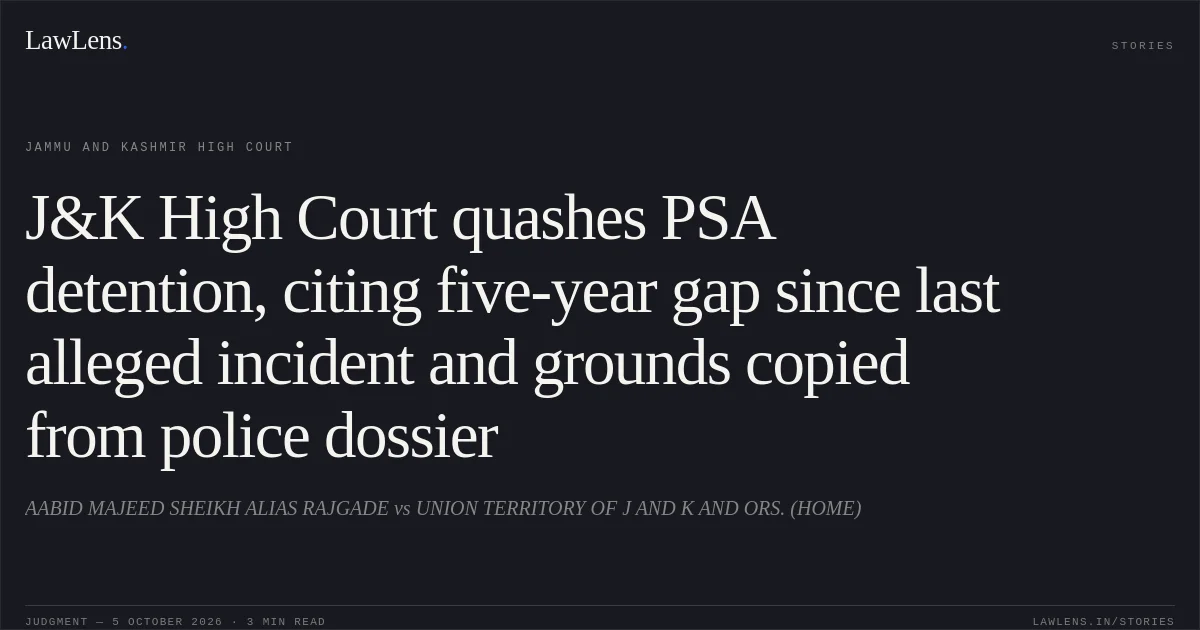
The District Magistrate, Pulwama, detained Aabid Majeed Sheikh under Section 8 of the Jammu and Kashmir Public Safety Act, 1978 (PSA), by order dated 3 May 2025, on grounds relating to security of the State.
Source reference: p. 1, paras. 1–2The grounds relied in part on three earlier FIRs registered in 2016, 2018 and 2020; the appellant had been granted bail in all three, and the last identified incident predated the detention order by approximately five years.
Source reference: pp. 2–3, para. 4; p. 9, para. 14The Writ Court dismissed his habeas corpus petition on 21 November 2025.
Source reference: no citationIn appeal, he challenged, among other matters, the absence of a live link between the past cases and detention, the alleged verbatim adoption of the police dossier, and non-supply of the detention record and failure to deal with his representation.
Source reference: pp. 2–6, paras. 4, 8Issues
Whether the five-year interval between the last alleged incident and the detention order snapped the live link required to justify preventive detention.
Source reference: pp. 9–10, paras. 14–18Whether the grounds of detention were based on vague and unsupported allegations, and whether their reproduction of the police dossier demonstrated non-application of mind by the Detaining Authority.
Source reference: pp. 11–15, paras. 20–23Whether the alleged non-supply of the full detention record and failure to consider and communicate the outcome of the representation violated Article 22(5) of the Constitution.
Source reference: pp. 15–18, paras. 24–30Whether the PSA remained applicable in the Union Territory of Jammu and Kashmir and whether the competent legislature could provide for the period of detention.
Source reference: pp. 18–21, para. 31Law Applied
Under Section 8 of the PSA, preventive detention must rest on the Detaining Authority’s subjective satisfaction that detention is necessary to prevent prejudicial conduct.
Source reference: no citationThe past conduct relied upon must ordinarily be sufficiently proximate and rationally connected to the need for detention; undue delay requires a satisfactory explanation, and the court must assess whether the live link has been broken (Rajinder Arora v. Union of India, AIR 2006 SC 796; Rameshwar Shaw v. District Magistrate, Burdwan, AIR 1964 SC 334).
Source reference: pp. 9–10, paras. 17–18The authority must independently apply its mind; grounds that merely reproduce the police dossier may evidence non-application of mind (Jai Singh v. State of J&K, AIR 1985 SC 764).
Source reference: pp. 12–15, paras. 21–23Article 22(5) requires communication of the factual material relied upon and a meaningful opportunity to make a representation; representations must be considered promptly and their outcome communicated (Shalini Soni v. Union of India, (1980) 4 SCC 544; Rajammal v. State of Tamil Nadu, (1999) 1 SCC 417; K. M. Abdulla Kunhi v. Union of India, (1991) 1 SCC 476).
Source reference: pp. 16–18, paras. 26–29The PSA continued in force under the Jammu and Kashmir Reorganisation Act, 2019, and the court relied on Fagu Shaw v. State of West Bengal, AIR 1974 SC 613, in rejecting the contention that only Parliament could prescribe the detention period.
Source reference: pp. 19–21, para. 31Reasoning
The last identified incident was from 2020, while the detention order was made in May 2025; the respondents offered no specific, concrete allegation of prejudicial activity after the appellant’s release in the last FIR to explain the delay or preserve the live link.
Source reference: p. 9, paras. 14–16The Court held that the grounds were vague and unsupported by material, and that their verbatim reproduction of the police dossier indicated that the Detaining Authority had not independently formed the required subjective satisfaction.
Source reference: pp. 11–15, paras. 20–23It also addressed the Article 22(5) safeguards concerning supply of the relied-upon material and consideration and communication of the representation.
Source reference: pp. 15–18, paras. 24–30By contrast, it rejected the challenges to the continued applicability of the PSA and to legislative competence concerning the detention period.
Source reference: pp. 18–21, para. 31Holding
The Court held that the detention could not stand in light of the unexplained five-year gap, the absence of a live link, and the defects in the grounds and decision-making process.
It allowed the Letters Patent Appeal, set aside the Writ Court’s judgment, quashed detention order No. DMP/PSA/28/2025 dated 3 May 2025, and directed the appellant’s release from preventive detention in this case if he had not already been released.
Source reference: p. 22, para. 33Acts & Sections Cited
1 provisions across 1 statute referred to in this judgment. Each provision opens on LawLens.
Jammu and Kashmir Reorganisation Act, 20191
Original Court PDF
AABID MAJEED SHEIKH ALIAS RAJGADEvsUNION TERRITORY OF J AND K AND ORS. (HOME)
Click to open original judgment
Original judgment, available to read, download and summarize on LawLens.in