Facts
The petitioner, a minor student, qualified NEET-UG 2026 and possessed a Migrant Certificate issued by the Relief and Rehabilitation Commissioner (Migrants), Jammu. She also held a Punjab Resident Certificate stating that she was born in Ludhiana.
Source reference: paras. 2; p. 2Admission to MBBS and BDS courses for the 2026 academic session was governed by the BFUHS Prospectus. Clause 11 prescribed eligibility for the Punjab State quota, while Clause 16(x) reserved 1% seats in private institutions for migrants from Jammu and Kashmir displaced due to terrorist violence and provided for waiver of the domicile requirement in accordance with Government of India instructions dated 15 October 2019.
Source reference: paras. 6–7; pp. 4–5The petitioner challenged BFUHS communication dated 4 August 2026 and sought a direction that candidates satisfying both the J&K migrant criteria and the Punjab State quota conditions should receive preference under the 1% quota.
Source reference: para. 1; p. 1The petitioner ranked 31st in the combined J&K migrant merit list, while seven seats had been earmarked in private medical colleges under the category.
Source reference: para. 4; p. 3Issues
1. Whether Clause 16(x) of the 2026 BFUHS Prospectus, providing a 1% quota and waiver of domicile requirements for eligible J&K migrants displaced due to terrorist violence, required such candidates additionally to satisfy the Punjab State quota conditions under Clause 11.
Source reference: paras. 6–10; pp. 4–62. Whether the petitioner was entitled to preference over other eligible J&K migrant candidates on the basis of her Punjab birth and claimed State quota eligibility, relying upon Doyel Koul v. State of Punjab and the earlier BFUHS clarification.
Source reference: paras. 3, 11; pp. 2–3, 6–73. Whether the current Prospectus and the waiver of domicile requirement could be disregarded or modified after commencement of the admission process.
Source reference: paras. 4, 11; pp. 3, 6–7Law Applied
The Court applied Clause 11 of the BFUHS Prospectus, which prescribes eligibility for the Punjab State quota through citizenship, Punjab schooling, birth in Punjab, or permanent residence in Punjab.
Source reference: para. 6; p. 4It also applied Clause 16(x), which creates a distinct 1% category for J&K migrants displaced due to terrorist violence, requires a certificate from the Relief and Rehabilitation Commissioner (Migrants), Jammu, and incorporates the Government of India instructions dated 15 October 2019 granting waiver of the domicile requirement.
Source reference: para. 7; pp. 4–5Clause 16(x)(c) restricts the concession to relaxation or waiver of domicile requirements and does not extend it to relaxation of minimum eligibility, NEET cut-off, enhancement of quota, or creation of additional seats.
Source reference: para. 7; p. 5The Court distinguished Doyel Koul v. State of Punjab because that decision concerned an earlier notification that did not expressly incorporate the Government of India instructions or provide for waiver of domicile.
Source reference: para. 11; pp. 6–7It also relied on Dr. Tanvi Bahl v. Shrey Goel, 2025 SCC OnLine SC 180, regarding the distinction and practical use of the expressions “domicile,” “permanent residence,” and “residence,” while noting that residence-based preference may be permissible at the undergraduate MBBS level.
Source reference: para. 12; p. 7Reasoning
The Court read Clauses 11 and 16(x) together and held that the express waiver of domicile in Clause 16(x) necessarily dispensed with the territorial or residential connection with Punjab otherwise contemplated by Clause 11.
Source reference: paras. 8–9; pp. 5–6The fact that Clause 11 did not use the precise word “domicile” was immaterial, because its requirements concerning Punjab birth, schooling, or permanent residence represented the relevant State connection, and the waiver had to be understood as waiving that connection for eligible J&K migrants.
Source reference: para. 9; p. 6Requiring such migrants to prove Punjab residence would defeat the rehabilitative object of the special category, which was intended to assist families forcibly displaced from J&K due to terrorism.
Source reference: para. 10; pp. 6–7The petitioner’s reliance on Doyel Koul was rejected because the present Prospectus was materially different, expressly superseded prior admission notifications, and incorporated the domicile waiver.
Source reference: para. 11; pp. 7–8The Court further found no basis to alter the applicable eligibility conditions after the admission process had commenced, particularly where such alteration could prejudice other candidates who participated under the existing Prospectus.
Source reference: para. 4; p. 3Holding
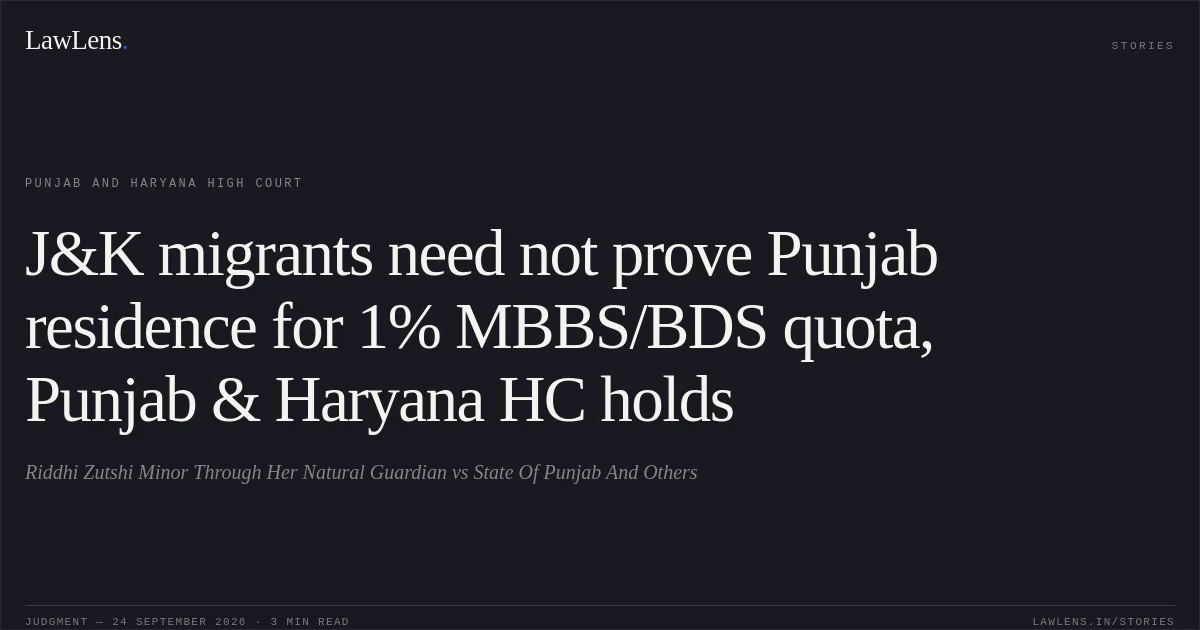
The Court held that eligible J&K migrants displaced due to terrorist violence were entitled to the benefit of the 1% quota upon satisfying the specific requirements of Clause 16(x), without additionally proving Punjab domicile, residence, birth, or State quota eligibility under Clause 11.
The petitioner was therefore not entitled to preferential consideration on the basis of her Punjab birth or resident certificate.
Source reference: paras. 13–14; p. 8The writ petition challenging BFUHS communication dated 4 August 2026 was dismissed, with no order as to costs; pending miscellaneous applications, if any, were also disposed of.
Source reference: paras. 13–14; p. 8Original Court PDF
Riddhi Zutshi Minor Through Her Natural GuardianvsState Of Punjab And Others
Click to open original judgment
Original judgment, available to read, download and summarize on LawLens.in