01Facts
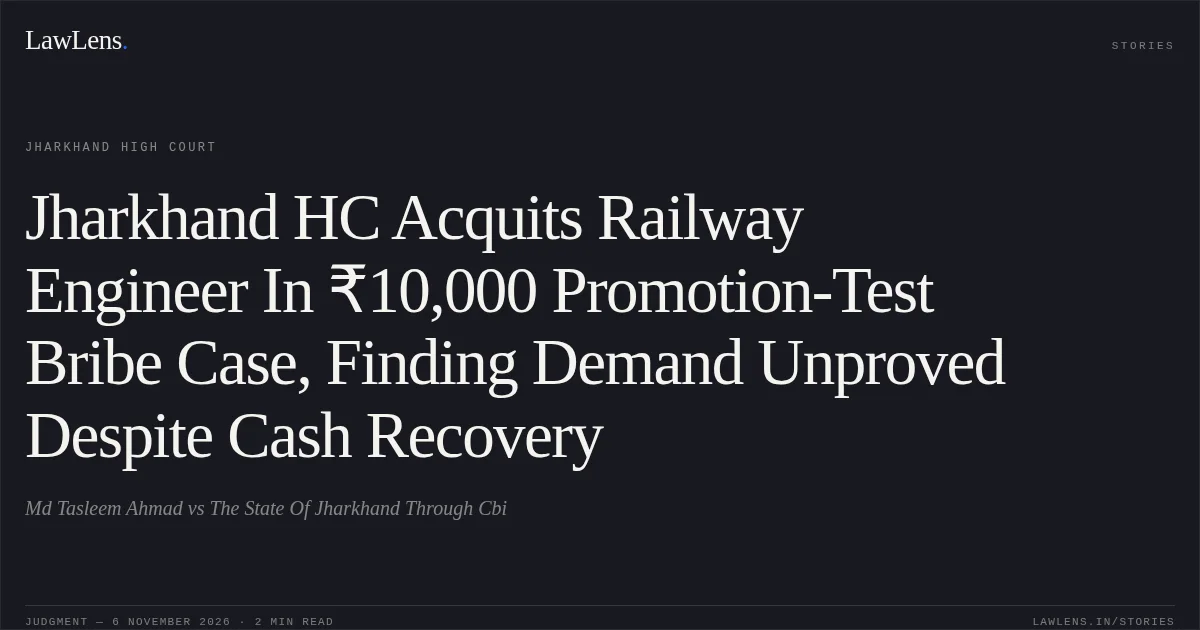
The appellant, an Assistant Engineer (Electrical) with South Eastern Railway, was accused of demanding ₹10,000 from a Group-D employee who had appeared in a promotion examination.
¶ 3–6The complainant reported the alleged demand to the C.B.I.; a trap was arranged, and the appellant was arrested after marked currency was recovered from him
¶ 3–6The Special Judge, C.B.I., Ranchi convicted the appellant under Sections 7 and 13(2) read with Section 13(1)(d) of the Prevention of Corruption Act, 1988, and imposed concurrent sentences of two years’ rigorous imprisonment and fines.
¶ 2The appellant challenged the conviction and sentence in appeal
¶ 2, 1302Issues
i.1. Whether the impugned judgment of conviction and sentence suffered from an error of law warranting interference in appeal
¶ 16ii.2. Whether the prosecution proved the demand and acceptance of illegal gratification, as required to sustain conviction under Sections 7 and 13(1)(d) read with Section 13(2) of the Act
¶ 20–2603Law Applied
Under the pre-2018 version of the Prevention of Corruption Act, 1988, proof of demand and acceptance of illegal gratification is essential to establish offences under Section 7 and Sections 13(1)(d)(i) and (ii); mere recovery of money, without proof of demand, is insufficient.
¶ 20–22The court relied on K. Shanthamma v. State of Telangana, (2022) 4 SCC 574, and Neeraj Dutta v. State (Govt. of NCT of Delhi), (2023) 4 SCC 731, for the requirement that demand and acceptance be proved, directly or circumstantially
¶ 20–22It also relied on P. Satyanarayana Murthy v. District Inspector of Police, State of A.P., (2015) 10 SCC 152, which holds that failure to prove demand is fatal and that the presumption under Section 20 does not arise in the absence of proof of demand and acceptance; Section 20 applies to Section 7, but not to Section 13(1)(d)(i) and (ii)
¶ 25Provisions in the judgment · 4 · Linked ones open on LawLens
Prevention of Corruption Act, 1988 Section 2Section 7Section 13Section 20
04Reasoning
The court considered the complainant’s and other candidates’ evidence alongside the circumstances that the examination result had been published before the complaint was lodged, that two other candidates who allegedly faced similar demands made no complaint, and that the complainant had previously failed and feared failing again
¶ 23It treated these circumstances as casting suspicion on the complainant’s motive and found that the C.B.I. had not properly verified the complaint
¶ 23Although the judgment recounted testimony that the appellant demanded money during the trap and that the currency was recovered from him, the court concluded that demand and acceptance had not been proved and that recovery alone could not establish the offences
¶ 17, 23–2705Holding
The court held that the prosecution had not proved the essential elements of the charged offences and that the conviction could not stand
¶ 26–28It set aside the judgment of conviction and sentence, acquitted the appellant, discharged him from his bail bond and discharged his sureties; the appeal was allowed
¶ 28–30Original Court PDF
Md Tasleem AhmadvsThe State Of Jharkhand Through Cbi
Click to open original judgment
Original judgment, available to read, download and summarize on LawLens.in