01Facts
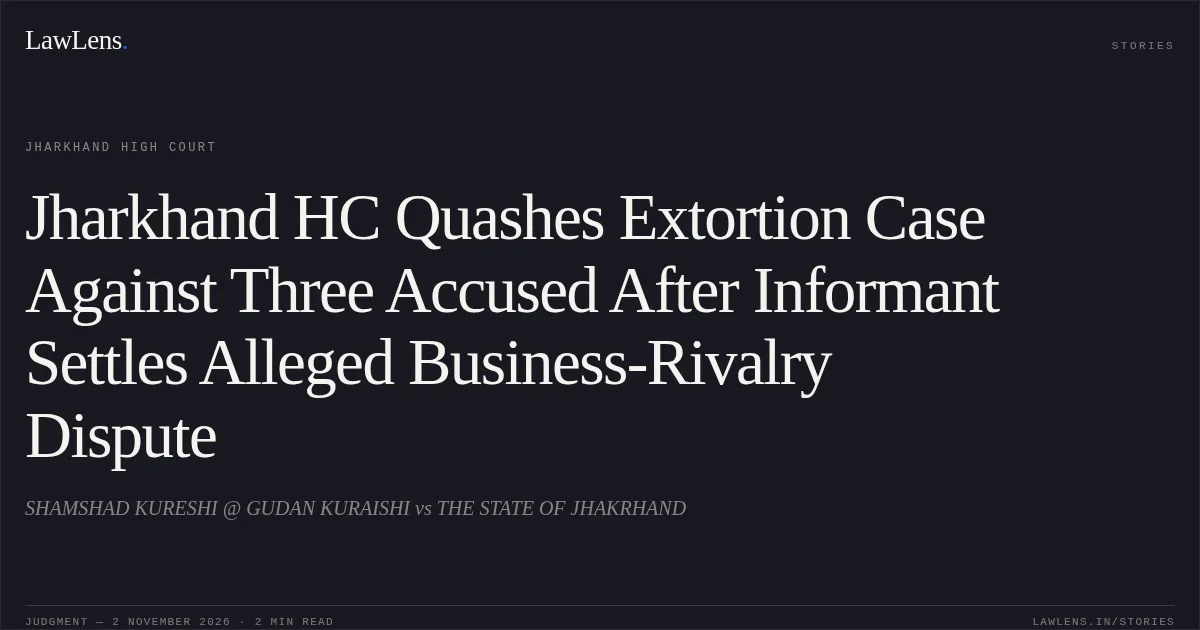
The petitioners invoked Section 528 of the Bharatiya Nagarik Suraksha Sanhita, 2023, seeking to quash the proceedings in Chainpur P.S. Case No. 321 of 2023, registered under Sections 384, 385, 386, 387, 504 and 506 of the IPC.
¶ 2The investigation was ongoing and no charge-sheet had been filed.
¶ 3The petitioners and the informant stated that the dispute arose from business rivalry, had been fully compromised, and the informant did not wish to pursue the case.
¶ 4The State did not oppose quashing.
¶ 502Issues
i.1. Whether the High Court should quash the FIR and criminal proceedings in the exercise of its inherent jurisdiction under Section 528 BNSS, on the basis of the parties’ compromise.
¶ 2, 4, 8ii.2. Whether continuation of the proceedings, despite the settlement, would amount to an abuse of process or be contrary to the interests of justice.
¶ 7–803Law Applied
Section 528 BNSS preserves the High Court’s inherent power to make orders necessary to prevent abuse of the process of court or otherwise secure the ends of justice.
¶ 2Relying on Parbatbhai Aahir @ Parbatbhai Bhimsinhbhai Karmur v. State of Gujarat, (2017) 9 SCC 641, which discussed the principles in Gian Singh v. State of Punjab, (2012) 10 SCC 303, the Court noted that inherent power to quash is distinct from statutory compounding under Section 320 CrPC and must be exercised with due regard to the nature and gravity of the offence.
¶ 6Proceedings involving private or personal disputes may be quashed where the parties have fully settled, the prospect of conviction is remote, and continuation would be oppressive, unjust or an abuse of process; heinous offences and offences with serious societal impact ordinarily stand on a different footing.
¶ 6Provisions in the judgment · 9 · Linked ones open on LawLens
Bharatiya Nagarik Suraksha Sanhita, 2023 Section 528
Indian Penal Code, 1860 Section 384Section 385Section 386Section 387Section 504Section 506
Code of Criminal Procedure, 1973 Section 482Section 320
04Reasoning
The Court treated the dispute as a private one arising from business rivalry and noted the parties’ joint submission that the matter had been fully settled and the informant was unwilling to pursue the case.
¶ 4The State had no objection to quashing.
¶ 5Applying the Parbatbhai Aahir principles, the Court concluded that the compromise made conviction remote and continuation of the case oppressive and contrary to the interests of justice.
¶ 7–805Holding
The Court held that continuing the proceedings would amount to an abuse of process and quashed the entire criminal proceeding, including Chainpur P.S. Case No. 321 of 2023, against the petitioners.
¶ 8–10The criminal miscellaneous petition was allowed, and the interlocutory application was disposed of.
¶ 8–10Original Court PDF
SHAMSHAD KURESHI @ GUDAN KURAISHIvsTHE STATE OF JHAKRHAND
Click to open original judgment
Original judgment, available to read, download and summarize on LawLens.in