01Facts
The petitioners were para-teachers in the Naudiha Bazar and Chhatarpur blocks of Palamu. Their appointments, made between 2006 and 2008, were challenged following inquiries into irregularities in the selection process.
¶ 8–12A High-Powered Committee reported discrepancies in the selection or block-level recommendations of 512 para-teachers. The JEPC’s 64th meeting recommended that eligible teachers whose selection process had procedural discrepancies be treated as a special case, while those lacking eligibility or selected contrary to law could be removed.
¶ 8–12The Deputy Commissioner, acting as First Appellate Authority, nevertheless terminated the petitioners’ services by order dated 16 January 2025, principally because block-level recommendations were missing, inconsistent with official records, or not produced.
¶ 34, 42–43The petitioners challenged the termination orders under Article 226. The respondents objected that the petitioners should first pursue the statutory second appeal under Rule 16 of the Jharkhand Assistant Teacher Service Rules, 2021.
¶ 22, 29–3002Issues
i.1. Whether the writ petitions were maintainable despite the alternative statutory remedy under Rule 16 of the Jharkhand Assistant Teacher Service Rules, 2021.
¶ 29(i)ii.2. Whether the termination order was illegal, arbitrary, or perverse, including whether the petitioners could be penalised for missing or inconsistent block-level recommendation records.
¶ 29(ii)03Law Applied
Article 226 permits the High Court to intervene notwithstanding an alternative remedy where, among other recognised exceptions, the impugned decision is affected by manifest error or perversity; a finding may be perverse if it rests on no evidence, relies on irrelevant material, or ignores vital evidence (*Syed Yakub v. K.S. Radhakrishnan*; *PSA Sical Terminals Pvt. Ltd. v. Board of Trustees of VO Chidambranar Port Trust*).
¶ 32–33The alternative-remedy rule is a rule of judicial discretion, not an absolute bar; it may not apply where the remedy is ineffective or raises a reasonable apprehension of bias (*Dhampur Sugar Mills Ltd. v. State of Uttar Pradesh*).
¶ 37–40Under *Mohinder Singh Gill v. Chief Election Commissioner*, an administrative order must be judged by the reasons stated in it and cannot be supplemented by new reasons in an affidavit.
¶ 55The Court also relied on *Gaurav Mehla v. State of Haryana*, which distinguished defects going to the root of a recruitment process from procedural defects that do not invalidate an otherwise advertised and fairly conducted selection.
¶ 52–54The relevant recruitment framework included the block-level recommendation requirement under the Sarva Shiksha Abhiyan process and Rule 16 of the 2021 Rules.
¶ 22, 5204Reasoning
The Court found that the impugned orders did not consider the e-Vidyavahini records, maintained by the respondents, which recorded block-level approval and induction training, or adequately address the JEPC’s 64th-meeting recommendation.
¶ 35–36The respondents’ own material indicated that the duty to preserve block-level recommendation records lay with the relevant education authorities, not the petitioners; the Court therefore held that the petitioners could not be penalised merely because those records were missing or inconsistent.
¶ 44–49The State Project Director had previously stopped the petitioners from working and challenged the favourable disciplinary-committee decisions, making a further appeal to that authority an ineffective remedy in the circumstances.
¶ 37–40The termination orders also did not establish that these petitioners lacked the required qualifications; the Court noted that persons found ineligible were listed separately. Given the advertisements, Aam Sabha recommendations, agreements, official service records, and long service, the alleged absence of block-level recommendations was treated as a procedural defect not shown to invalidate the recruitment at its root.
¶ 51–5505Holding
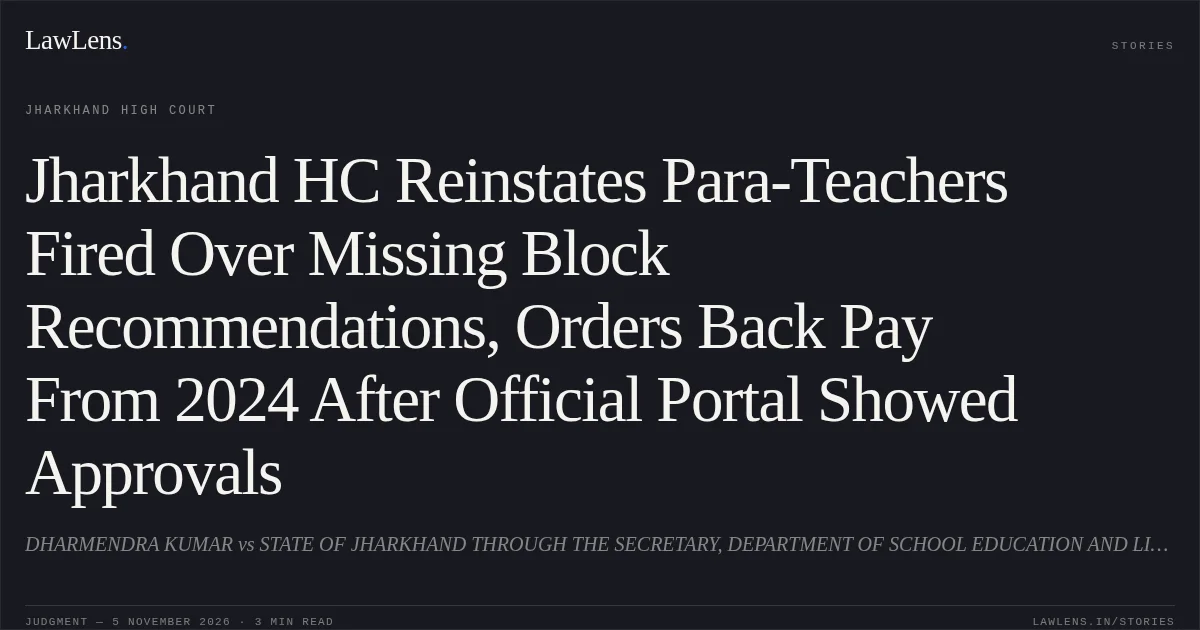
The Court held that the alternative-remedy objection did not bar the writ petitions and that the termination orders were perverse and unsustainable.
¶ 56–59It quashed and set aside the impugned order dated 16 January 2025 and directed the petitioners’ reinstatement.
¶ 56–59The petitioners were to receive salary or honorarium from the dates of the favourable disciplinary-cum-administrative committee decisions—13 March 2024 or 27 April 2024, as applicable—until reinstatement, with consequential service benefits.
¶ 56–59The respondents were directed to permit the petitioners to rejoin within four weeks and to comply with the payment directions within a further eight weeks. The writ petitions were allowed, with no order as to costs.
¶ 56–59Original Court PDF
DHARMENDRA KUMARvsSTATE OF JHARKHAND THROUGH THE SECRETARY, DEPARTMENT OF SCHOOL EDUCATION AND LITERACY
Click to open original judgment
Original judgment, available to read, download and summarize on LawLens.in