Facts
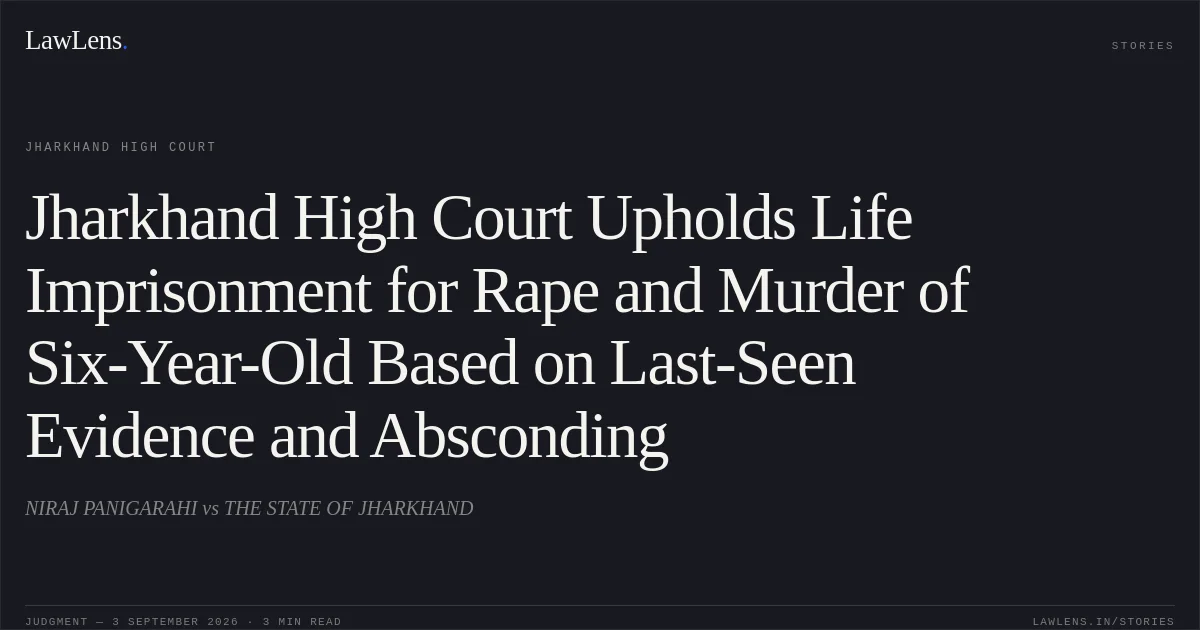
The appellant, a cook employed at the same hotel where the deceased child’s mother worked, was alleged to have taken the six-year-old victim to a fair on 26.04.2013, after which she disappeared.
Source reference: paras. 2–3Her dead body was recovered from a hillock near Middle School, Kamdara, on 28.04.2013, bearing severe head and thigh injuries and genital injuries consistent with rape.
Source reference: paras. 2–3The appellant was arrested in Odisha after allegedly fleeing from the area.
Source reference: paras. 2–3The trial court convicted him under Sections 302, 376(2) and 201 IPC and Section 6 of the POCSO Act, sentencing him to life imprisonment for the offences under Sections 302 and 376(2) IPC, and seven years’ rigorous imprisonment under Section 201 IPC, with sentences to run concurrently.
Source reference: paras. 23–24The appellant challenged the conviction, principally contesting the last-seen evidence and relying on alibi.
Source reference: para. 20Issues
Whether the prosecution established beyond reasonable doubt that the appellant was the person last seen with the deceased and that the circumstantial evidence sufficiently connected him with the rape and murder.
Source reference: para. 23Whether the appellant’s plea of alibi and the alleged absence of direct eyewitnesses created a reasonable doubt warranting acquittal.
Source reference: paras. 20, 23Whether the conviction and sentences imposed by the trial court required appellate interference.
Source reference: paras. 2, 24Law Applied
The Court applied Sections 302, 376(2) and 201 of the Indian Penal Code, concerning murder, aggravated rape and causing disappearance of evidence, respectively, and Section 6 of the POCSO Act concerning aggravated penetrative sexual assault on a child.
Source reference: paras. 2–3It applied the settled principle that a conviction may rest on circumstantial evidence where the circumstances, including reliable last-seen evidence, form a complete and convincing chain pointing exclusively to the accused’s guilt.
Source reference: para. 23The Court also treated the accused’s unexplained abscondence as a relevant circumstance and rejected the plea of alibi where the defence evidence was unreliable and failed to outweigh the prosecution case.
Source reference: para. 23Medical evidence establishing rape and death from shock and haemorrhage served as corroboration of the prosecution’s account.
Source reference: para. 11Reasoning
The Court found the evidence of P.Ws. 1, 3 and 5 consistent in placing the appellant with the deceased at or near the fair shortly before her disappearance, while P.W. 9 independently stated that she had seen the appellant accompanied by a girl at approximately the same time.
Source reference: para. 23The deceased’s body was recovered within two days, strengthening the temporal proximity between the last-seen circumstance and the discovery of the body.
Source reference: para. 23The post-mortem evidence showed multiple grievous blunt-force injuries, ruptured hymen and vaginal tears, and opined that death resulted from shock and haemorrhage following rape and violence.
Source reference: para. 11The Court further relied on the appellant’s flight to Odisha and his failure to provide a reasonable explanation under his Section 313 Cr.P.C. statement.
Source reference: para. 23The alibi evidence of the appellant and his brother was rejected, particularly because the brother’s testimony was considered unreliable and inconsistent with his claimed familiarity with the appellant’s personal circumstances.
Source reference: para. 23Collectively, these circumstances were held to establish the appellant’s guilt beyond reasonable doubt despite the absence of a direct eyewitness.
Source reference: paras. 23–24Holding
The High Court held that the prosecution had sufficiently proved that the appellant had taken the deceased child away, sexually assaulted her and thereafter murdered her, with the circumstantial evidence forming a complete and convincing chain.
The plea of alibi and the challenge based on the absence of eyewitnesses were rejected.
Source reference: paras. 23–24Finding no error in the trial court’s appreciation of the evidence, the Court dismissed the appeal and affirmed the conviction and sentences; any pending interlocutory applications were closed.
Source reference: paras. 24–25Acts & Sections Cited
5 provisions across 3 statutes referred to in this judgment. Each provision opens on LawLens.
Indian Penal Code, 18603
Protection of Children from Sexual Offences Act, 20121
Code of Criminal Procedure, 19731
Original Court PDF
NIRAJ PANIGARAHIvsTHE STATE OF JHARKHAND
Click to open original judgment
Original judgment, available to read, download and summarize on LawLens.in