Facts
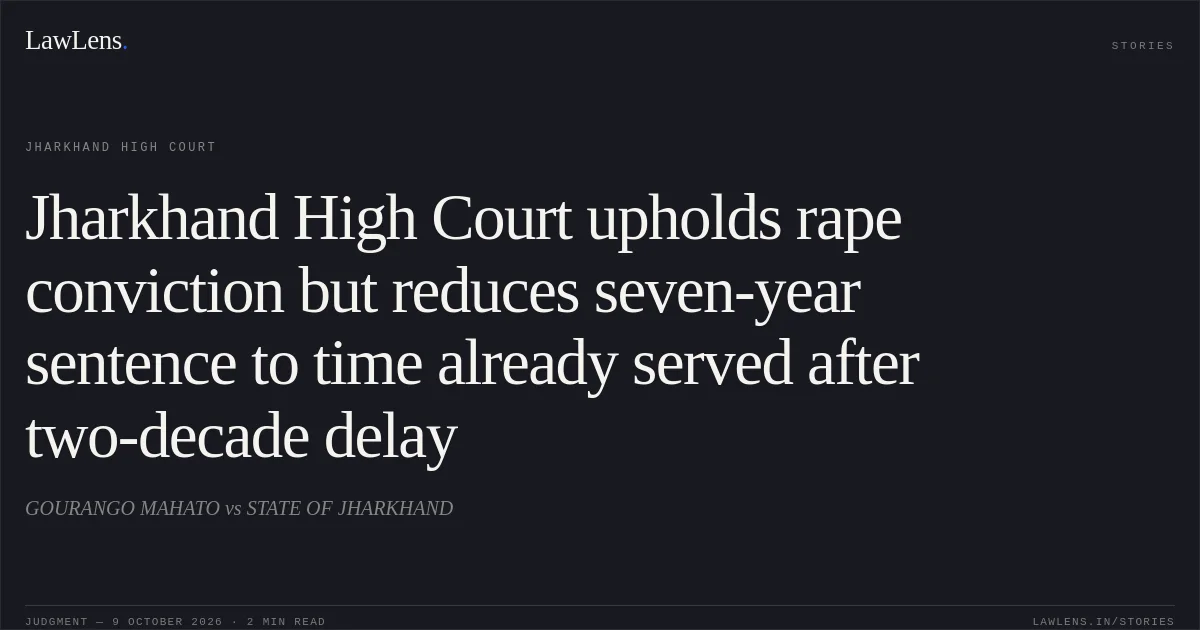
The appellant was convicted by the Additional Sessions Judge (F.T.C.-2), Seraikela-Kharsawan, under Sections 376 and 448 of the Indian Penal Code (IPC) for allegedly entering the prosecutrix’s room and raping her on 25 April 2004.
Source reference: paras. 2–4He was sentenced to seven years’ rigorous imprisonment for rape and six months’ rigorous imprisonment for house-trespass, to run concurrently.
Source reference: paras. 2–4On appeal, he challenged the reliability of the prosecutrix’s evidence, relying, among other matters, on the absence of medical corroboration and alleged inconsistencies in the prosecution evidence.
Source reference: paras. 8–9The State opposed the appeal and supported the conviction.
Source reference: para. 10Issues
1. Whether the conviction under Sections 376 and 448 IPC suffered from a serious error warranting appellate interference.
Source reference: para. 122. Whether the sentence should be reduced in light of the time elapsed since the offence and the period of imprisonment already undergone.
Source reference: paras. 9, 22Law Applied
The court considered the offences under Sections 376 and 448 IPC.
Source reference: paras. 2, 21It applied the principle that the prosecutrix’s testimony may be relied upon to establish rape even without medical corroboration, where the court finds her evidence credible; the absence of medical corroboration, by itself, does not require rejection of that evidence.
Source reference: para. 21No precedent was cited.
Source reference: no citationIn considering sentence, the court assessed the elapsed time and the appellant’s period in custody against the circumstances of the case.
Source reference: para. 22Reasoning
The court accepted the prosecutrix’s account that the appellant entered her room and raped her, and considered the fact that he was apprehended and arrested in the room where the incident was alleged to have occurred as supporting her account.
Source reference: paras. 14, 19, 21It held that the medical report’s lack of a definite opinion on rape and the failure to seize the prosecutrix’s clothes did not displace her testimony; the Investigating Officer explained that she had washed her clothes after bathing.
Source reference: paras. 19–21The court also rejected the defence theory of false implication arising from the appellant’s relationship with the prosecutrix’s husband.
Source reference: para. 21As to sentence, it considered that the offence occurred in 2004 and that the appellant had already spent approximately one and a half years in custody.
Source reference: para. 22Holding
The High Court upheld the convictions under Sections 376 and 448 IPC, finding no illegality or infirmity in the trial court’s decision.
It modified the sentence to the period already undergone, holding that further imprisonment would not be just and proper in the circumstances.
Source reference: paras. 22–24The appeal was dismissed on the merits with that modification; the appellant, being on bail, was discharged from his bail bond and the sureties were discharged.
Source reference: paras. 24–25Acts & Sections Cited
2 provisions across 1 statute referred to in this judgment. Each provision opens on LawLens.
Indian Penal Code, 18602
Original Court PDF
GOURANGO MAHATOvsSTATE OF JHARKHAND
Click to open original judgment
Original judgment, available to read, download and summarize on LawLens.in