Facts
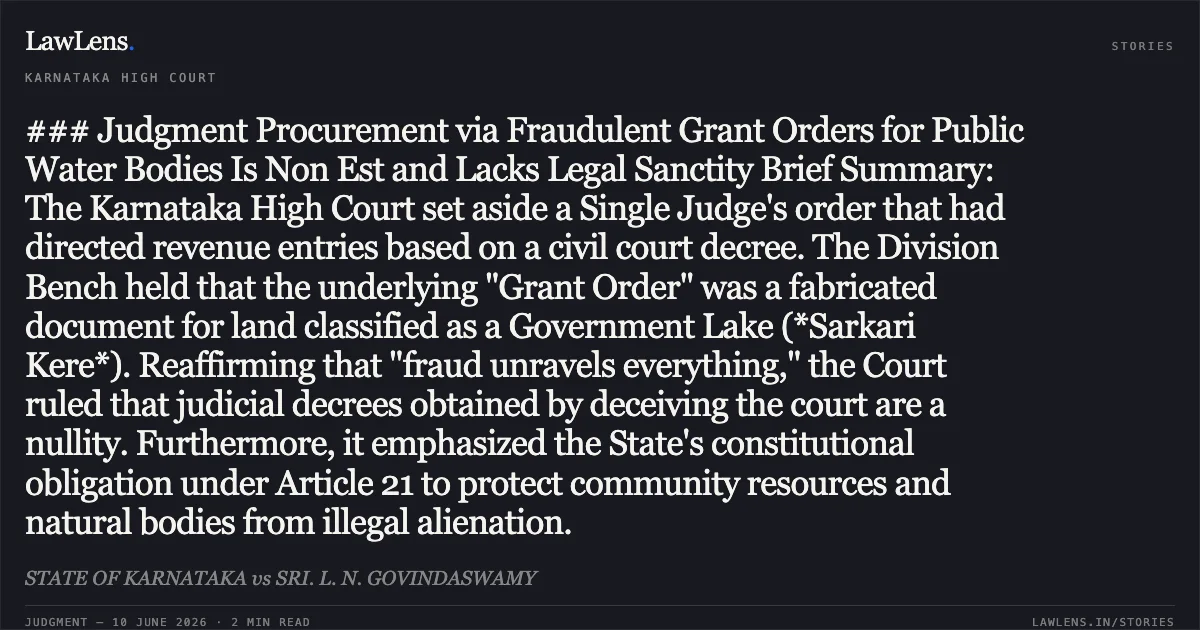
The Petitioner (Respondent No. 1) claimed title to 13 Acres 29 Guntas in Sy. Nos. 82, 52, and 61 of Dattagalli Village via a 1954 Grant Order
Source reference: p. 4Relying on a 2001 Civil Court decree in O.S. No. 96/1997 which declared him the absolute owner—a decree that attained finality after the State’s appeals were dismissed on grounds of delay—the Petitioner sought a Writ of Mandamus to enter his name in revenue records (RTC) and receive compensation for land utilized by the Mysore Urban Development Authority (MUDA)
Source reference: p. 5-7The Writ Court allowed the petition
Source reference: p. 3The State appealed, contending that the lands are classified as "Sarkari Kere" (Government Lake/Tank Bed), making them "B-Kharab" land and legally non-grantable
Source reference: p. 10-11Upon inspection of original records, no evidence of the alleged 1954 grant was found
Source reference: p. 19-20Issues
1. Whether a person can claim title based on a Grant Order that is found to be non-existent/fraudulent in original government records, despite a prior Civil Court decree
Source reference: para. 132. Whether land classified as "Sarkari Kere" (Government Lake) can be validly granted to a private individual
Source reference: para. 19-20Law Applied
The court applied the doctrine that "fraud unravels everything" (fraus et jus nunquam cohabitant), relying on Vishnu Vardhan @ Vishnu Pradhan v. State of Uttar Pradesh and Meghamala Ors. v. G. Narasimha Reddy, holding that judicial orders procured through deception or concealment lack legal sanctity.
Source reference: para. 14-16Environmentally, the court applied the principle from Hinch Lal Tiwari v. Kamala Devi, which mandates that material resources like tanks, ponds, and forests are nature's bounty protected under Article 21 of the Constitution and cannot be allotted for private use
Source reference: para. 19Reasoning
The Court conducted a de novo review of the original revenue records and found no entry corresponding to the Petitioner’s alleged 1954 Grant Order
Source reference: para. 12It determined the document produced as "Annexure-B" was a "dubious, fake, and created" fabrication
Source reference: para. 13, 17The Court reasoned that since the underlying grant was fraudulent, the resulting Civil Court decree—obtained by "playing fraud on the court"—was non-est and a nullity
Source reference: para. 13, 18Furthermore, the Court emphasized that since the land was classified as "Sarkari Kere" (Government Lake), it is "B-Kharab" land belonging to the community; the State is constitutionally obligated under Article 21 to preserve such water bodies and lacks the authority to grant them to private parties
Source reference: para. 19-20The Court held that the Writ Court erred by focusing solely on the procedural finality of the civil decree while ignoring the substantive fraud and the ecological nature of the land
Source reference: para. 18Holding
The High Court held that the Petitioner had "no legs to stand on" because the title was based on a forged document and the land was a protected public water body
The High Court allowed the Writ Appeal and set aside the Writ Court’s order. Consequently, the Writ Petition was dismissed, and the State was not required to update the RTC or pay compensation based on the fraudulent claim
Source reference: para. 21-22Acts & Sections Cited
1 provisions across 1 statute referred to in this judgment. Each provision opens on LawLens.
KARNATAKA HIGH COURT ACT, 19611
Original Court PDF
STATE OF KARNATAKAvsSRI. L. N. GOVINDASWAMY
Click to open original judgment
Original judgment, available to read, download and summarize on LawLens.in