Madhya Pradesh High CourtCriminal LawCriminal Procedure and Evidence

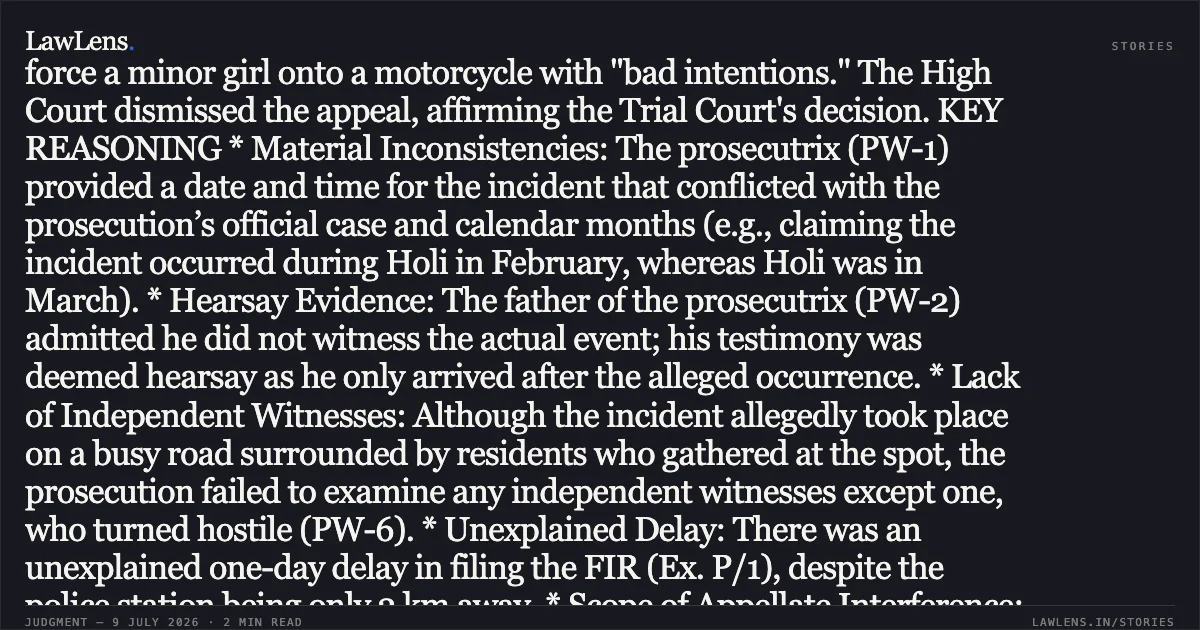
### Judgment Summary: Criminal Appeal No. 1199 of 2021 LEGAL HEADLINE Acquittal upheld where prosecutrix’s testimony lacks independent corroboration and contains material inconsistencies regarding the incident. OVERVIEW The State of Madhya Pradesh appealed against the acquittal of Rajesh Mishra and Babulal Thakur, who were charged under Section 354 of the IPC and Sections 7/8 of the POCSO Act. The prosecution alleged that the accused attempted to force a minor girl onto a motorcycle with "bad intentions." The High Court dismissed the appeal, affirming the Trial Court's decision. KEY REASONING * Material Inconsistencies: The prosecutrix (PW-1) provided a date and time for the incident that conflicted with the prosecution’s official case and calendar months (e.g., claiming the incident occurred during Holi in February, whereas Holi was in March). * Hearsay Evidence: The father of the prosecutrix (PW-2) admitted he did not witness the actual event; his testimony was deemed hearsay as he only arrived after the alleged occurrence. * Lack of Independent Witnesses: Although the incident allegedly took place on a busy road surrounded by residents who gathered at the spot, the prosecution failed to examine any independent witnesses except one, who turned hostile (PW-6). * Unexplained Delay: There was an unexplained one-day delay in filing the FIR (Ex. P/1), despite the police station being only 2 km away. * Scope of Appellate Interference: Following the principles in *H.D. Sundara v. State of Karnataka (2023)*, the Court held that if the Trial Court’s view is a "possible view," the appellate court cannot overturn an acquittal simply because another view might exist. CONCLUSION The High Court found no perversity or manifest error in the Trial Court’s findings. Since the prosecution failed to prove the charges beyond a reasonable doubt, the acquittal was affirmed.

The State Of Madhya Pradeshv.Rajesh Mishra

### Judgment Summary: Criminal Appeal No. 1199 of 2021 LEGAL HEADLINE Acquittal upheld where prosecutrix’s testimony lacks independent corroboration and contains material inconsistencies regarding the incident. OVERVIEW The State of Madhya Pradesh appealed against the acquittal of Rajesh Mishra and Babulal Thakur, who were charged under Section 354 of the IPC and Sections 7/8 of the POCSO Act. The prosecution alleged that the accused attempted to force a minor girl onto a motorcycle with "bad intentions." The High Court dismissed the appeal, affirming the Trial Court's decision. KEY REASONING * Material Inconsistencies: The prosecutrix (PW-1) provided a date and time for the incident that conflicted with the prosecution’s official case and calendar months (e.g., claiming the incident occurred during Holi in February, whereas Holi was in March). * Hearsay Evidence: The father of the prosecutrix (PW-2) admitted he did not witness the actual event; his testimony was deemed hearsay as he only arrived after the alleged occurrence. * Lack of Independent Witnesses: Although the incident allegedly took place on a busy road surrounded by residents who gathered at the spot, the prosecution failed to examine any independent witnesses except one, who turned hostile (PW-6). * Unexplained Delay: There was an unexplained one-day delay in filing the FIR (Ex. P/1), despite the police station being only 2 km away. * Scope of Appellate Interference: Following the principles in *H.D. Sundara v. State of Karnataka (2023)*, the Court held that if the Trial Court’s view is a "possible view," the appellate court cannot overturn an acquittal simply because another view might exist. CONCLUSION The High Court found no perversity or manifest error in the Trial Court’s findings. Since the prosecution failed to prove the charges beyond a reasonable doubt, the acquittal was affirmed.. The State Of Madhya Pradesh vs Rajesh Mishra. Madhya Pradesh High Court. LawLens
The LawLens card for this judgmentXLinkedInWhatsApp

In brief

The question

1. Whether the prosecution proved the age of the prosecutrix to establish the applicability of the POCSO Act.

The court held

The High Court answered the issues in the negative, holding that the prosecution failed to establish the guilt of the accused beyond reasonable doubt due to material contradictions and lack of independent corroboration.

It also directed

The appeal by the State was dismissed, and the acquittal of Rajesh Mishra and Babulal Thakur was upheld.

01Facts

On February 9, 2018, the 15-year-old prosecutrix alleged that while she was moving idols into her house, the accused (Rajesh and Babulal) arrived on a motorcycle and caught hold of her hand with "bad intentions".

¶ 2

Her father (PW-2) rushed out upon hearing her screams, causing the duo to flee.

¶ 2

The trial court (XVIII ASJ/Special Judge POCSO) acquitted the respondents on February 25, 2020, citing failure to prove the case beyond reasonable doubt.

¶ 6

The State appealed this acquittal, contending that the testimonies of the minor prosecutrix and her father were sufficient for conviction despite the lack of independent witnesses.

¶ 7

02Issues

i.1. Whether the prosecution proved the age of the prosecutrix to establish the applicability of the POCSO Act.

¶ 10

ii.2. Whether the testimonies of PW-1 (prosecutrix) and PW-2 (father) were reliable and consistent enough to sustain a conviction under Section 354 IPC and Sections 7/8 of the POCSO Act.

¶ 11

iii.3. Whether the High Court should interfere with a trial court’s judgment of acquittal when an alternative view might be possible.

¶ 15, 16

03Law Applied

Section 354 of the Indian Penal Code (outraging modesty) and Sections 7 and 8 of the Protection of Children from Sexual Offences (POCSO) Act, 2012.

¶ 4

Section 378 of the CrPC regarding appeals against acquittal.

¶ 1

The court relied on the "Presumption of Innocence" reinforced by acquittal, as established in H.D. Sundara v. State of Karnataka (2023), Babu Sahebagouda Rudragoudar v. State of Karnataka (2024), and Mallappa v. State of Karnataka (2024), which mandate that appellate courts should not reverse an acquittal if the trial court’s view is a "legally plausible view".

¶ 16, 17, 18-20

Provisions in the judgment · 5 · Linked ones open on LawLens

Code of Criminal Procedure, 1973 Section 378Section 161

Indian Penal Code, 1860 Section 354

Protection of Children from Sexual Offences Act, 2012 Section 7Section 8

04Reasoning

The Court observed that while the prosecutrix was a minor (15-16 years), her testimony contained material inconsistencies regarding the timing of the incident—stating it occurred during Holi (March) rather than February.

¶ 10, 11

PW-2 (the father) admitted he did not witness the actual incident, rendering his testimony hearsay.

¶ 11

The Court identified unexplained delays in filing the FIR and found the prosecutrix's statement that the spot map was signed while blank to be a significant procedural lapse.

¶ 14

Applying the Mallappa principles, the Court reasoned that the trial court’s appreciation of evidence was comprehensive and its conclusion of a "doubtful case" was a reasonable possibility.

¶ 21

05Holding

The High Court answered the issues in the negative, holding that the prosecution failed to establish the guilt of the accused beyond reasonable doubt due to material contradictions and lack of independent corroboration.

¶ 15, 21

The appeal by the State was dismissed, and the acquittal of Rajesh Mishra and Babulal Thakur was upheld.

¶ 22
Madhya Pradesh High Court

Original Court PDF

The State Of Madhya PradeshvsRajesh Mishra

Madhya Pradesh High Court · June 29, 2026

Click to open original judgment

Original judgment, available to read, download and summarize on LawLens.in
Click to open original judgment