Facts
The petitioner filed a writ petition under Article 226 of the Constitution seeking directions to the Principal Judge, Family Court, Darbhanga, in Maintenance Case No. 66 of 2023.
Source reference: p. 1, para. 1She sought preservation and production of CCTV footage from Darbhanga Sadar Police Station relating to 27 and 28 June 2022, alleging that the footage would establish the circumstances of her alleged marriage, coercion, and the conduct of the private respondents.
Source reference: p. 1, para. 1She also sought directions concerning her status as the wife of Respondent No. 5, alleged acts of the private respondents, and the addition of appropriate offences to FIR No. 51 of 2022, stated to be pending before the Additional Sessions Judge-I, Darbhanga.
Source reference: pp. 2–3, para. 1; p. 4, para. 2Issues
Whether a writ petition under Article 226 of the Constitution is maintainable for seeking directions against the Principal Judge, Family Court, Darbhanga, in relation to pending judicial proceedings in Maintenance Case No. 66 of 2023?
Source reference: p. 3, para. 2Whether the High Court could entertain, in the present writ petition, the petitioner’s grievances concerning FIR No. 51 of 2022 and proceedings pending before the Additional Sessions Judge-I, Darbhanga?
Source reference: p. 4, para. 2Law Applied
The Court applied Article 226 of the Constitution of India and the settled principle that writ jurisdiction cannot ordinarily be invoked to control or interfere with judicial proceedings or orders of a competent court.
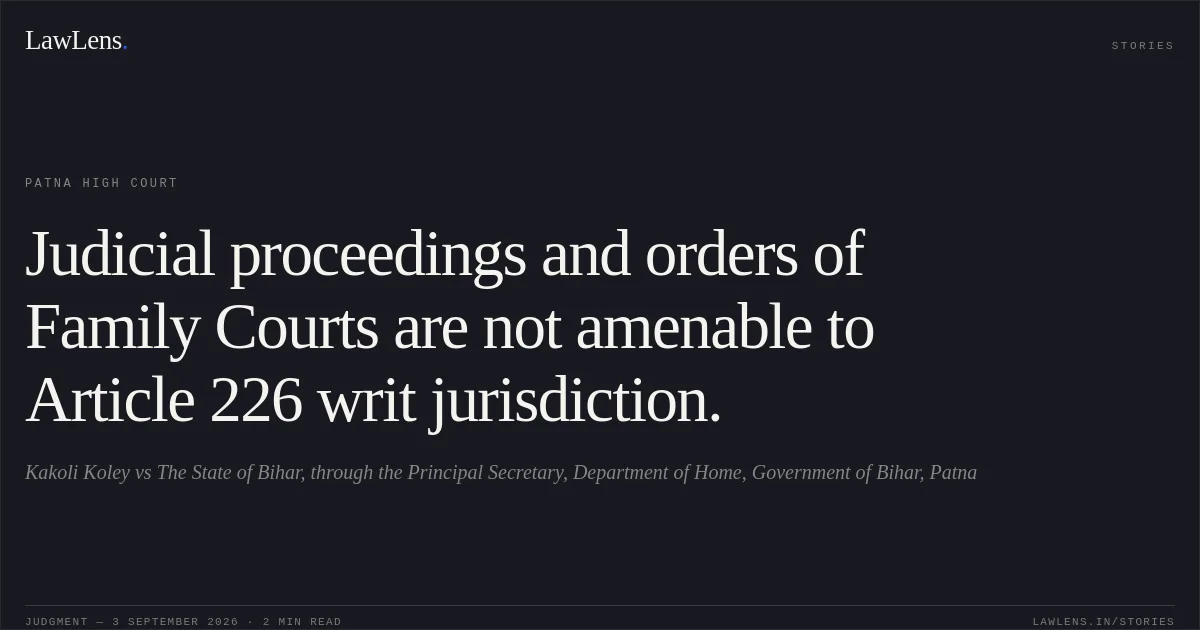
Source reference: p. 4, para. 2Judicial proceedings and orders are not amenable to writ jurisdiction in the manner sought by the petitioner.
Source reference: p. 4, para. 2The Court further applied the principle that a litigant aggrieved by the functioning or orders of a Family Court must pursue the appropriate remedy before the competent forum and that grievances relating to a pending criminal case must be raised in the proceedings or forum having jurisdiction over that case.
Source reference: p. 4, paras. 2–3Reasoning
The Court examined the reliefs sought and found that the petition was directed principally against the manner in which the Family Court was dealing with the petitioner’s application in the pending maintenance case.
Source reference: p. 3, para. 2Since the reliefs required the High Court to issue directions concerning the conduct of judicial proceedings and to require the Family Court to examine evidence, summon persons, determine marital status, and address alleged offences, the Court held that the petition was misconceived and not maintainable under Article 226.
Source reference: pp. 3–4, para. 2The additional reliefs concerning FIR No. 51 of 2022 also could not be entertained because that matter was pending before the competent criminal court and involved allegations against private respondents.
Source reference: p. 4, para. 2The Court therefore left the petitioner to pursue appropriate remedies before the appropriate forum.
Source reference: p. 4, para. 3Holding
The High Court held that the writ petition was not maintainable because it sought interference with judicial proceedings of the Family Court and with a pending criminal case.
The petition was accordingly disposed of, with liberty to the petitioner to seek appropriate relief through an appropriate proceeding before the competent forum.
Source reference: p. 4, para. 3No direction was issued for preservation or production of the CCTV footage, alteration of the FIR, determination of the petitioner’s marital status, or interference with the pending proceedings.
Source reference: no citationOriginal Court PDF
Kakoli KoleyvsThe State of Bihar, through the Principal Secretary, Department of Home, Government of Bihar, Patna
Click to open original judgment
Original judgment, available to read, download and summarize on LawLens.in