Facts
The respondents are employees of the Indian Audit and Accounts Department (IAAD) under the Comptroller Auditor General of India (CAGI).
Source reference: p. 3They were on deputation at stations where their spouses were posted. Per a 2025 Deputation Policy, they were repatriated to parent postings after completing seven years.
Source reference: p. 3The respondents challenged this before the Central Administrative Tribunal (CAT), which, by judgment dated 15 April 2026, disapproved of the 2025 Policy, ordered its reconsideration on specific lines, and stayed the repatriations.
Source reference: p. 3-4During the pendency of this writ petition filed by the CAGI, the respondents joined their parent postings.
Source reference: p. 4-5Issues
1. Whether the Central Administrative Tribunal was justified in disapproving the 2025 Deputation Policy and directing its reconsideration despite a contrary ruling by the Jharkhand High Court.
Source reference: p. 6, 92. Whether a Court or Tribunal has the jurisdiction to direct the executive to frame or modify a policy along specific lines.
Source reference: p. 11Law Applied
The Court applied the principle that transfer is an incident of service and an employee holds no fundamental or indefeasible right to claim a posting of choice.
Source reference: p. 6, para. 18It relied on SK Nausad Rahaman v. Union of India [para. 23-27] and Bank of India v. Jagjit Singh Mehta [p. 7], establishing that spousal posting guidelines are subject to administrative exigencies and do not confer legally enforceable rights.
Source reference: p. 8It further followed Adwin Vinifred Tirkey v. Union of India (Jharkhand High Court), which explicitly upheld the validity of the 2025 Policy.
Source reference: p. 4, 9It cited Union of India v. K. Pushpavanam to affirm that courts cannot direct the executive to frame or modify policies.
Source reference: p. 11Reasoning
The Court observed that the CAT failed to follow the Jharkhand High Court’s decision in Adwin Vinifred Tirkey, which dealt with the same policy and similar facts.
Source reference: p. 9It held that the CAT, being hierarchically lower, cannot rule contrary to a High Court's judgment without cogent grounds for distinction, which were absent here.
Source reference: p. 10The Court reasoned that the 2025 Policy successfully balanced administrative needs with personal concerns, as already determined in previous litigation.
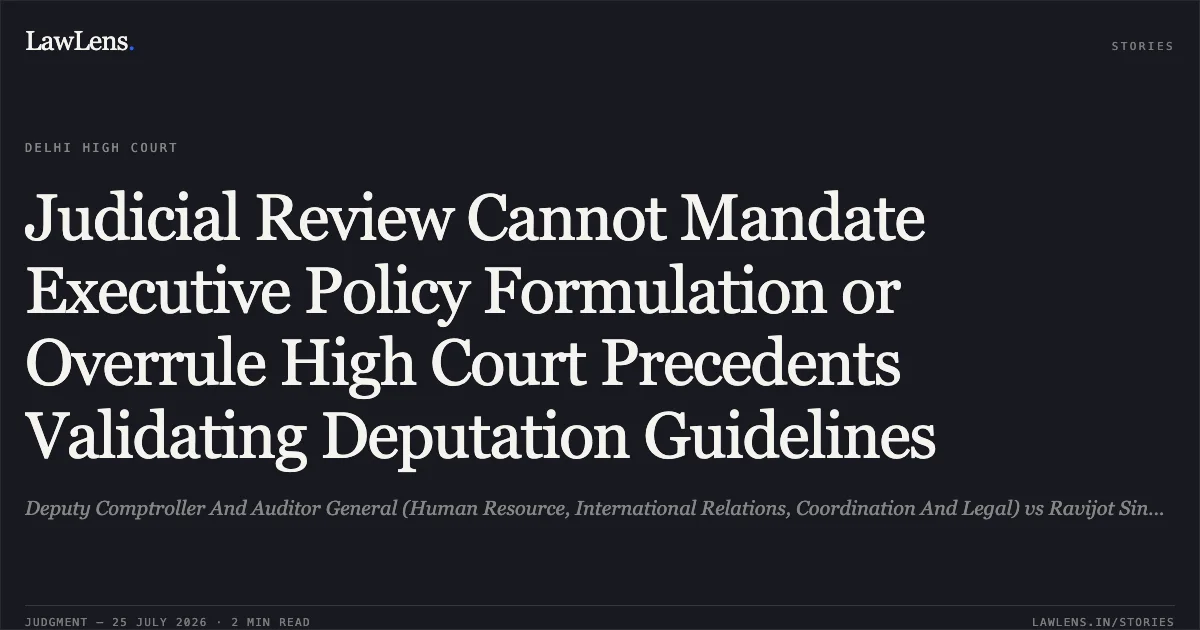
Source reference: p. 11The Court found that the CAT exceeded its jurisdiction by not only ordering a policy review but also prescribing the specific "lines" and "mechanisms" the revised policy should follow, which violates the separation of powers regarding executive policy-making.
Source reference: p. 11Holding
The Court allowed the writ petitions and set aside the CAT’s judgment insofar as it disapproved and directed the reframing of the 2025 Policy.
The Court held that the direction to maintain status quo on postings no longer survived as respondents had already joined their parent cadres. However, the Court granted liberty to the respondents to represent their cases under the DoPT OM dated 30 September 2009.
Source reference: p. 12-13Original Court PDF
Deputy Comptroller And Auditor General (Human Resource, International Relations, Coordination And Legal)vsRavijot Singh & Ors.
Click to open original judgment
Original judgment, available to read, download and summarize on LawLens.in