Facts
The Petitioner, a retired Forest Officer, filed a Public Interest Litigation (PIL) challenging the State’s method of purchasing tendu leaves (tendupatta).
Source reference: para. 4-5Under the Chhattisgarh Tendupatta (Vyapar Viniyaman) Adhiniyam, 1964, the State is required to fix a "purchase price" based on committee recommendations.
Source reference: para. 4-5However, via an order dated 03-11-2009, the State directed that 80% of net profits be distributed to collectors (Sangrahaks) as incentive wages rather than paying a fixed purchase price at the time of collection.
Source reference: para. 9The Petitioner argued this model violates the 1964 Act and is repugnant to the Forest Rights Act, 2006, which recognizes forest dwellers as owners of minor forest produce.
Source reference: para. 12-13The State maintained that Respondent No. 4 (a Cooperative Sangh) acts as an authorized "agent" under the Act and the profit-sharing model is a socio-economic policy to protect dwellers from middlemen.
Source reference: para. 15-16Issues
1. Whether the impugned order dated 03-11-2009 overreaches the legislative mandate of the Adhiniyam, 1964 or is repugnant to the Forest Rights Act, 2006.
Source reference: para. 13, 242. Whether the Court can interfere in the State’s economic and socio-economic policy regarding tendupatta trade under Article 226.
Source reference: para. 19, 243. Whether the PIL is maintainable in light of a twelve-year delay in challenging the 2009 order.
Source reference: para. 25Law Applied
The Court applied the Chhattisgarh Tendupatta (Vyapar Viniyaman) Adhiniyam, 1964, specifically Section 4 (appointment of agents) and Section 5 (restriction on purchase/transport), which establishes a State monopoly.
Source reference: para. 15It relied on the 11 principles governing PIL interference from Guruvayoor Devaswom Managing Committee v. C.K. Rajan.
Source reference: para. 23The Court invoked the doctrine of judicial restraint in policy matters as established in Narmada Bachao Andolan v. Union of India (avoiding transgression into policy fields).
Source reference: para. 24Shri Sitaram Sugar Co. Ltd. v. Union of India (judicial review not concerned with economic policy wisdom).
Source reference: para. 26Kirloskar Ferrous Industries Ltd. v. Union of India (courts should not replace policymakers' specialized judgments with their own).
Source reference: para. 27Reasoning
The Court observed that Respondent No. 4 is a legally appointed agent under Section 4 of the Adhiniyam, 1964, making its trade activities lawful.
Source reference: para. 24It found that the 2009 order was an executive instruction that did not abrogate the statute but facilitated a profit-sharing model beneficial to forest dwellers.
Source reference: para. 24, 29Applying the "economic policy" test, the Court reasoned that the tendupatta trade is a complex socio-economic system designed to provide a level playing field for dwellers with unequal bargaining power.
Source reference: para. 29, 31The Court emphasized that it lacks the expertise to second-guess the wisdom of such redistributive policies.
Source reference: para. 27The Court noted that the Petitioner failed to demonstrate any actual exploitation or loss to the public exchequer.
Source reference: para. 18, 28The Court held that the challenge, brought twelve years after the order's issuance, was barred by laches and lacked compelling public interest.
Source reference: para. 25, 33Holding
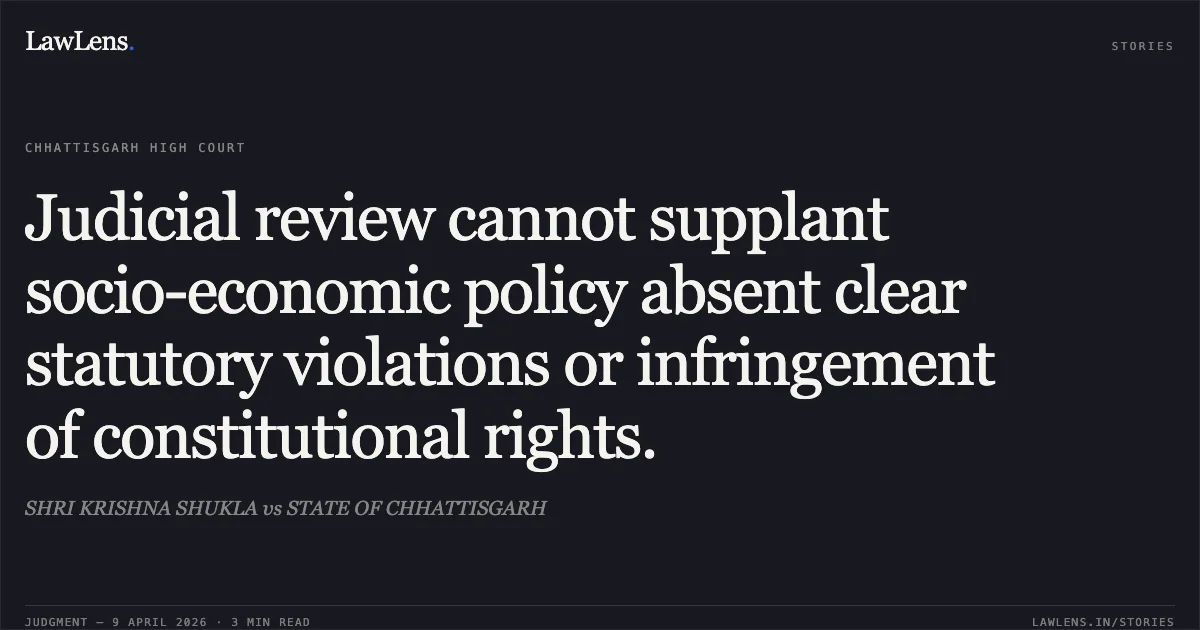
The Court dismissed the writ petition, holding that the State’s trade model is a valid socio-economic policy that does not violate the Adhiniyam, 1964 or constitutional provisions.
The Court directly answered that it would not invoke powers of judicial review to interfere in the State's economic policy decisions regarding the purchase and sale of tendupatta.
Source reference: para. 32The petition was dismissed on merits as well as on grounds of delay and laches.
Source reference: para. 33Acts & Sections Cited
2 provisions across 1 statute referred to in this judgment. Each provision opens on LawLens.
Original Court PDF
SHRI KRISHNA SHUKLAvsSTATE OF CHHATTISGARH
Click to open original judgment
Original judgment, available to read, download and summarize on LawLens.in