Facts
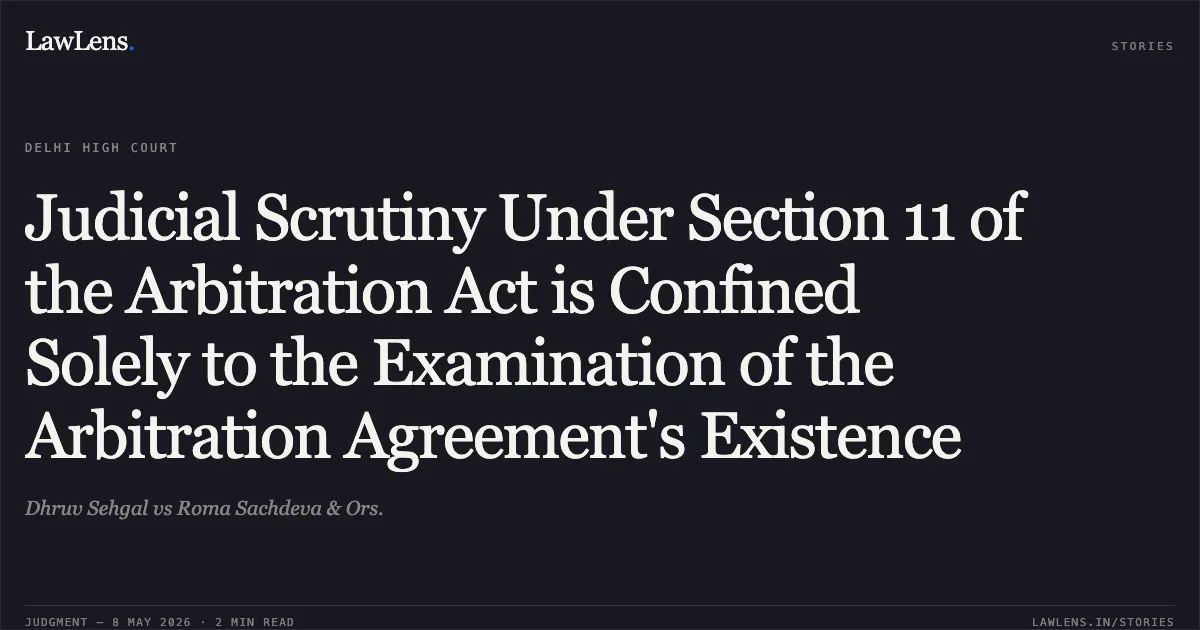
The Petitioner filed an application under Section 11(6) of the Arbitration and Conciliation Act, 1996, seeking the appointment of an arbitrator based on Clause 33 of a Collaboration Agreement dated 03.04.2019.
Source reference: p.1, 2Statutory notice under Section 21 was served on 07.11.2024.
Source reference: p.2During proceedings, Respondents 1 to 3 were deleted, leaving the dispute confined to the Petitioner and Respondent No. 4.
Source reference: p.2Respondent No. 4 resisted the reference, alleging the Petitioner failed to perform contractual obligations, committed fraud, and claiming financial inability to bear arbitration costs.
Source reference: p.2Issues
1. Whether the Court, under Section 11 of the Act, can adjudicate on merits such as non-performance of contractual obligations or allegations of fraud.
Source reference: p.2 / para. 82. Whether the financial condition of a party is a valid ground for the Referral Court to refuse the appointment of an arbitrator.
Source reference: p.2 / para. 93. What is the scope and standard of judicial scrutiny by a Referral Court following recent Supreme Court precedents.
Source reference: p.3 / para. 11Law Applied
Section 11(6) and 11(6-A) of the Arbitration and Conciliation Act, 1996.
Source reference: p.1, 3The Court relied on the three-judge Bench decision in SBI General Insurance Co. Ltd. v. Krish Spinning, which integrated the seven-judge Bench ruling in Interplay Between Arbitration Agreements under Arbitration Act, 1996 & Stamp Act, 1899, In re.
Source reference: p.3These precedents establish that judicial interference under Section 11 is confined strictly to a prima facie examination of the existence of an arbitration agreement.
Source reference: p.4The "eye of the needle" and "ex facie meritless" tests have been curtailed to uphold arbitral autonomy and the principle of negative competence-competence.
Source reference: p.5Reasoning
The Court noted that the Respondent’s objections regarding non-performance and fraud pertained to the merits of the dispute, which are within the exclusive domain of the Arbitral Tribunal.
Source reference: p.2Similarly, the objection regarding financial incapacity was ruled to be outside the limited Section 11 jurisdiction.
Source reference: p.2Citing Krish Spinning, the Court emphasized that the Referral Court must not engage in "contested or laborious enquiry" and should limit its role to a formal verification of the written agreement.
Source reference: p.4The Court observed that even issues like "accord and satisfaction" or "frivolity" are better handled by the Tribunal, which has the benefit of full evidentiary material.
Source reference: p.5, 6Since the existence of the arbitration clause was not in doubt, the Court held that it must facilitate the parties' original intent to arbitrate.
Source reference: p.5Holding
The Court allowed the petition and appointed Ms. Nayantara Roy, Advocate, as the Sole Arbitrator.
It held that the scope of Section 11 is narrow and procedural, intended only to resolve deadlocks in appointment.
Source reference: p.6The arbitration will be conducted under the aegis of the Delhi International Arbitration Centre (DIAC).
Source reference: p.7All rights and contentions on merits, including fraud and non-performance, were left open for the Arbitrator’s adjudication.
Source reference: p.7Acts & Sections Cited
7 provisions across 1 statute referred to in this judgment. Each provision opens on LawLens.
Arbitration and Conciliation Act, 19967
Original Court PDF
Dhruv SehgalvsRoma Sachdeva & Ors.
Click to open original judgment
Original judgment, available to read, download and summarize on LawLens.in