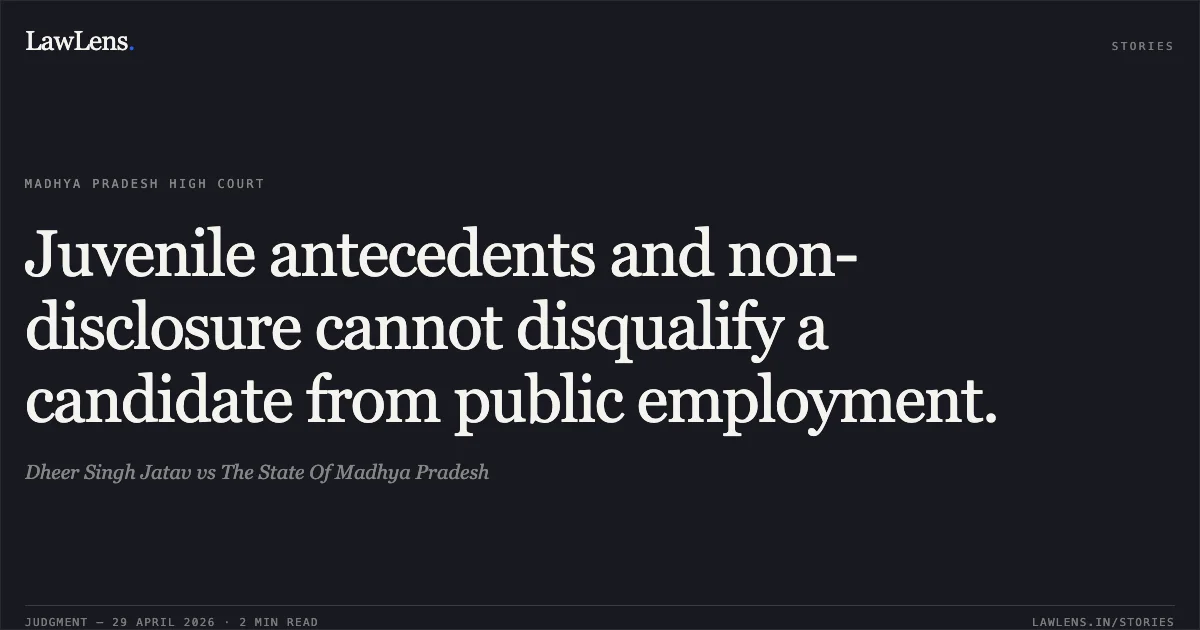
Facts
The petitioner (born 07.02.1985) was involved in a criminal case in 2002 while he was a minor. He was subsequently acquitted on 28.12.2002 based on a compromise.
Source reference: p. 1-2In 2013, the petitioner was selected and joined as a Forest Guard. However, on 03.01.2015, the respondents issued an order removing him from service on the grounds that he suppressed information regarding his criminal history in his affidavit and verification form.
Source reference: p. 2The petitioner challenged this removal, asserting his protection as a juvenile at the time of the alleged offense.
Source reference: p. 2Issues
1. Whether the respondents failed to consider the statutory protections afforded to juveniles under the Juvenile Justice Act when passing the order of removal.
Source reference: p. 32. Whether the non-disclosure of a criminal case involving a juvenile constitutes valid grounds for termination of service without considering the merits of the acquittal and the nature of the offense.
Source reference: p. 3Law Applied
Section 25 of the Juvenile Justice Act, 1986 (corresponding to Section 24 of the 2015 Act), which stipulates that a juvenile who has committed an offense shall not suffer disqualification attaching to a conviction.
Source reference: p. 2Precedent set by the Hon'ble Supreme Court in Union of India and Others v. Ramesh Bishnoi (2019) 19 SCC 710, which protects candidates from the adverse effects of juvenile records during recruitment processes.
Source reference: p. 2Reasoning
The court observed that the respondents passed the impugned order dated 03.01.2015 without considering the legal implications of the petitioner’s age at the time of the offense or the specific protections under Section 25 of the Juvenile Justice Act.
Source reference: p. 3The State’s counsel conceded that these aspects, along with the principles laid down in Ramesh Bishnoi, were not pondered during the decision-making process.
Source reference: p. 3Furthermore, the court noted that the petitioner was not afforded an opportunity of being heard prior to his removal, violating principles of natural justice.
Source reference: p. 3Holding
The court disposed of the petition by directing the petitioner to submit a fresh representation to the competent authority within one month.
The respondents are directed to decide said representation afresh within three months, specifically considering Section 25 of the Juvenile Justice Act and the Ramesh Bishnoi judgment, and providing the petitioner with a personal hearing. The court clarified that the new decision must be made without being influenced by the earlier rejection order.
Source reference: p. 3-4Acts & Sections Cited
7 provisions across 1 statute referred to in this judgment. Each provision opens on LawLens.
Indian Penal Code, 18607
Original Court PDF
Dheer Singh JatavvsThe State Of Madhya Pradesh
Click to open original judgment
Original judgment, available to read, download and summarize on LawLens.in


