Facts
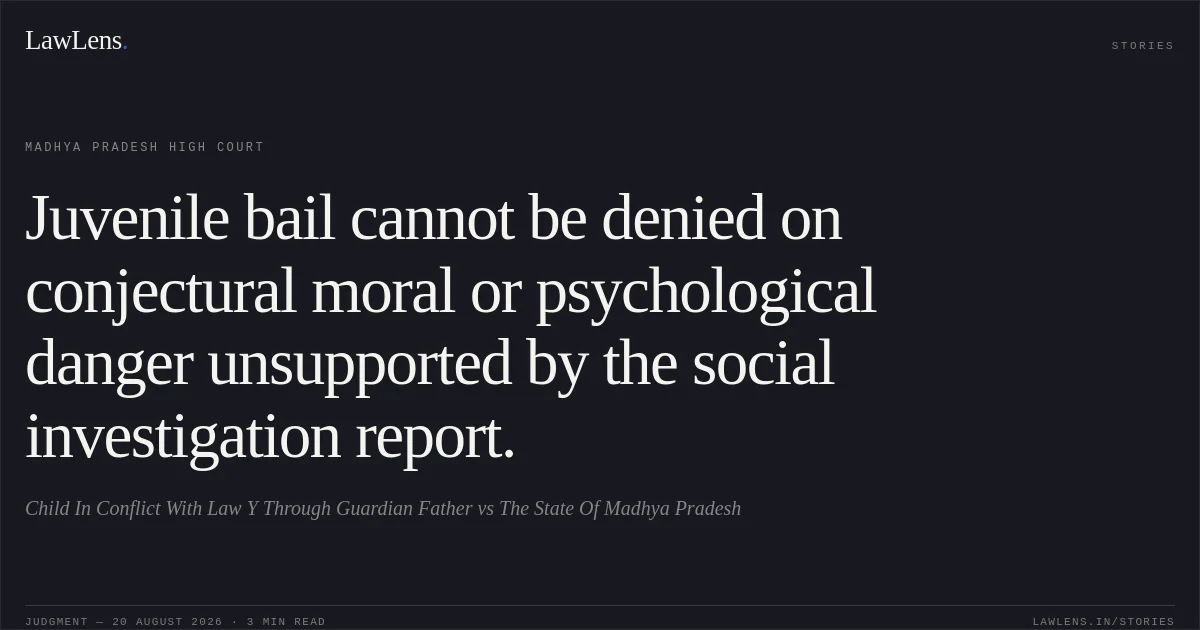
The applicant, a Child in Conflict with Law (‘Y’), was implicated in Crime No. 199/2026 registered under Section 140(3) of the Bharatiya Nyaya Sanhita after Manish, aged 22 years, was reported missing following a quarrel with Mayank.
Source reference: paras. 3–4During investigation, co-accused Mahendra @ Mayank allegedly disclosed the abduction and murder of Manish and named ‘Y’ in his memorandum; ‘Y’ was arrested on 03.05.2026 and was not named in the FIR.
Source reference: paras. 3–4An application for release under Section 12 of the Juvenile Justice (Care and Protection of Children) Act, 2015 was rejected by the Juvenile Justice Board, Ratlam, on 05.06.2026.
Source reference: para. 5The appellate court dismissed the appeal under Section 101 of the Act on 11.06.2026, holding that release could expose the child to moral and psychological danger and defeat the ends of justice.
Source reference: para. 5Issues
1. Whether the Juvenile Justice Board and the appellate court erred in refusing to release the Child in Conflict with Law on bail under Section 12 of the Juvenile Justice Act, 2015.
Source reference: paras. 5–72. Whether the findings that release would expose the child to moral or psychological danger or defeat the ends of justice were supported by the record.
Source reference: paras. 6, 9–133. Whether the impugned orders suffered from material irregularity warranting interference in revisional jurisdiction under Section 102 of the Juvenile Justice Act, 2015.
Source reference: paras. 1–2, 13–14Law Applied
The Court applied Sections 12, 101 and 102 of the Juvenile Justice (Care and Protection of Children) Act, 2015.
Source reference: paras. 1–2, 5Section 12 governs the release of a child alleged to be in conflict with law on bail, subject to the statutory exceptions relating to the likelihood of association with known criminals, exposure to moral, physical or psychological danger, or defeat of the ends of justice.
Source reference: para. 5Section 101 provides the appellate remedy against an order of the Juvenile Justice Board, while Section 102 confers revisional jurisdiction on the High Court.
Source reference: paras. 1–2The Court also applied the principle that continued detention of a juvenile must be justified by the statutory grounds and that the child’s best interests, rehabilitation, supervision and welfare are central considerations under the juvenile justice framework.
Source reference: paras. 11–13Reasoning
The High Court found that the lower courts had relied on the possibility of moral and psychological harm and the alleged defeat of justice without adequately appreciating the record.
Source reference: paras. 6, 12The social investigation report indicated that ‘Y’ had behaved well in the institution and that the child’s educational and welfare interests were being considered; he had also enrolled for the Class 10 examination through the MP Open School Board.
Source reference: para. 11The Court further considered the family’s educational background and the fact that the parents had shifted from the place of the dispute to Indore, reducing the likelihood of the child associating with known criminal persons.
Source reference: para. 12In these circumstances, the Court held that the statutory concerns relied upon by the courts below were misdirected and that continued detention was unwarranted.
Source reference: paras. 12–14The impugned orders therefore suffered from material irregularity and required revisional interference.
Source reference: paras. 12–14Holding
The criminal revision was allowed.
The High Court set aside the appellate order dated 11.06.2026 and the Juvenile Justice Board’s order dated 05.06.2026.
Source reference: para. 14‘Y’ was directed to be released into the custody of his natural guardian upon furnishing a personal bond of ₹50,000 with one solvent surety in the like amount, subject to conditions requiring cooperation with the investigation or trial, non-interference with witnesses, abstention from similar offences, avoidance of unnecessary adjournments, supervision and maintenance by the guardian, protection from contact with known criminals or other dangers, monthly reporting to the Probation Officer, and regular appearance before the Juvenile Justice Board.
Source reference: para. 15A certified copy of the order was directed to be sent to the concerned Juvenile Justice Board/Court for compliance.
Source reference: para. 17Acts & Sections Cited
4 provisions across 2 statutes referred to in this judgment. Each provision opens on LawLens.
Juvenile Justice (Care and Protection of Children) Act, 2015.3
Bharatiya Nyaya Sanhita, 20231
Original Court PDF
Child In Conflict With Law Y Through Guardian FathervsThe State Of Madhya Pradesh
Click to open original judgment
Original judgment, available to read, download and summarize on LawLens.in