Facts
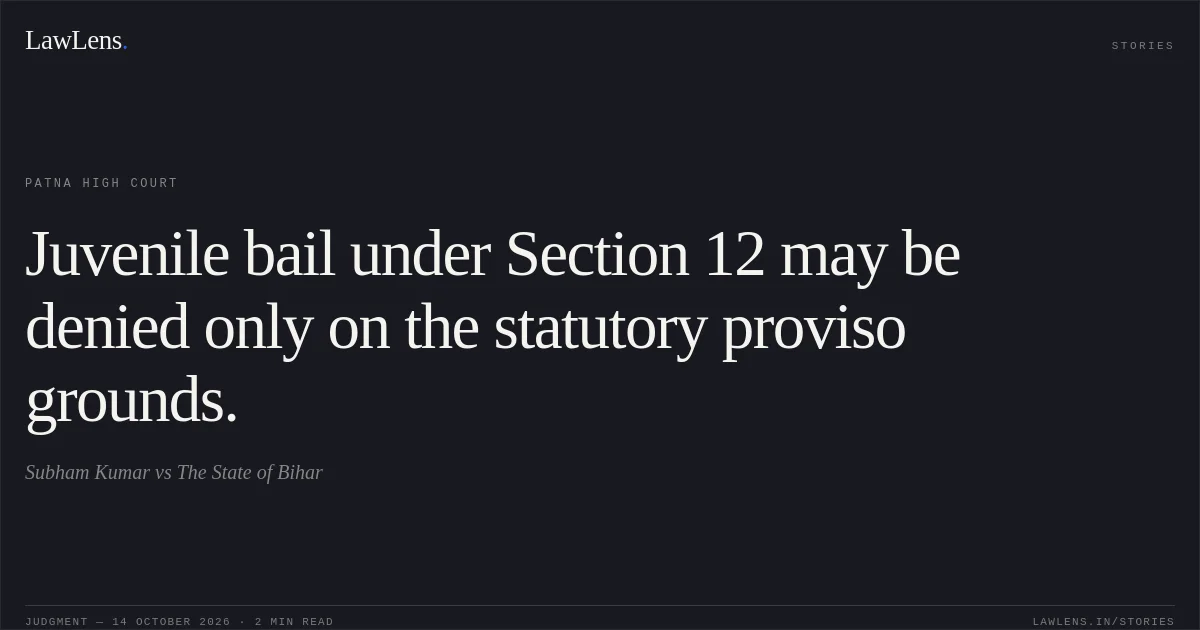
The appellant, a child in conflict with law, challenged the Children Court’s order rejecting his application for bail under Section 12 of the Juvenile Justice (Care and Protection of Children) Act, 2015, in a case registered for offences including murder and offences under the Arms Act
Source reference: p. 1The prosecution alleged that the appellant and others assaulted and killed the informant’s husband; the informant was not an eyewitness, and the appellant argued that the case against him rested on suspicion and hearsay
Source reference: pp. 2–4The Children Court rejected bail on the ground that the alleged offence was heinous
Source reference: pp. 3, 19–20The appellant had been in an observation home since 5 December 2025
Source reference: p. 4Issues
1. Whether the seriousness or heinous nature of the alleged offence is, by itself, a lawful ground to deny bail to a child in conflict with law under Section 12 of the JJ Act
Source reference: pp. 5–6, 18–202. Whether the Children Court’s refusal of bail could stand where it did not find that any of the grounds specified in the proviso to Section 12(1) applied
Source reference: pp. 19–20Law Applied
Section 12 of the Juvenile Justice (Care and Protection of Children) Act, 2015, overrides inconsistent bail provisions and makes release on bail the rule for a child in conflict with law.
Source reference: pp. 4–6Bail may be denied only where there are reasonable grounds to believe that release is likely to bring the child into association with a known criminal, expose the child to moral, physical or psychological danger, or defeat the ends of justice; the reasons and supporting circumstances must be recorded
Source reference: pp. 4–6The court relied on *Juvenile in Conflict with Law v. State of Rajasthan*, 2024 SCC OnLine SC 5297, and *Re-Exploitation of Children in Orphanages in the State of T.N. v. Union of India*, (2020) 14 SCC 327, among other decisions, for the requirement that the proviso’s grounds be specifically established
Source reference: pp. 6–8It also relied on the JJ Act’s rehabilitative purpose and the principles in Section 3, including the child’s best interests, family responsibility and institutionalisation as a last resort
Source reference: pp. 12–16Reasoning
The High Court found that the Children Court had refused bail solely because the alleged offence was heinous, a consideration that does not independently justify refusal under Section 12
Source reference: pp. 18–20On examining the case diary and charge-sheet, the Court also found that the prosecution case against the appellant rested on suspicion and hearsay, without legally cogent material connecting him to the alleged offence
Source reference: p. 19The impugned order contained no finding, supported by relevant material, that release would trigger any of the three statutory grounds for refusal; it was therefore inconsistent with Section 12
Source reference: pp. 19–20The Court further noted the importance of the child’s family in supporting rehabilitation and reintegration
Source reference: pp. 15–16, 19Holding
The High Court allowed the appeal, set aside the Children Court’s order and directed the appellant’s release on bail on furnishing a bond of ₹10,000, subject to affidavits and undertakings by his parents to supervise him, prevent contact with criminal persons, attend to his developmental needs, ensure his continued education, and secure his appearance before the Court when required
Acts & Sections Cited
10 provisions across 3 statutes referred to in this judgment. Each provision opens on LawLens.
Bharatiya Nyaya Sanhita, 20234
Arms Act, 19591
Juvenile Justice (Care and Protection of Children) Act, 2015.5
Original Court PDF
Subham KumarvsThe State of Bihar
Click to open original judgment
Original judgment, available to read, download and summarize on LawLens.in