Facts
The petitioner, mother of the detenue (Abhicyrill @ Abhi), challenged a detention order dated 11.12.2025 passed by the District Magistrate, Kolar, under the Karnataka Prevention of Dangerous Activities of Bootleggers, Drug-Offenders, Gamblers, Goondas, Immoral Traffic Offenders, Slum Grabbers and Video or Audio Pirates Act, 1985 ("1985 Act")
Source reference: p. 3-4The detention was based on ten criminal cases registered against the 19-year-old detenue between 2023 and 2025
Source reference: p. 5-6The petitioner argued that several of these offences occurred when the detenue was a juvenile (under 18 years), and thus, pursuant to Section 24 of the JJ Act, they could not form the basis for a detention order
Source reference: p. 4Issues
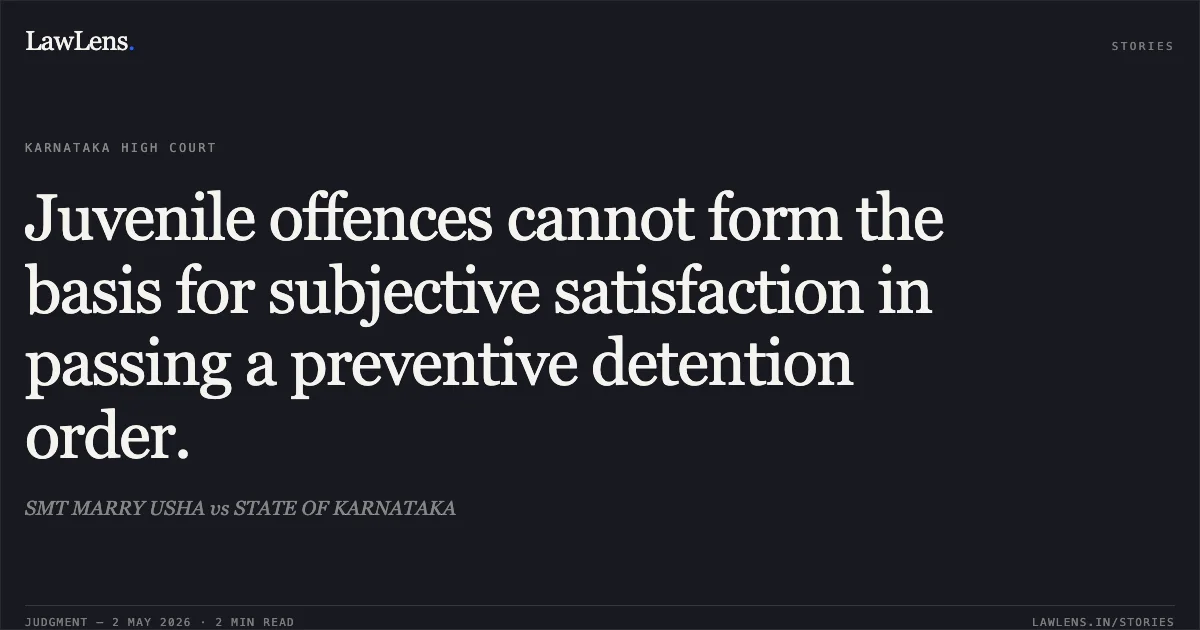
1. Whether criminal offences committed by a person while they were a juvenile (under 18 years of age) can be relied upon to form the subjective satisfaction required for a preventive detention order under the 1985 Act.
Source reference: p. 7 / para. 8-9Law Applied
Section 24 of the Juvenile Justice (Care and Protection of Children) Act, 2015 ("JJ Act"), which stipulates that a child who has committed an offence shall not suffer any disqualification attached to a conviction, notwithstanding any other law
Source reference: p. 8Section 2(12) of the JJ Act, defining a "child" as a person who has not completed 18 years of age
Source reference: p. 7The JJ Act is a beneficial legislation enacted under Article 15(3) of the Constitution of India to protect the human rights of children in alignment with international conventions
Source reference: p. 9The only exception to the removal of disqualification is under Section 19 of the JJ Act, where a child above 16 years is tried as an adult for a heinous offence
Source reference: p. 8-10Reasoning
The Court observed that the detenue was 19 years old at the time of the detention order, but many of the ten offences cited by the State—specifically those from 2023 and early 2024—were committed when the detenue was below 18 years of age
Source reference: p. 7The Court reasoned that the legislative intent of Section 24 of the JJ Act is to ensure that juvenile lapses do not result in lifelong legal disqualifications
Source reference: p. 9Since the detenue was not tried as an adult for heinous offences under the specific exceptions of the JJ Act, his juvenile record was legally protected from being used against him
Source reference: p. 9-10The Court concluded that the inclusion of these juvenile offences in the grounds for detention vitiated the detaining authority's "subjective satisfaction," as it directly contravened the statutory protections afforded to minors
Source reference: p. 10Holding
The Court held that a detention order based even partially on offences committed during the detenue's minority (unless falling under regulated exceptions) is illegal
The Court answered the issue in the negative, quashed the detention order dated 11.12.2025, and ordered the immediate release of the detenue from Central Prison, Bellary, provided he was not required in any other case
Source reference: p. 10-11Acts & Sections Cited
27 provisions across 4 statutes referred to in this judgment. Each provision opens on LawLens.
Juvenile Justice (Care and Protection of Children) Act, 2015.3
Indian Penal Code, 1860
Bharatiya Nyaya Sanhita, 2023
Arms Act, 19591
Original Court PDF
SMT MARRY USHAvsSTATE OF KARNATAKA
Click to open original judgment
Original judgment, available to read, download and summarize on LawLens.in


