01Facts
The petitioner was one of several family members who executed a sale deed dated 18 August 2018.
The Income Tax Department initiated reassessment proceedings for AY 2018–19, culminating in an assessment under Sections 147, 144 and 144B, a demand notice, and penalty-related proceedings.
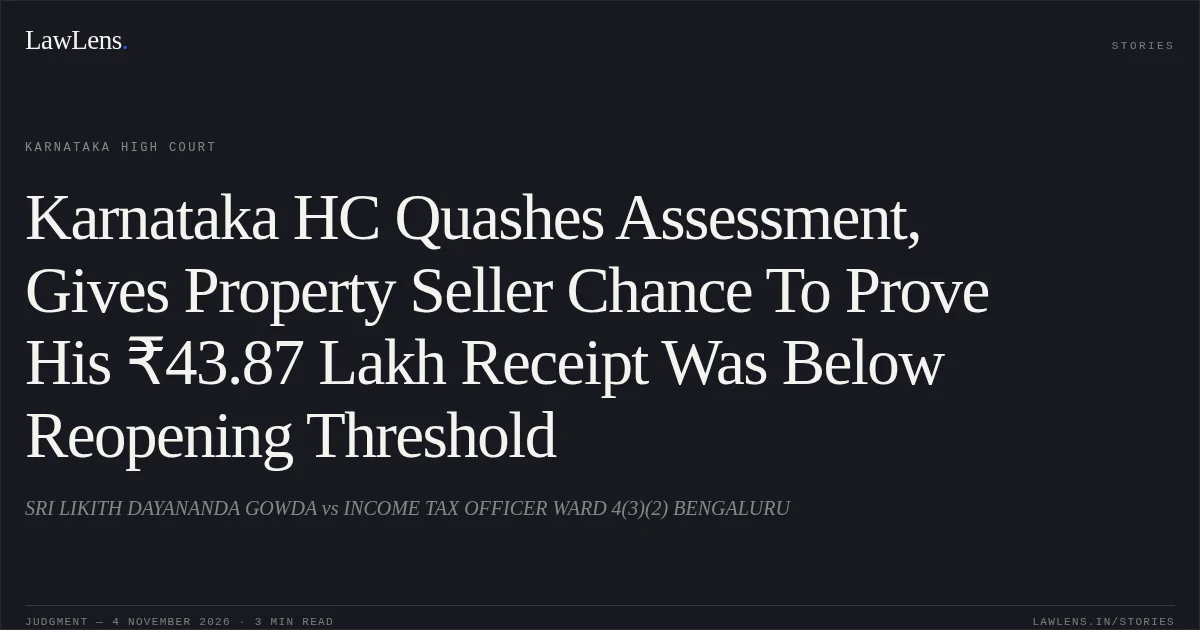
The petitioner contended that the Department had treated the entire sale consideration as his income, although he had received only ₹43,87,804, with corresponding TDS, and that this amount was below the ₹50 lakh threshold he said applied under Section 149.
pp. 3–5He had not responded during the Section 148A proceedings.
pp. 2–3He sought to quash the reopening proceedings and consequential orders.
pp. 2–302Issues
i.Whether the Court should interfere with the reassessment and penalty-related proceedings where the petitioner claimed that his share of the sale consideration was below the applicable Section 149 threshold but had not raised that contention during the Section 148A proceedings.
pp. 4–7ii.Whether the petitioner should be permitted to respond to the Section 148A(b) notice and substantiate his claim before the Department, with the consequential assessment and related proceedings set aside.
pp. 6–803Law Applied
The Court considered the reassessment framework under Sections 148A, 148 and 149 of the Income-tax Act, 1961, including the petitioner’s contention that the amount escaping assessment was below the threshold for commencing proceedings under Section 149 without the benefit of an extended limitation period.
pp. 4–5It also referred to Pramila Mahadev Tadkase v. Income Tax Officer, [2024] 158 taxmann.com 246, where the Court had intervened after a detailed response to a Section 148A notice was not considered; the present case was distinguishable because the petitioner had not filed a response or produced the sale deed at that stage.
p. 6The Court did not decide the Section 149 threshold question on its merits; it left the relevant questions open for consideration by the first respondent.
p. 8Provisions in the judgment · 9
Income Tax Act, 1961 9 provisions
Section 144Section 144BSection 147Section 148Section 148ASection 149Section 156Section 272ASection 27404Reasoning
The Court noted that the petitioner’s claim—that he received only ₹43,87,804 and that the balance of the sale consideration was distributed among the co-vendors—could potentially bear on whether the reassessment proceedings were maintainable.
pp. 5–6But the petitioner had not presented the sale deed or supporting evidence during the Section 148A inquiry, unlike the petitioner in Pramila Mahadev Tadkase.
pp. 5–6In view of the petitioner’s plea of bona fides, the Court considered limited interference appropriate: it restored the matter to the Section 148A stage so that the petitioner could submit the sale deed, evidence of remittances towards TDS, and appropriate affirmation from the co-vendors.
pp. 6–7It did not determine whether the petitioner’s claim was correct or whether the Section 149 threshold was met.
05Holding
The petition was allowed in part.
pp. 7–8The Court quashed the assessment order dated 19 January 2026, the consequential demand notice, the penalty show-cause notice, and the letter dated 22 July 2026.
pp. 7–8It directed the petitioner to respond to the Section 148A(b) notice by 26 November 2026, without further notice, and directed the first respondent to consider all questions, which remained open.
p. 8The Court did not quash the Section 148A(d) order or the Section 148 notice, nor did it decide the merits of the petitioner’s Section 149 threshold argument.
Original Court PDF
SRI LIKITH DAYANANDA GOWDAvsINCOME TAX OFFICER WARD 4(3)(2) BENGALURU
Click to open original judgment
Original judgment, available to read, download and summarize on LawLens.in