01Facts
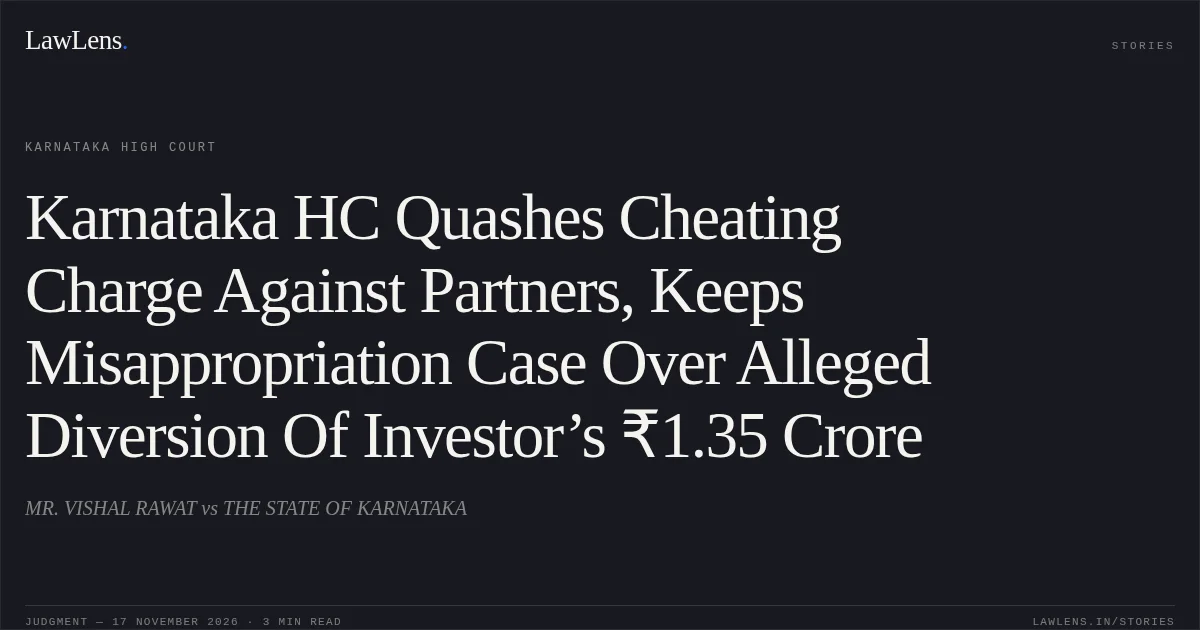
The complainant alleged that the petitioners induced him to invest in their partnership firm, Avante Exports, and promised repayment of the investment with a share of the profits.
pp. 5–6, 8–10Between 18 June 2015 and 12 February 2019, he transferred a total of ₹1,35,29,900: ₹65 lakh to the firm and the balance to the petitioners and their mother.
pp. 5–6, 8–10The police investigation allegedly showed that money credited to the firm was subsequently transferred to the petitioners’ and their mother’s personal accounts.
pp. 5–6, 8–10The complainant also alleged that the partnership was converted into a company and that purported share certificates issued to him lacked the company’s and directors’ seals and signatures.
pp. 5–6, 8–10On referral of the private complaint for investigation under Section 175(3) of the BNSS, the police filed a charge sheet for offences under Sections 403, 406, 420 read with Section 34 IPC.
pp. 3–4, 6–7The Magistrate took cognizance, and the petitioners sought to quash the charge sheet and subsequent proceedings.
pp. 3–4, 6–702Issues
i.1. Whether the complaint and charge-sheet materials disclosed the ingredients of cheating under Section 420 IPC, including dishonest intention at the inception of the transaction.
p. 6, 12, 16ii.2. Whether the alleged diversion of funds from the partnership account to the petitioners’ and their mother’s personal accounts disclosed offences under Sections 403 and 406 IPC.
pp. 16–19iii.3. Whether the Magistrate’s brief order taking cognizance warranted setting aside the proceedings for want of reasons or application of mind.
pp. 20–2103Law Applied
Sections 403 and 406 IPC address, respectively, dishonest misappropriation or conversion of movable property and punishment for criminal breach of trust; under Section 405 IPC, criminal breach of trust arises where a person entrusted with property dishonestly misappropriates or converts it, contrary to a direction of law or an express or implied legal contract.
pp. 17–18Section 420 IPC requires cheating, including dishonest inducement; the Court treated absence of an allegation of dishonest intention at the inception of the transaction as material to that offence.
p. 12, 16The Court considered Vijay Kumar Ghai v. State of West Bengal, V. Ganesan v. State, and Ms. Ann Nimmi Sebastian v. State of Karnataka, distinguishing them on their facts, and referred to its decision in Criminal Petition Nos. 101445/2022 and 101448/2022 for the proposition that a higher court may supplement reasons where an order taking cognizance lacks reasons.
pp. 11–16, 20Provisions in the judgment · 8 · Linked ones open on LawLens
Code of Criminal Procedure, 1973 Section 482
Bharatiya Nagarik Suraksha Sanhita, 2023 Section 175Section 528
Indian Penal Code, 1860 Section 34Section 403Section 405Section 406Section 420
04Reasoning
The complaint described an investment arrangement and did not allege that the petitioners intended to cheat the complainant when they sought his investment; accordingly, the materials did not disclose the requisite basis for proceeding under Section 420 IPC.
p. 12, 16The alleged diversion of money credited to the partnership account into the personal accounts of the petitioners and their mother, however, supported a prima facie inference that funds entrusted for the firm’s business had been dishonestly misappropriated or converted.
pp. 16–19The Court therefore found sufficient material to proceed under Sections 403 and 406 IPC, while noting that the petitioners could contest the circumstances of the transfers at trial.
pp. 16–19Although the Magistrate’s cognizance order was brief, that deficiency did not require quashing or remand; the High Court supplied reasons for upholding cognizance of the offences supported by the materials.
pp. 20–2105Holding
The petition was allowed in part.
p. 21The order taking cognizance under Section 420 IPC was set aside, but cognizance under Sections 403 and 406 IPC was upheld; the petitioners were to face trial for those offences read with Section 34 IPC.
p. 21The Court confined its observations to the petition under Section 528 BNSS.
p. 21Original Court PDF
MR. VISHAL RAWATvsTHE STATE OF KARNATAKA
Click to open original judgment
Original judgment, available to read, download and summarize on LawLens.in