01Facts
Respondent No. 3 filed a private complaint, registered as PCR No. 219/2021. On the Magistrate’s reference under Section 156(3) Cr.P.C., the police registered Crime No. 103/2021 and, after investigation, filed a ‘B’ final report.
pp. 4–5Respondent No. 3 filed a protest petition; the Magistrate thereafter took cognizance of various IPC offences and summoned the petitioners, who were police officers, without first obtaining sanction to prosecute them.
pp. 4–5The petitioners challenged that order. By memo, they confined the petition to PCR No. 219/2021, reserving liberty to challenge the cognizance order in PCR No. 214/2021 against respondent No. 2.
p. 302Issues
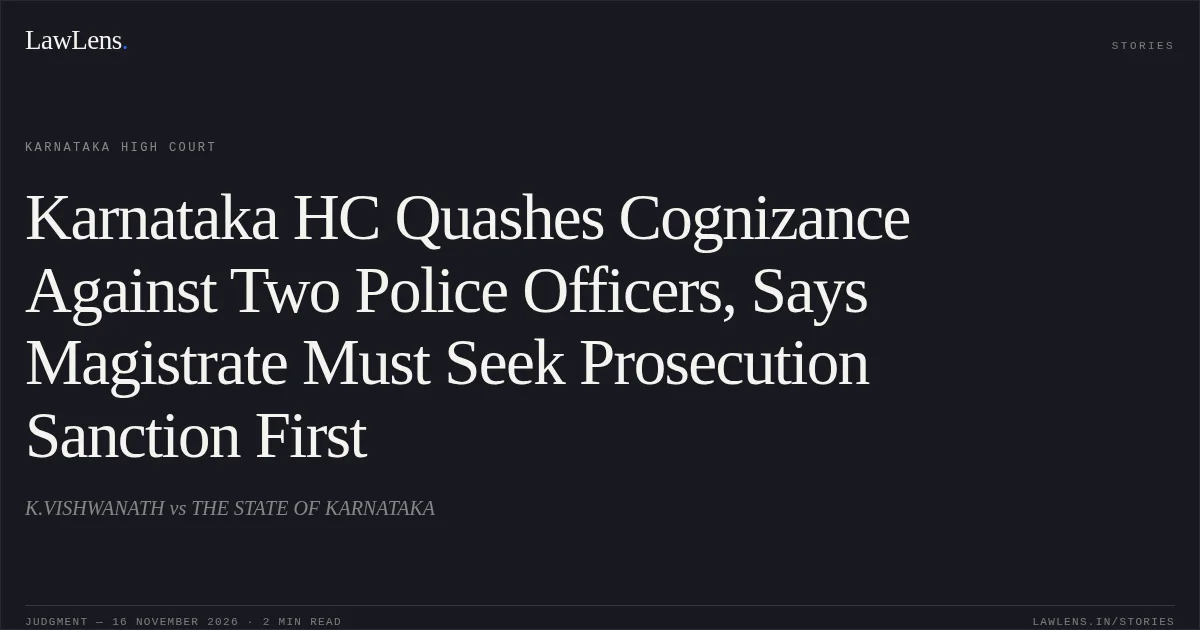
i.Whether the Magistrate could take cognizance and summon the petitioners, who were Government servants, without first obtaining sanction to prosecute them?
pp. 5–6, 11–13ii.Whether, after considering the protest petition following the police ‘B’ final report, the Magistrate was required to refer the matter to the competent authorities for a decision on sanction before proceeding further?
pp. 6–7, 11–1403Law Applied
The petition invoked Articles 226 and 227 of the Constitution and Section 482 Cr.P.C.
p. 4The Court stated that, in the circumstances of this case, the proper course was for the Magistrate to communicate the matter to the competent authorities for appropriate orders regarding sanction to prosecute, rather than first taking cognizance and then seeking sanction.
pp. 6–7The order does not identify a specific statutory provision governing sanction or rely on any precedent.
Provisions in the judgment · 14 · Linked ones open on LawLens
Code of Criminal Procedure, 1973 Section 482Section 156
Indian Penal Code, 1860 12 provisions
Section 166Section 167Section 330Section 386Section 388Section 420Section 463Section 464Section 468Section 471Section 324Section 14904Reasoning
The Magistrate had considered the protest petition filed after the police submitted a ‘B’ final report. The petitioners’ objection was that, as Government servants, they could not be summoned before sanction was obtained.
pp. 5–7, 11–13The Court accepted that the Magistrate had adopted the wrong sequence: the matter should first have been communicated to the competent authorities for orders on sanction, and the case should then proceed in accordance with law.
pp. 5–7, 11–13It therefore found the cognizance order liable to be quashed.
pp. 5–7, 11–1305Holding
The petition was allowed, limited to PCR No. 219/2021. The impugned order in that PCR was quashed, and the matter was remitted to the Magistrate to communicate with the competent authorities concerning sanction to prosecute the petitioners and thereafter proceed in accordance with law.
p. 7The petitioners’ liberty to challenge the cognizance order in PCR No. 214/2021 against respondent No. 2 was preserved.
p. 3Original Court PDF
K.VISHWANATHvsTHE STATE OF KARNATAKA
Click to open original judgment
Original judgment, available to read, download and summarize on LawLens.in