01Facts
Police arrested Accused No. 1 near Manikya Hotel, Siddapura, and seized cash, chits, an OC chit and a pen.
p. 2The petitioner was arrayed as Accused No. 2 based on Accused No. 1’s statement; police seized no articles from him and drew no mahazar in his presence.
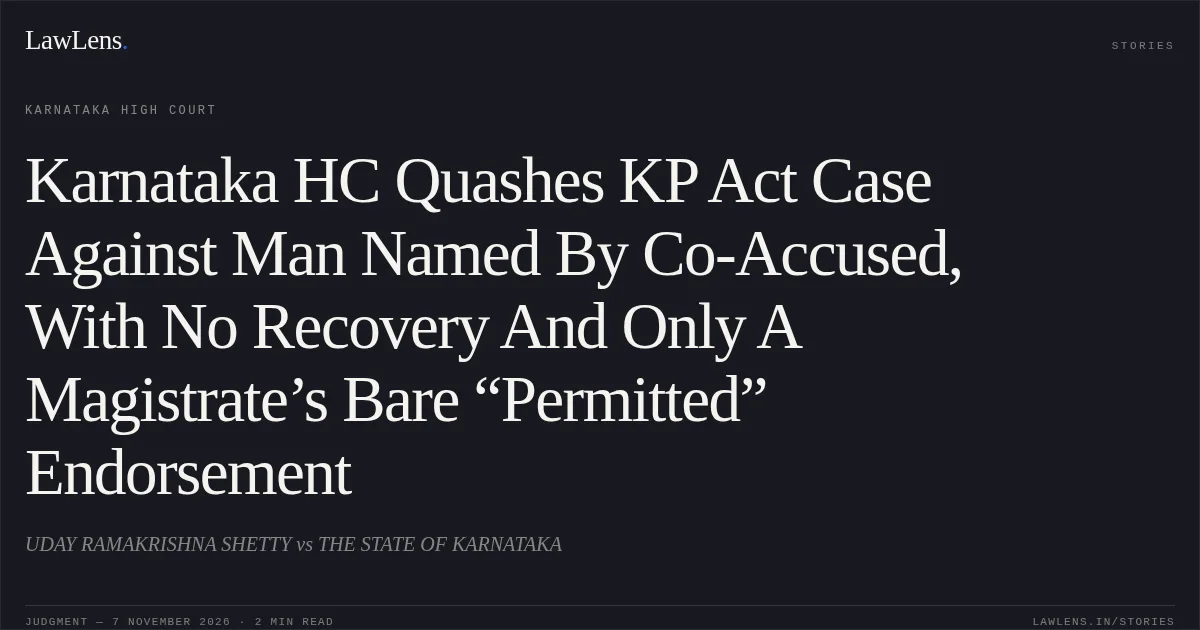
p. 2 · p. 8The petitioner sought to quash the proceedings under Section 78(3) of the Karnataka Police Act, 1963, arguing that the offence was non-cognizable and the police had not obtained a valid Magistrate’s order to investigate.
pp. 3–4The Magistrate had endorsed the requisition “Permitted”.
p. 802Issues
i.1. Whether the Magistrate’s “Permitted” endorsement on the police requisition constituted a valid order under Section 155(2) CrPC authorising investigation of a non-cognizable offence.
pp. 4–5, 8ii.2. Whether proceedings against the petitioner, implicated only through Accused No. 1’s statement and without recovery of any incriminating article from him, should be quashed.
p. 803Law Applied
Section 155(1) CrPC requires the police officer receiving information about a non-cognizable offence to record its substance in the prescribed book and refer the informant to the Magistrate; Section 155(2) bars police investigation of such an offence without an order from a Magistrate empowered to try or commit the case.
pp. 4–5In Vaggeppa Gurulinga Jangaligi v. State of Karnataka, ILR 2020 KAR 630, the Court held that a Magistrate must consider the requisition judicially, record satisfaction that investigation is warranted, and specify the rank and designation of the investigating officer; a bare “permitted” endorsement is not a valid order.
pp. 5–7The judgment also refers to Rules 1 and 2 of Chapter V of the Karnataka Criminal Rules of Practice in setting out the required procedure.
pp. 5–7Provisions in the judgment · 4 · Linked ones open on LawLens
Code of Criminal Procedure, 1973 Section 482Section 155
Bharatiya Nagarik Suraksha Sanhita, 2023 Section 528
KARNATAKA POLICE ACT, 1963. Section 78
04Reasoning
The Court treated Section 78(3) of the Karnataka Police Act as a non-cognizable offence, requiring compliance with Sections 155(1) and 155(2) CrPC before investigation.
p. 4The Magistrate’s endorsement merely stated “Permitted” and did not demonstrate judicial consideration or satisfy the requirements identified in Vaggeppa; accordingly, it did not constitute a valid authorisation to investigate.
p. 8The petitioner was additionally implicated only on the basis of Accused No. 1’s statement, with no recovery from him or mahazar drawn in his presence.
p. 8The Court therefore held that the proceedings against the petitioner could not be sustained.
p. 805Holding
The petition was allowed.
pp. 8–9The proceedings against the petitioner/Accused No. 2 for the offence under Section 78(3) of the Karnataka Police Act in C.C. No. 556/2026, arising from Crime No. 146/2026 of Siddapura Police Station, were quashed.
pp. 8–9Original Court PDF
UDAY RAMAKRISHNA SHETTYvsTHE STATE OF KARNATAKA
Click to open original judgment
Original judgment, available to read, download and summarize on LawLens.in