01Facts
Respondent No. 1 filed a private complaint alleging that cheques issued towards dues for supplied textiles were dishonoured, and the Magistrate took cognizance of the offence under Section 138 of the Negotiable Instruments Act, 1881 (“NI Act”) against the firm and the petitioners
p. 3The cheques were drawn on the firm’s account and signed by petitioner No. 1; petitioner No. 2 was also authorised to operate the account, while petitioners Nos. 3 and 4 were alleged to be employees involved in the firm’s affairs
pp. 5–8Petitioners Nos. 2 to 5 before the Magistrate sought to quash the proceedings against them
pp. 2–302Issues
i.Whether the complaint contained sufficient averments to prosecute petitioners Nos. 2 to 4 (accused Nos. 3 to 5) vicariously under Section 141 of the NI Act
pp. 8–13ii.Whether petitioner No. 1 (accused No. 2), as the partner who signed the dishonoured cheques, could be prosecuted under Section 138 of the NI Act
p. 1303Law Applied
Section 138 of the NI Act provides for liability arising from the dishonour of a cheque, while Section 141 permits vicarious liability where the person sought to be prosecuted was, at the time of the offence, both in charge of and responsible to the company for the conduct of its business
pp. 8–13The court relied on Ashok Shewakramani v. State of Andhra Pradesh, holding that those requirements are conjunctive and that general assertions of managing the company or participating in its day-to-day affairs are insufficient; it also relied on Sunita Palita v. Panchami Stone Quarry and Siby Thomas v. Somany Ceramics Ltd. on the need for adequate allegations concerning the accused’s role
pp. 4–5, 8–13Provisions in the judgment · 3 · Linked ones open on LawLens
Code of Criminal Procedure, 1973 Section 482
Negotiable Instruments Act, 1881 Section 138Section 141
04Reasoning
The court found that petitioner No. 1 had signed the cheques on behalf of the firm and was therefore liable to remain subject to the proceedings
pp. 7–8, 13Although petitioner No. 2 was authorised to operate the account, the cheques were not signed by her; account-operating authority alone did not make her liable under Section 138
pp. 7–8As to petitioners Nos. 3 and 4, the complaint’s general assertions that they participated in the firm’s affairs, including communications with the complainant, did not specify how they were in charge of and responsible for the firm’s business as required by Section 141
pp. 8–1305Holding
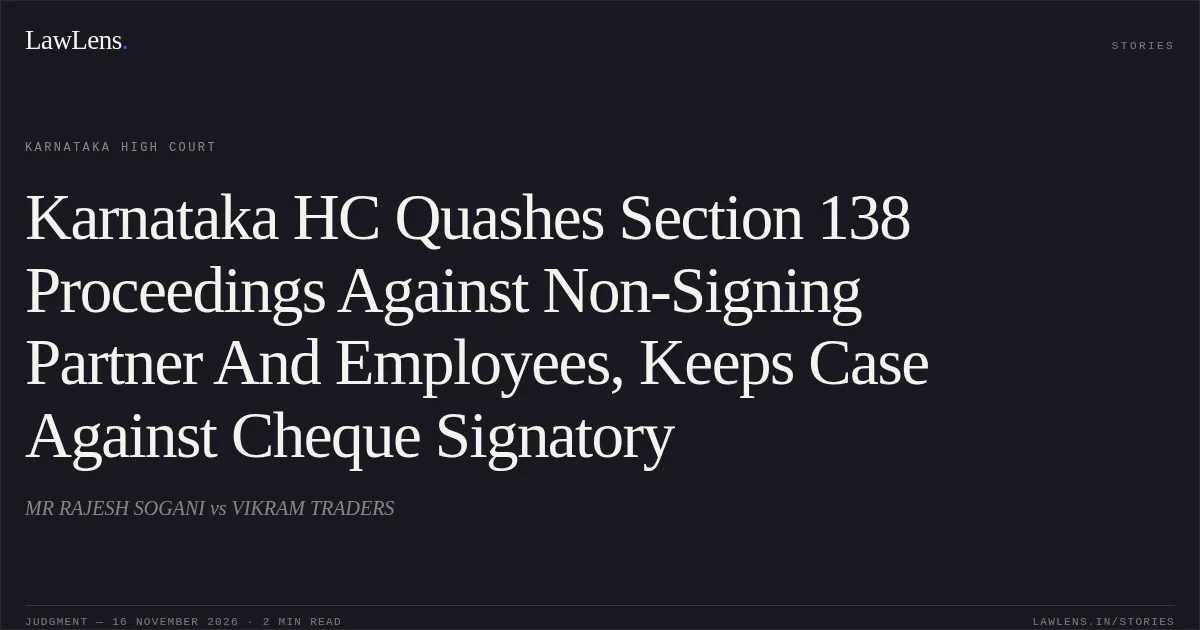
The petition was allowed in part.
p. 14The proceedings in C.C. No. 13211 of 2022 were quashed against petitioners Nos. 2 to 4 (accused Nos. 3 to 5), but the petition was dismissed as to petitioner No. 1 (accused No. 2), against whom the proceedings were permitted to continue
p. 14Original Court PDF
MR RAJESH SOGANIvsVIKRAM TRADERS
Click to open original judgment
Original judgment, available to read, download and summarize on LawLens.in