01Facts
On 25 August 2015, Eranaika was a pillion rider on a motorcycle involved in a collision with another motorcycle.
¶ 3 · p. 3He sustained a fracture of the lower pole of his right patella and claimed compensation for his injuries and resulting loss of earning capacity.
¶ 3 · p. 3The Motor Accident Claims Tribunal found that both motorcycle riders were negligent, apportioned liability equally, and awarded ₹40,000 globally, but limited the insurer’s liability to 50%.
¶ 7 · p. 5Eranaika appealed, challenging the liability apportionment as against him and seeking enhanced compensation.
¶ 7 · p. 502Issues
i.1. Whether the Tribunal was justified in restricting the insurer’s liability to 50% of the compensation payable to the claimant
¶ 15 · p. 8ii.2. Whether the claimant was entitled to enhanced compensation
¶ 15 · p. 803Law Applied
The appeal was brought under Section 173(1) of the Motor Vehicles Act.
p. 2Under the doctrine of composite negligence, where an injured claimant is not himself negligent, he may recover the entire compensation from any one of the joint tortfeasors; apportionment between tortfeasors does not restrict the claimant’s recovery.
¶ 10, 16 · p. 6, 9The Court relied on Karnataka State Road Transport Corporation v. Arun @ Aravind, ILR 2004 KAR 26, and T.O. Anthony v. Karvarnan, (2008) 3 SCC 748, for this principle.
¶ 10, 16 · p. 6, 9For personal-injury compensation, the Court assessed proven expenses and the reasonable consequences of the injury; it declined to award future loss of income or loss of amenities where disability was not established by medical evidence.
¶ 17–18 · pp. 9–11Provisions in the judgment · 1 · Linked ones open on LawLens
Motor Vehicles Act, 1988 Section 173
04Reasoning
The collision involved two motorcycles, and the evidence did not establish that the claimant, as pillion rider, had contributed to the accident.
¶ 16 · p. 9The Court therefore treated the case as one of composite—not contributory—negligence.
¶ 16 · p. 9Although negligence had been apportioned equally between the riders, that allocation could not limit the claimant’s right to recover the full compensation from a joint tortfeasor; the tortfeasors could pursue reimbursement between themselves.
¶ 16 · p. 9On quantum, the Court assessed the claimant’s income notionally at ₹9,000 per month, awarded ₹40,000 for pain and suffering, ₹2,000 for medical expenses, ₹10,000 for diet, attendant, conveyance and incidental expenses, and ₹27,000 for three months’ loss of income during treatment.
¶ 17–18 · pp. 9–11Because no doctor was examined to prove disability, the Court declined to award compensation for future loss of income or loss of amenities.
¶ 17–18 · pp. 9–1105Holding
The appeal was allowed in part.
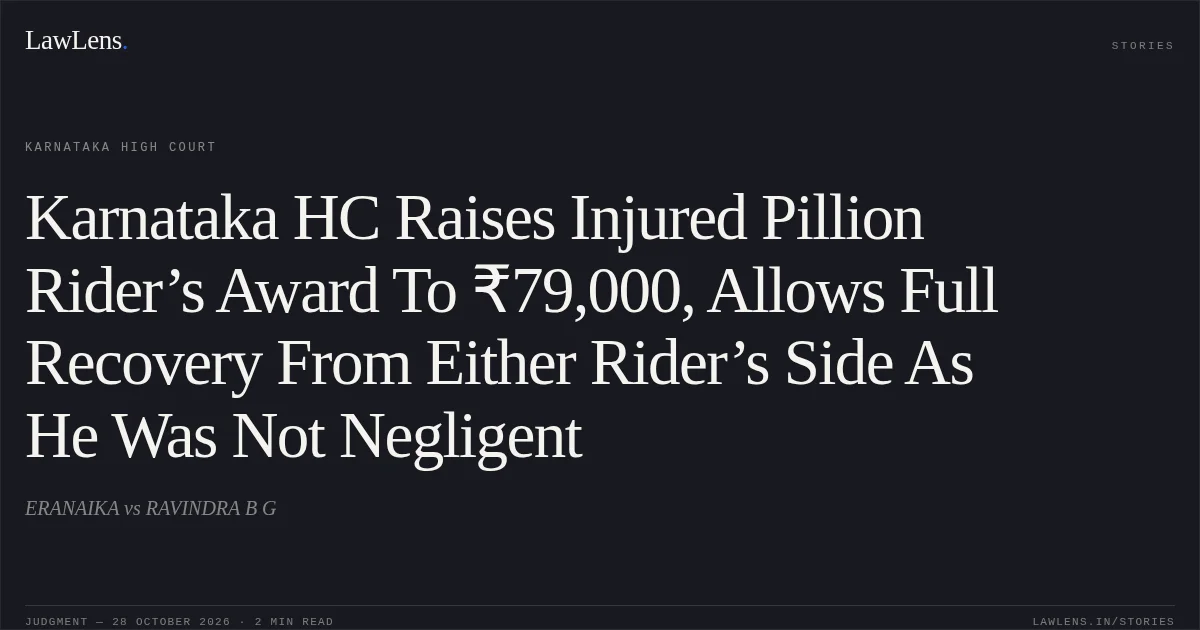
¶ 19 · pp. 11–12The Court enhanced compensation from ₹40,000 to ₹79,000, with interest at 8% per annum from the date of the claim petition until deposit.
¶ 19 · pp. 11–12The claimant was entitled to recover the entire compensation from any of the tortfeasors, while the insurer retained liberty to seek reimbursement from the other tortfeasors to the extent of their apportioned negligence.
¶ 19 · pp. 11–12The Court also directed that, if the claimant had already withdrawn an amount deposited under the Tribunal’s award, interest on that amount would not run from the award date to the withdrawal date and the amount would be deducted from the total compensation.
¶ 19 · pp. 11–12Original Court PDF
ERANAIKAvsRAVINDRA B G
Click to open original judgment
Original judgment, available to read, download and summarize on LawLens.in