01Facts
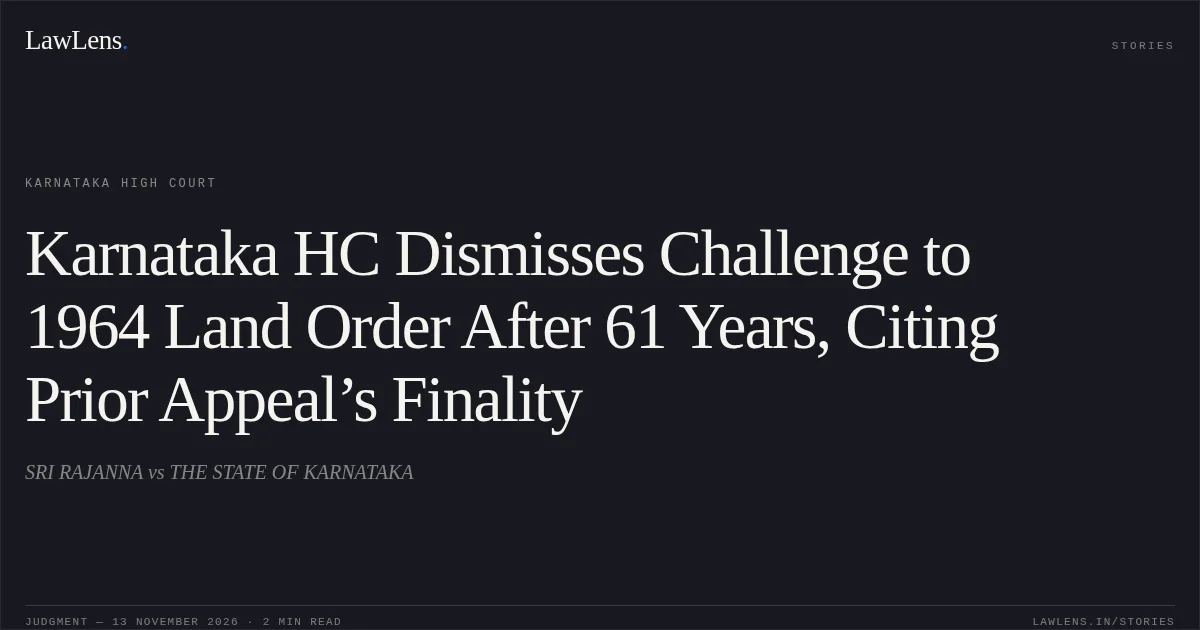
The appellant claimed ownership and cultivation of land in Sy.No.28, Buradikatti Village, by succession.
¶ 3.1–3.9After revenue authorities asserted that the land had been acquired in 1948 and altered survey and revenue records in 2022, the appellant challenged the alteration, alleging that it was made without notice or a hearing.
¶ 3.1–3.9The authorities stated that the lands had been acquired for residential sites, possession had been taken in 1951, and plots had subsequently been allotted.
¶ 3.1–3.9Earlier civil proceedings concerning the lands had rejected claims that the acquisition had not been acted upon or that title had been acquired by adverse possession; the decision was affirmed in appeal.
¶ 3.1–3.9The Single Judge dismissed the appellant’s writ petition, and the appellant brought this intra-court appeal.
¶ 8–1002Issues
i.1. Whether the appellant had established grounds for appellate interference with the Single Judge’s order
¶ 11(i)ii.2. Whether the acquisition could be held to have lapsed under Section 24(2) of the 2013 Act in these writ proceedings
¶ 11(ii)iii.3. Whether the revenue order dated 21 October 2022 was liable to be quashed for want of notice and a hearing
¶ 11(iii)03Law Applied
Under Section 24(2) of the Right to Fair Compensation and Transparency in Land Acquisition, Rehabilitation and Resettlement Act, 2013, lapse requires the cumulative satisfaction of the statutory conditions concerning possession and compensation; taking possession may be evidenced by a panchnama, and subsequent re-entry by a former owner does not divest the State of land that has vested in it.
¶ 15–17The Constitution Bench decision in Indore Development Authority v. Manoharlal, (2020) 8 SCC 129, further establishes that Section 24 does not revive stale claims or reopen concluded proceedings.
¶ 15–17An intra-court appeal warrants interference where the Single Judge’s decision involves a patent error of law, perversity, or failure to consider material circumstances.
¶ 12Although breach of natural justice may justify writ intervention, the Court may consider whether the breach caused legally cognisable prejudice; an efficacious statutory remedy is ordinarily a reason to decline writ interference, subject to recognised exceptions.
¶ 18–19, 22–24Revenue entries do not create or extinguish title and cannot override rights finally adjudicated by a competent civil court.
¶ 20–21Provisions in the judgment · 2 · Linked ones open on LawLens
KARNATAKA HIGH COURT ACT, 1961 Section 4
Right to Fair Compensation and Transparency in Land Acquisition, Rehabilitation and Resettlement Act, 2013 Section 24
04Reasoning
The Division Bench found no basis to reopen the civil court’s final findings on the claims concerning the subject lands.
¶ 13The unavailability of older acquisition records in a particular office did not, by itself, disprove acquisition, particularly in light of the State’s records and the concluded civil litigation.
¶ 13The Section 24(2) claim was also unsuitable for determination collaterally in a challenge to the 2022 revenue proceedings, brought decades after the asserted acquisition; the possession question could not be reopened in the appeal, and the appellant had not established the statutory basis for lapse.
¶ 16–17As to notice, the Court held that the appellant had not shown legally cognisable prejudice warranting relief: the claimed rights had been considered in concluded civil proceedings, while revenue entries could not be used to reopen those findings.
¶ 18–24The appellant also had statutory appellate or revisional remedies against the survey and phodi order.
¶ 18–2405Holding
The Court answered all three issues in the negative.
¶ 25–27It affirmed the Single Judge’s dismissal of the writ petition, finding no patent illegality, perversity, or other ground for appellate interference.
¶ 25–27The Court dismissed the writ appeal. It affirmed the Single Judge’s dismissal of the writ petition, finding no patent illegality, perversity, or other ground for appellate interference; there was no order as to costs.
¶ 25–27Original Court PDF
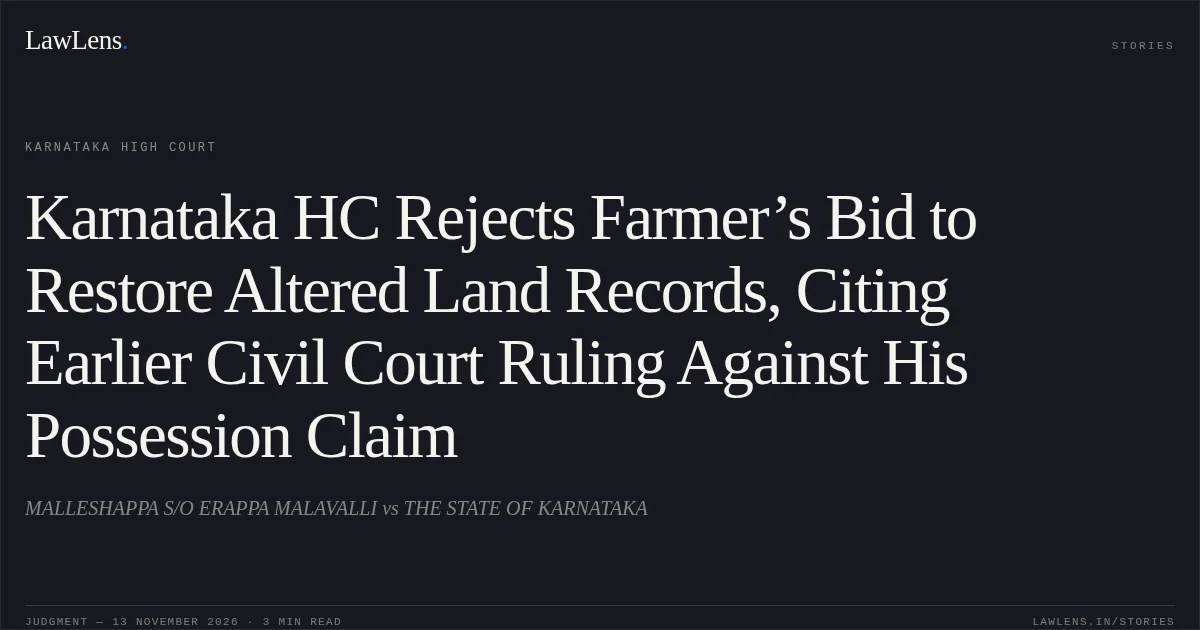
MALLESHAPPA S/O ERAPPA MALAVALLIvsTHE STATE OF KARNATAKA
Click to open original judgment
Original judgment, available to read, download and summarize on LawLens.in