01Facts
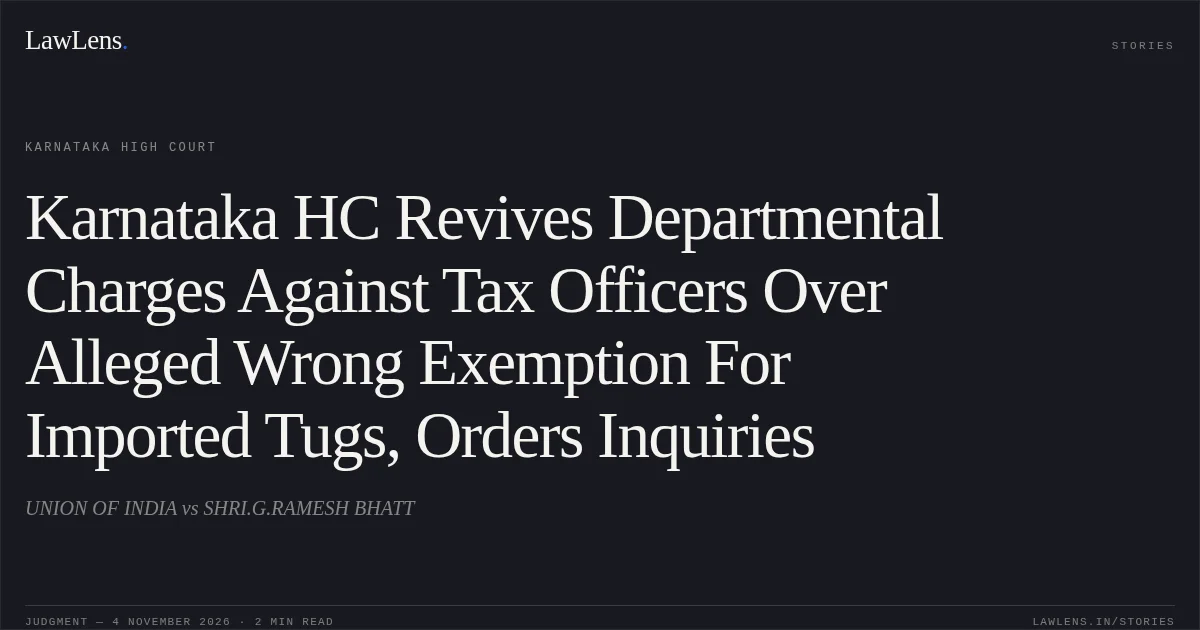
The respondents, then serving as Customs/Central Excise officers, were charged in memoranda dated 22 November 2013 with improperly allowing exemption under Notification No. 21/2002 to tugs imported by Temba Shipyards Ltd.
pp. 7–9, 18The charge alleged that the notification covered raw materials or parts used in manufacture, not finished goods, and that its application facilitated clearance without the applicable duty.
pp. 7–9, 18The Central Administrative Tribunal quashed the charge memoranda in three original applications.
pp. 4–6The Union of India challenged those orders in these consolidated writ petitions.
pp. 4–6In W.P. No. 3146/2018, an inquiry had already been conducted, and the respondent separately alleged that relevant defence documents had not been supplied.
p. 2102Issues
i.Whether the CAT was justified in quashing the charge memoranda at the threshold.
p. 12ii.Whether the allegations concerning the officers’ application of the exemption notification could be examined in disciplinary proceedings, or instead concerned only the quasi-judicial assessment of duty.
p. 18, 2003Law Applied
Under Articles 226 and 227, a charge-sheet or show-cause notice ordinarily should not be quashed before the disciplinary process is completed, because it generally does not itself infringe the employee’s rights; intervention may be warranted in exceptional cases, such as where the issuing authority lacks jurisdiction or the notice is wholly illegal.
pp. 12–14, 17The Court applied Union of India v. Kunisetty Satyanarayana, (2006) 12 SCC 28, and Secretary, Ministry of Defence v. Prabhash Chandra Mirdha, (2012) 11 SCC 565, on this principle.
pp. 12–17It also noted that the truth and correctness of charges are ordinarily matters for the disciplinary authority to determine, and distinguished Zunjarrao Bhikaji Nagarkar v. Union of India, (1999) 7 SCC 409, because the allegations here concerned the application of an exemption notification, not merely the assessment of duty.
pp. 20–2104Reasoning
The Court held that the charge memoranda alleged that the officers applied an exemption meant for raw materials or parts to finished goods, an allegation capable of inquiry into whether the notification was wrongly or intentionally applied.
p. 18, 20The duty dispute against Temba Shipyards Ltd. remained pending before the CESTAT; its interim stay did not determine the disciplinary allegations, and the CAT’s findings on duty liability and loss risked bearing on that appeal.
pp. 19–20The CAT therefore went beyond the proper scope of review by deciding the merits of the charge and concluding that no loss had been caused.
pp. 19–20In W.P. No. 3146/2018, however, the inquiry was to resume from the evidence stage after the respondent received the requested defence documents or an adequate opportunity to inspect relied-upon material.
p. 2105Holding
The Court answered the principal issue in the negative: the CAT was not justified in quashing the charge memoranda at the threshold.
pp. 12–13, 22It allowed all three writ petitions and set aside the CAT’s orders.
p. 23In W.P. Nos. 13495/2015 and 13496/2015, the disciplinary inquiries were directed to proceed and conclude within six months of the order being uploaded.
pp. 23–24In W.P. No. 3146/2018, a de novo inquiry was directed from the evidence stage, subject to the respondent being provided the requested documents or an adequate opportunity to inspect the relevant material, and to completion within six months.
pp. 23–24Original Court PDF
UNION OF INDIAvsSHRI.G.RAMESH BHATT
Click to open original judgment
Original judgment, available to read, download and summarize on LawLens.in