Facts
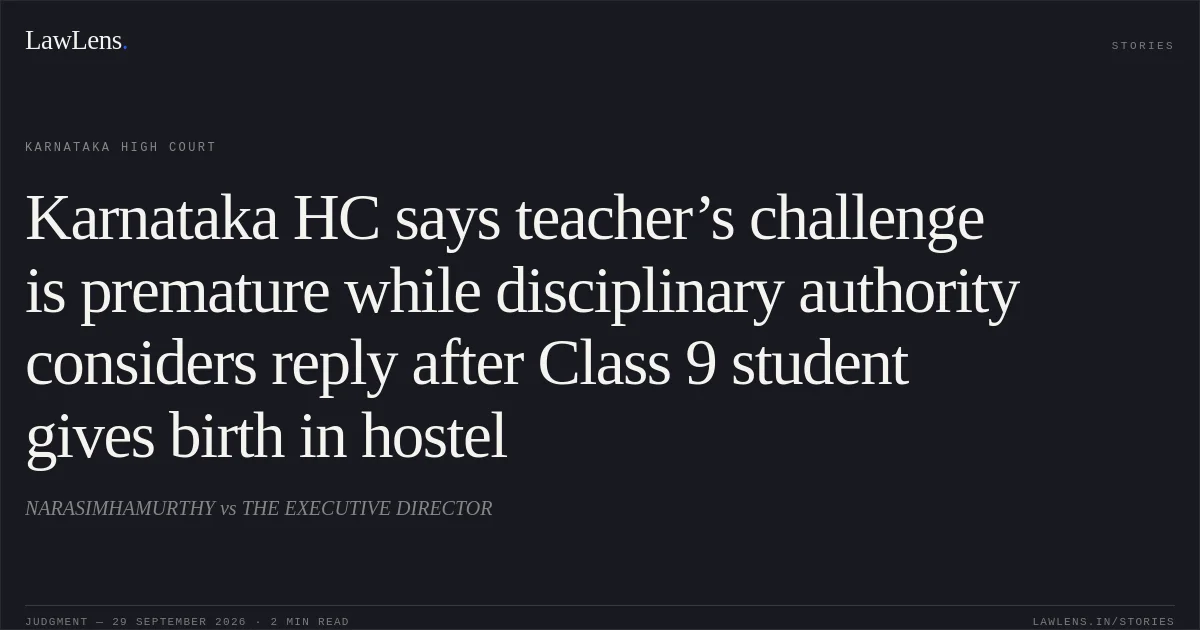
The petitioner, a Science Teacher, was subjected to disciplinary proceedings following the delivery of a child by a ninth-standard student in the school hostel on 27 August 2025.
Source reference: pp. 3–6The petitioner had been the class teacher for the relevant class for three months, and the proceedings against him concerned his alleged failure to report the student’s absence.
Source reference: pp. 3–6The enquiry report found Charge No. 5 proved, and the disciplinary authority issued a second show-cause notice.
Source reference: pp. 3–6After submitting his reply, the petitioner filed this writ petition under Articles 226 and 227, seeking to quash the finding on Charge No. 5 and the notice.
Source reference: pp. 3–6The disciplinary authority had not yet made a final decision
Source reference: pp. 3–6Issues
1. Whether the petitioner could challenge the enquiry report and second show-cause notice before the disciplinary authority made a final decision
Source reference: pp. 4–72. Whether the petitioner’s claims that he had no nexus with the incident and that the proceedings amounted to victimisation could be considered at that stage
Source reference: pp. 6–7Law Applied
The Court applied the procedural principle that a challenge to disciplinary proceedings at the enquiry-report and second-show-cause-notice stage is premature where the employee has submitted a reply and the disciplinary authority has yet to decide the matter.
Source reference: pp. 3, 5–7The authority must consider the reply and take an appropriate decision in accordance with law; an adverse final order may then be challenged.
Source reference: pp. 3, 5–7Although the petition invoked Articles 226 and 227 of the Constitution, the Court cited no statute or precedent in support of this principle
Source reference: pp. 3, 5–7Reasoning
The petitioner had already responded to the second show-cause notice, but the disciplinary authority had not taken a final decision.
Source reference: pp. 6–7The Court therefore declined to assess the petitioner’s objections to the charge or his allegation of victimisation at that stage.
Source reference: pp. 6–7It directed no particular outcome on the merits, leaving the authority to consider the reply and decide the matter in accordance with law
Source reference: pp. 6–7Holding
The Court held that the challenge was premature and did not interfere with the enquiry report or second show-cause notice.
It disposed of the petition with the observation that, if the disciplinary authority passed an adverse order after considering the petitioner’s reply, he could challenge that order in accordance with law.
Source reference: p. 8Original Court PDF
NARASIMHAMURTHYvsTHE EXECUTIVE DIRECTOR
Click to open original judgment
Original judgment, available to read, download and summarize on LawLens.in