Facts
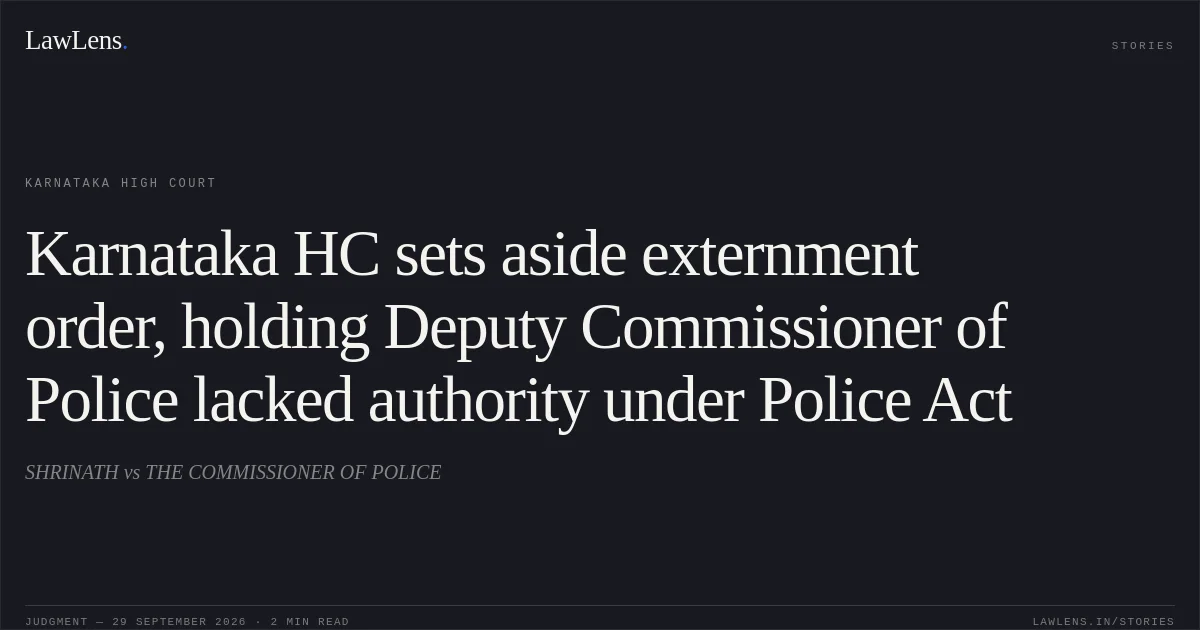
The Deputy Commissioner of Police, Kalaburagi, issued a show-cause notice to the petitioner on 13 November 2025 and passed an externment order against him on 25 November 2025.
Source reference: p. 2, para. 1; p. 5, para. 5The petitioner challenged the notice and order under Articles 226 and 227 of the Constitution, contending that the Deputy Commissioner of Police was not an authority empowered to order externment under Section 55 of the Karnataka Police Act, 1963.
Source reference: pp. 1–2, para. 1He also sought a declaration that the proceedings were vitiated by non-consideration of his oral submissions.
Source reference: pp. 1–2, para. 1The State supported the order, relying on the petitioner’s alleged habitual offending and the authority’s assessment under Sections 55 and 56 of the Act.
Source reference: p. 4, para. 3Issues
1. Whether the Deputy Commissioner of Police was competent under Section 55 of the Karnataka Police Act, 1963, to pass the petitioner’s externment order.
Source reference: pp. 3–4, para. 2; pp. 5–7, paras. 5–72. Whether the externment order should be set aside on the ground that it was passed by an authority lacking jurisdiction.
Source reference: p. 7, para. 7Law Applied
Section 55 of the Karnataka Police Act, 1963, identifies the authorities empowered to exercise the externment power: the Commissioner in a city or other area for which a Commissioner has been appointed under Section 7, and, in other areas, the District Magistrate or Sub-Divisional Magistrate having jurisdiction and specially empowered by the Government.
Source reference: pp. 5–6, para. 6The court relied on Chandrakant Shankar Vaddar v. State of Karnataka and Others, W.P. No. 104096 of 2026, decided 24 August 2026, for the rule that the statutory authorities specified in Section 55 cannot be replaced by another authority through executive delegation; a Superintendent of Police is not within the categories named in the section.
Source reference: pp. 3, 5–6, paras. 2, 6The court also noted that it had perused Sections 7–11, Section 2(10), Sections 55 and 56 of the Act, and Sections 14–17 of the Bharatiya Nagarik Suraksha Sanhita, 2023.
Source reference: p. 5, para. 6Reasoning
The court treated the identity of the decision-maker as determinative.
Source reference: no citationIt was undisputed that the Deputy Commissioner of Police had passed the externment order.
Source reference: p. 5, para. 5Applying Section 55 and the reasoning in Chandrakant Shankar Vaddar, the court held that the Deputy Commissioner of Police was not among the authorities statutorily empowered to make the order.
Source reference: pp. 6–7, paras. 6–7The order therefore lacked jurisdiction, irrespective of the State’s submissions concerning the petitioner’s alleged habitual offending.
Source reference: pp. 6–7, paras. 6–7Holding
The court answered the jurisdictional issue in the negative and held that the Deputy Commissioner of Police was not competent to pass the externment order under Section 55 of the Act.
It allowed the writ petition and set aside the externment order dated 25 November 2025; it made no order as to costs.
Source reference: p. 7, OrderActs & Sections Cited
12 provisions across 2 statutes referred to in this judgment. Each provision opens on LawLens.
KARNATAKA POLICE ACT, 1963.8
Bharatiya Nagarik Suraksha Sanhita, 20234
Original Court PDF
SHRINATHvsTHE COMMISSIONER OF POLICE
Click to open original judgment
Original judgment, available to read, download and summarize on LawLens.in