01Facts
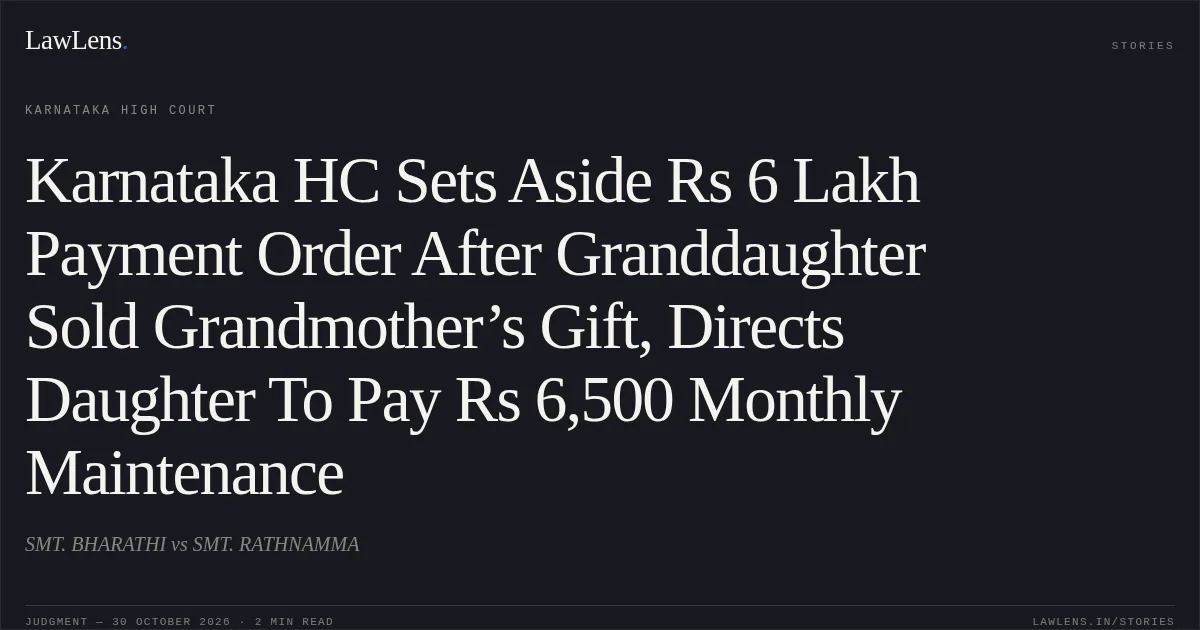
Rathnamma, the first respondent and mother of the first petitioner and grandmother of the second petitioner, executed a registered gift deed conveying her property to the second petitioner.
pp. 3–5The second petitioner later sold the property to third parties.
pp. 3–5Rathnamma applied to the Senior Citizen Tribunal for maintenance and cancellation of the gift deed.
pp. 3–5The Tribunal ordered monthly maintenance of ₹5,000 and directed the petitioners to pay ₹6,00,000, representing the sale proceeds.
pp. 3–5The petitioners challenged that order under Articles 226 and 227 of the Constitution.
p. 3During the writ proceedings, they paid ₹3,000 per month under an interim order.
pp. 3–5, 7The first petitioner offered to pay ₹5,000 monthly; the Court was also informed that Rathnamma received a widow’s pension and earned a small amount through domestic work
pp. 3–5, 702Issues
i.1. Whether the Tribunal’s direction requiring the petitioners to pay ₹6,00,000 towards the sale proceeds of the gifted property should be set aside
pp. 7–8 · ¶ 14–16ii.2. Whether, having regard to the parties’ respective financial circumstances, the first petitioner should pay monthly maintenance of ₹6,500 to Rathnamma
pp. 5–7 · ¶ 7–1303Law Applied
The Court applied its jurisdiction under Articles 226 and 227 of the Constitution to review the Tribunal’s order
p. 3It stated that a daughter’s obligation to maintain her aged mother is not displaced merely because the mother receives a pension or has a small independent income.
pp. 6–7 · ¶ 11–12The amount of maintenance should take account of the liable person’s financial capacity and the senior citizen’s needs and independent income
pp. 6–7 · ¶ 11–12No statute or judicial precedent was cited in the order.
04Reasoning
The Court balanced Rathnamma’s age, limited income, and lack of support from her son against the first petitioner’s net monthly income of approximately ₹45,000 and the parties’ generally limited financial means.
pp. 6–7 · ¶ 10–13It concluded that ₹6,500 per month would meet Rathnamma’s basic needs without imposing an unreasonable burden on the first petitioner
pp. 6–7 · ¶ 10–13Although Rathnamma had gifted her property and it had subsequently been sold, the Court considered the direction to pay the entire ₹6,00,000 disproportionate, particularly because third-party rights had been created and the petitioners said the sale was for legal necessities.
pp. 7–8 · ¶ 14–16It found that regular maintenance would appropriately balance the equities
pp. 7–8 · ¶ 14–1605Holding
The petition was allowed in part.
pp. 9–11 · ¶ 19The Court set aside the Tribunal’s direction to pay ₹6,00,000 and ordered the first petitioner to pay Rathnamma ₹6,500 monthly by the fifth day of each month.
pp. 9–11 · ¶ 19The petitioners were also directed to pay ₹15,000 as consolidated differential maintenance for the period covered by the interim order, within six weeks of receiving a copy of the order.
pp. 9–11 · ¶ 19Rathnamma may seek enhancement before the competent Tribunal after three years if circumstances warrant
pp. 9–11 · ¶ 19Original Court PDF
SMT. BHARATHIvsSMT. RATHNAMMA
Click to open original judgment
Original judgment, available to read, download and summarize on LawLens.in