01Facts
TSI’s predecessor entered into a service agreement with Writer Safeguard Private Limited, HCMPL’s predecessor, for ATM cash-replenishment services.
¶ 5–8The agreement included a seven-day reporting procedure for discrepancies between cash-balance reports (CBRs) and bank switch data (Clause 4.3), and provisions governing the service provider’s liability for cash losses (Clause 13).
¶ 5–8, 42–46After HCMPL employees misappropriated cash and manipulated CBRs, TSI withheld HCMPL’s unpaid invoices, asserting a right to recover the resulting losses.
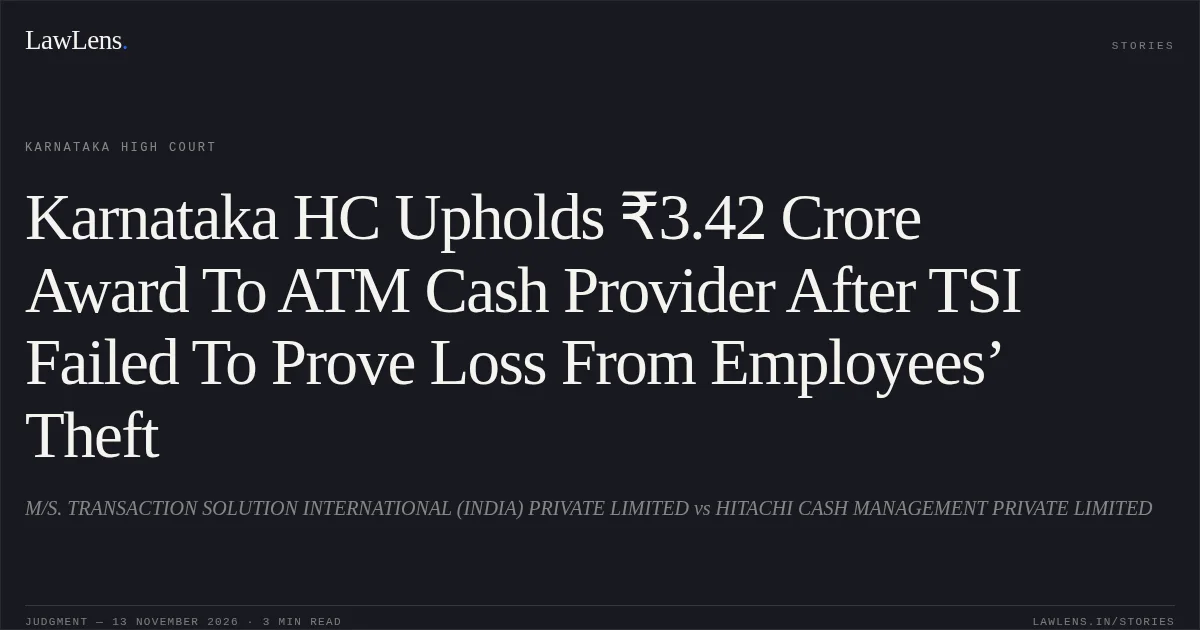
¶ 9–13, 18The arbitral tribunal awarded HCMPL ₹3,42,31,114, with interest and costs, and rejected TSI’s counterclaims, including its claim for misappropriated amounts, which it had not proved as a loss incurred by TSI.
¶ 26–30, 56–62The Commercial Court dismissed TSI’s Section 34 challenge. TSI appealed, arguing that the award misinterpreted the agreement and that the Commercial Court’s decision was unreasoned.
¶ 31–3602Issues
i.1. Whether the arbitral tribunal’s interpretation of Clauses 4.3 and 13—under which HCMPL was absolved of liability for a discrepancy not reported within the contractual period—was a plausible interpretation or amounted to patent illegality warranting interference under Section 34 of the Arbitration and Conciliation Act, 1996.
¶ 37–39, 64–76ii.2. Whether TSI established a recoverable loss from the employees’ misappropriation, such that it could sustain its counterclaim or rely on that loss to resist HCMPL’s invoice claim.
¶ 56–63iii.3. Whether the Commercial Court’s judgment was liable to be set aside for being unreasoned.
¶ 8203Law Applied
Under Sections 34 and 37 of the Arbitration and Conciliation Act, 1996, a court does not re-adjudicate the merits or substitute its interpretation of a contract for that of the arbitral tribunal.
¶ 39, 71, 78–81An award may be set aside for patent illegality where, among other things, the tribunal’s interpretation is not one a reasonable person could adopt or effectively rewrites the contract; a plausible contractual interpretation is not ordinarily open to interference.
¶ 39, 71, 78–81The Court relied on MSK Projects (I) (JV) Ltd. v. State of Rajasthan, (2011) 10 SCC 573, on the distinction between an error within jurisdiction and a jurisdictional error; McDermott International Inc. v. Burn Standard Co. Ltd., (2006) 11 SCC 181, and SAIL Ltd. v. Gupta Brothers Steel Tube Ltd., (2009) 10 SCC 63, on the arbitrator’s authority to interpret the contract.
¶ 78–80A party claiming loss must establish that it actually suffered that loss; contractual liability alone does not prove the claimant’s loss.
¶ 58–63Provisions in the judgment · 5 · Linked ones open on LawLens
Commercial Courts Act, 2015 Section 13
Arbitration and Conciliation Act, 1996 Section 37Section 34Section 31
Code of Civil Procedure, 1908 Section 151
04Reasoning
The tribunal had read Clause 4.3 as requiring timely notification of a CBR/switch-data discrepancy and as absolving HCMPL where the discrepancy was not reported within the stipulated period.
¶ 65–76The High Court considered that interpretation plausible: a discrepancy caused by manipulated CBRs could constitute a CD loss, and timely reconciliation could have revealed the shortage earlier, but the agreement did not make the tribunal’s reading unreasonable or impermissible.
¶ 65–76, 81Further, TSI had not produced its books of account or other cogent evidence showing that it had itself borne the misappropriated amount; the tribunal’s rejection of TSI’s counterclaim therefore warranted no interference, irrespective of the interpretation of HCMPL’s contractual liability.
¶ 56–63The Court also rejected the challenge to the Commercial Court’s reasoning after itself examining the award and finding no basis for setting it aside.
¶ 8205Holding
The High Court held that the arbitral tribunal’s interpretation was a plausible view and that TSI had not proved a loss supporting its counterclaim or defence to HCMPL’s invoices.
¶ 81–86No ground for interference under Section 34 was established.
¶ 81–86The appeal was dismissed, the arbitral award remained undisturbed, and the pending application was disposed of.
¶ 81–86Original Court PDF
M/S. TRANSACTION SOLUTION INTERNATIONAL (INDIA) PRIVATE LIMITEDvsHITACHI CASH MANAGEMENT PRIVATE LIMITED
Click to open original judgment
Original judgment, available to read, download and summarize on LawLens.in