01Facts
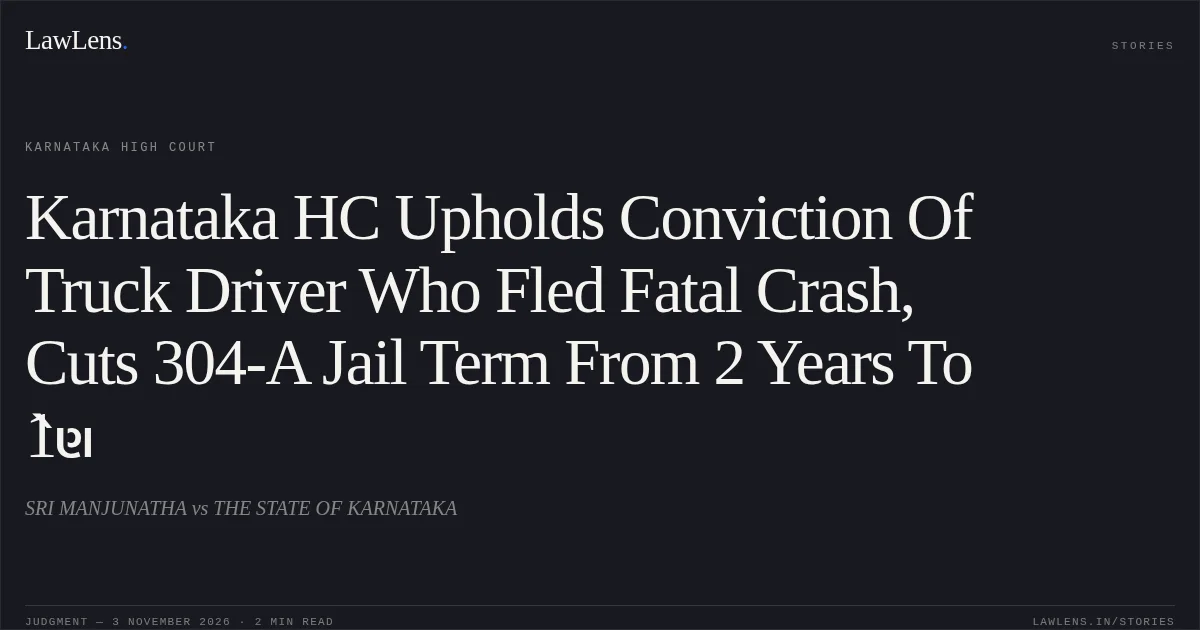
On 14 July 2016, a lorry driven by the accused collided with a motorcycle on the Hiremagalur–Chikkamagaluru road.
pp. 3–4The motorcycle rider sustained grievous injuries, and the pillion rider died at the scene.
pp. 3–4The trial court convicted the accused under Sections 279, 338 and 304-A of the Indian Penal Code, 1860 (IPC), and Section 187 of the Motor Vehicles Act, 1988 (MV Act), and the appellate court affirmed the conviction.
p. 2, 4In revision, the accused challenged, among other matters, his identification as the driver.
p. 402Issues
i.1. Whether the trial and appellate courts committed an error warranting revisional interference in convicting the accused under Sections 279, 338 and 304-A IPC and Section 187 of the MV Act.
p. 5ii.2. Whether the two-year sentence of imprisonment imposed under Section 304-A IPC should be reduced.
pp. 11–1303Law Applied
The Court applied Sections 397 and 401 of the Code of Criminal Procedure, 1973 (Cr.P.C.), which confer revisional jurisdiction, and held that such jurisdiction permits interference where the lower court’s decision is perverse, grossly erroneous, unreasonable, unsupported by material, based on irrelevant material, or reflects arbitrary or capricious discretion.
pp. 6–7The offences of rash or negligent driving causing hurt or death were considered under Sections 279, 338 and 304-A IPC; Section 187 of the MV Act concerns failure to perform the duties arising from an accident.
On sentencing, the Court relied on State of Punjab v. Saurabh Bakshi, (2015) 5 SCC 182, and the principles that road-safety offences causing death call for proportionate punishment, with the impact on victims and society taken into account.
pp. 11–13Provisions in the judgment · 9 · Linked ones open on LawLens
Code of Criminal Procedure, 1973 Section 397Section 401Section 313Section 428
Indian Penal Code, 1860 Section 279Section 338
Motor Vehicles Act, 1988 Section 187Section 133
Bharatiya Nagarik Suraksha Sanhita, 2023 Section 468
04Reasoning
The Court found the driver’s identity established by the eyewitness evidence of PWs 1 and 7 and by the lorry owner’s evidence and reply to the statutory notice identifying the accused as the driver.
pp. 8–10The spot panchnama and sketch, considered with the eyewitness testimony, supported the finding that the lorry came onto the motorcycle’s side of the road and caused the collision, establishing rashness and negligence.
pp. 7–8, 10The concurrent findings were therefore supported by material evidence and did not meet the threshold for revisional interference.
p. 10As to sentence, the Court considered the fatality and grievous injury, but concluded that the two-year term under Section 304-A IPC should be reduced to one year, relying on the sentencing principles discussed in Saurabh Bakshi.
pp. 11–1305Holding
The High Court maintained the conviction but reduced the sentence of imprisonment for the Section 304-A offence from two years to one year.
pp. 13–14The revision petition was allowed in part.
p. 11, 13The conviction and fines were left undisturbed, but the sentence of imprisonment under Section 304-A IPC was reduced from two years to one year; the substantive sentences were to run concurrently.
p. 11, 13The petitioner was directed to surrender, and set-off was allowed for the period already undergone.
p. 14Original Court PDF
SRI MANJUNATHAvsTHE STATE OF KARNATAKA
Click to open original judgment
Original judgment, available to read, download and summarize on LawLens.in