01Facts
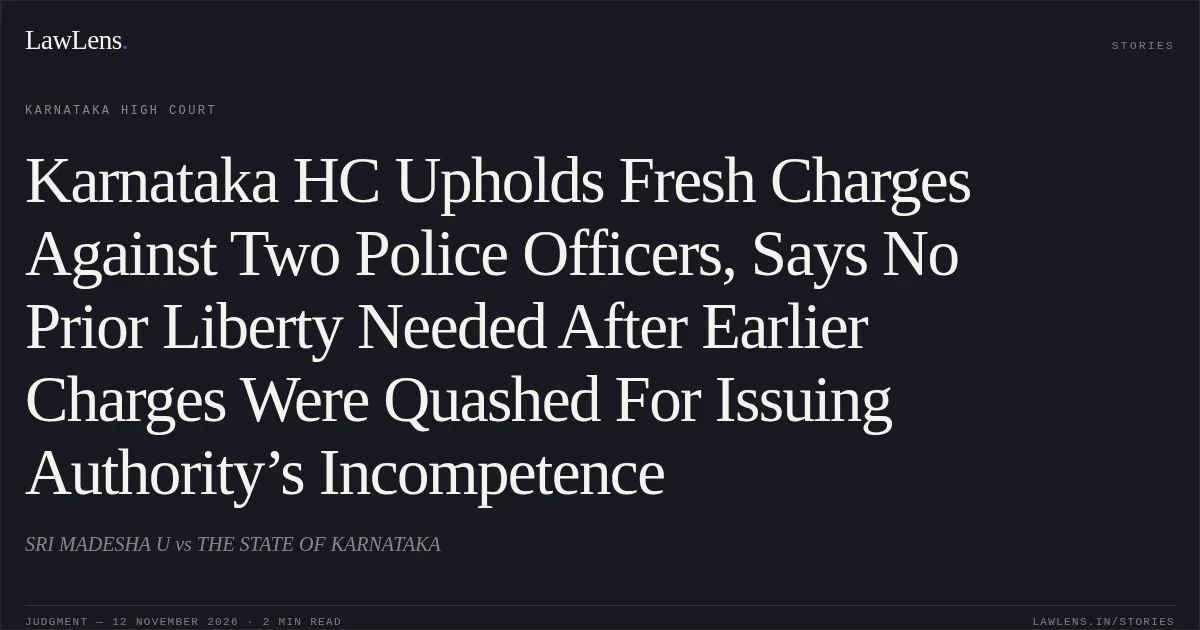
The petitioners challenged fresh Articles of Charge dated 18 May 2024.
pp. 3–5 · ¶ 1, 3–4Earlier Articles of Charge, dated 6 February 2019, had been quashed by the Karnataka State Administrative Tribunal because they were issued by an incompetent authority.
pp. 3–5 · ¶ 1, 3–4The Tribunal’s order of 2 November 2023 did not expressly grant the respondents liberty to issue fresh charges.
pp. 3–5 · ¶ 1, 3–4The petitioners argued that, without such liberty, the fresh charges could not be issued and were also unsustainable on their merits.
pp. 3–5 · ¶ 1, 3–4The Tribunal rejected their challenge, leading to this writ petition.
pp. 3–5 · ¶ 1, 3–402Issues
i.1. Whether fresh Articles of Charge could be issued by the competent disciplinary authority after the earlier charges were quashed for having been issued by an incompetent authority, despite the Tribunal not expressly granting liberty to do so.
pp. 5–6 · ¶ 5ii.2. Whether the High Court should examine the merits of the Articles of Charge at the threshold under Article 226.
pp. 6–7 · ¶ 603Law Applied
The Court applied the principle that quashing disciplinary charges solely because they were issued by an incompetent authority does not, in itself, prevent the competent authority from issuing fresh charges; express liberty to do so is unnecessary in those circumstances.
pp. 5–6 · ¶ 5It also applied the rule that a court exercising jurisdiction under Article 226 ordinarily will not assess the merits of disciplinary charges at the threshold; interference is available where the charges were issued by an incompetent authority or are vitiated by mala fides.
pp. 6–7 · ¶ 6The judgment refers to this threshold-interference principle as having been clarified by the Supreme Court but does not identify a particular precedent.
p. 6 · ¶ 604Reasoning
The earlier charges had been quashed only because they were framed by an authority lacking disciplinary competence.
pp. 5–6 · ¶ 5The fresh charges were issued by the disciplinary authority, so the basis for quashing the earlier charges did not bar their re-issuance; the absence of an express grant of liberty did not alter that conclusion.
pp. 5–6 · ¶ 5As the petitioners’ challenge to the merits was not a basis for threshold interference, the Court left those matters to be examined in the disciplinary inquiry.
pp. 6–7 · ¶ 6The petitioners had not established that the fresh charges were issued by an incompetent authority or with mala fides.
pp. 6–7 · ¶ 605Holding
The High Court found no merit in the writ petition and rejected it, thereby leaving the Tribunal’s order undisturbed.
p. 7 · ¶ 7It left all parties’ contentions open.
p. 7 · ¶ 7Original Court PDF
SRI MADESHA UvsTHE STATE OF KARNATAKA
Click to open original judgment
Original judgment, available to read, download and summarize on LawLens.in