01Facts
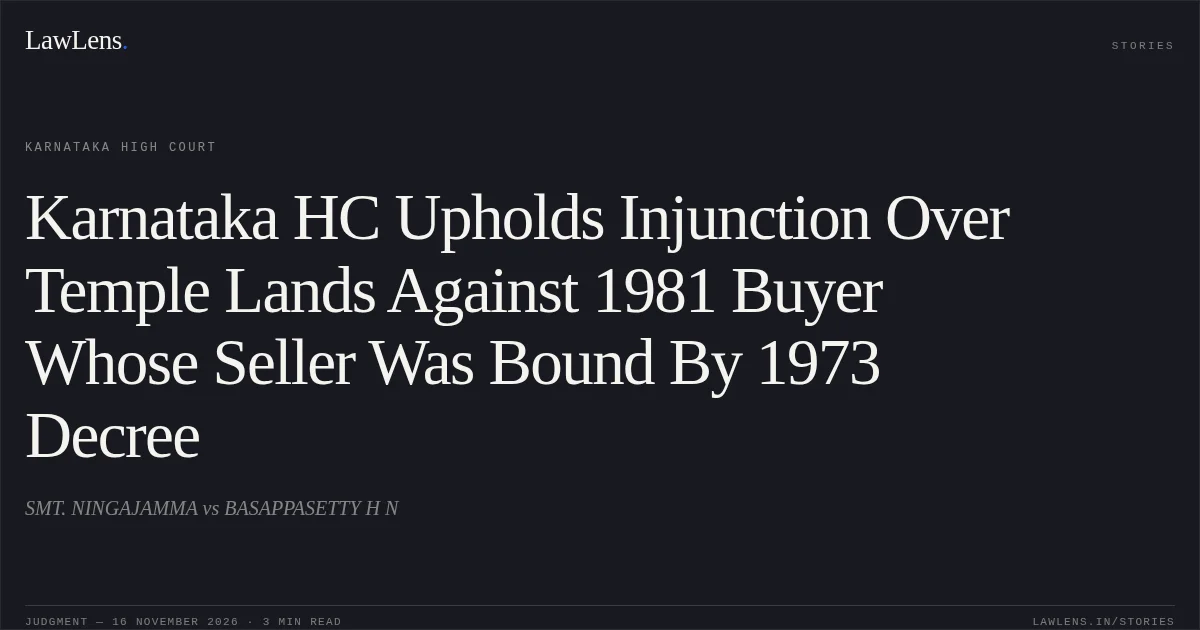
The dispute concerned four parcels of land claimed to belong to the Sri Rachavatti Veerabhadraswamy Gaddige and Sri Nanjundeshwara Kambi Devaru.
pp. 4–6The plaintiffs asserted that the properties had been purchased in 1931 in the names of devotees and sought a permanent injunction, relying also on a 1973 decree declaring the properties to belong to the Gaddige and to be enjoyed by its Archak.
pp. 4–6, 14The defendants claimed through a 1981 sale deed executed by Sannamma, who had been a defendant in the earlier suit.
p. 6, 10, 17The trial court decreed the injunction suit; the first appellate court dismissed the defendants’ appeal and affirmed the decree.
pp. 7–9The defendants then brought this second appeal under Section 100 of the Code of Civil Procedure, 1908 (CPC).
pp. 7–902Issues
i.1. Whether a suit for bare injunction was maintainable where the defendants disputed the plaintiffs’ title and possession had been refused in the earlier suit.
pp. 12–13ii.2. Whether the plaintiffs could maintain the suit in their individual capacity when they claimed that the properties belonged to the Gaddige.
p. 13iii.3. Whether the courts below erred in disregarding the defendants’ claim under the registered 1981 sale deed.
p. 13iv.4. Whether the appellants had established a substantial question of law warranting interference under Section 100 CPC.
pp. 17–1903Law Applied
Under Section 100 CPC, a second appeal lies only where a substantial question of law arises; concurrent findings based on the evidence are not ordinarily reopened merely because a party disputes the courts’ appreciation of the facts.
pp. 17–19The Court also applied the principle that a person cannot convey a better title than that person possesses, and treated the prior decree concerning the same properties as material to whether Sannamma could convey title under the later sale deed.
p. 17It cited Hardial Singh v. Balbir Kaur, 2022 SCC OnLine SC 311, for the proposition that even gross errors do not, by themselves, justify interference in a second appeal.
p. 19The appellants invoked Anathula Sudhakar v. P. Buchi Reddy, (2008) 4 SCC 594, and authorities on Order I Rule 8 CPC; those authorities formed part of their submissions, but the Court did not separately decide those arguments as substantial questions of law.
pp. 9–13Provisions in the judgment · 2 · Linked ones open on LawLens
Code of Civil Procedure, 1908 Section 100Section 96
04Reasoning
The Court noted that the defendants traced their claim to Sannamma’s 1981 sale deed, but that she had suffered a 1973 decree declaring the same properties to belong to the Gaddige and to be enjoyed by its Archak.
p. 17The Court reasoned that, as Sannamma had no alienable title, the sale deed could not sustain the defendants’ claim to title or lawful possession; the revenue records also showed her name jointly with others.
p. 17It further found that both courts had considered the mutation extract, RTCs, tax receipt and patta book in concluding that the plaintiffs were in possession, and that the first appellate court had reappreciated the evidence.
pp. 18–19The appellants’ objections therefore did not disclose a substantial question of law under Section 100 CPC.
p. 1905Holding
The Karnataka High Court held that the appellants had not demonstrated a substantial question of law and found no basis to disturb the concurrent findings on title and possession.
p. 19It dismissed the second appeal, leaving the decree granting permanent injunction in favour of the plaintiffs undisturbed.
p. 19Original Court PDF
SMT. NINGAJAMMAvsBASAPPASETTY H N
Click to open original judgment
Original judgment, available to read, download and summarize on LawLens.in