01Facts
The plaintiff sued to redeem land mortgaged to the defendant under a registered deed dated 6 May 1964 for ₹1,400, with an eight-year redemption period, and sought possession.
¶ 3–7, 12The defendant admitted the mortgage but claimed that his possession arose from an earlier tenancy.
¶ 3–7, 12The Land Tribunal granted him occupancy rights over 2 acres 4 guntas in Survey No. 75/1 but rejected his claim over the land forming the subject matter of the suit.
¶ 3–7, 12The Trial Court decreed redemption and possession; the First Appellate Court affirmed.
¶ 3–7, 12The defendant’s legal representatives appealed to the High Court.
¶ 3–7, 1202Issues
i.Whether the suit for redemption was maintainable in light of the defendant’s claim for occupancy rights before the Land Tribunal.
¶ 8ii.Whether the redemption suit, filed in 1995, was barred by limitation, although limitation had not been specifically pleaded in the written statement.
¶ 9, 13–15iii.Whether the decree could stand when the mortgage deed was not produced at trial, despite the defendant’s admission of its execution.
¶ 2103Law Applied
Article 61(a) of the Limitation Act, 1963 prescribes thirty years for a mortgagor’s suit to redeem or recover possession of mortgaged immovable property, running from when the right to redeem or recover possession accrues.
¶ 15Under Section 44 of the Karnataka Land Reforms Act, vesting consequent on the grant of occupancy rights is confined to the land in respect of which those rights were granted; a grant over one portion does not extend to other land merely because it lies in the same survey number.
¶ 18Sections 67 and 68 of the Transfer of Property Act, 1882, concerning mortgagee remedies, do not displace the limitation rule applicable to a mortgagor’s redemption suit.
¶ 16No precedent was relied upon.
Provisions in the judgment · 5 · Linked ones open on LawLens
Code of Civil Procedure, 1908 Section 100
Limitation Act, 1963 Section 61
Transfer of Property Act, 1882 Section 67Section 68Section 44
04Reasoning
The defendant’s occupancy-rights claim had been rejected for the suit land, so the grant concerning a distinct extent of 2 acres 4 guntas did not defeat the plaintiff’s right to redeem the remaining land.
¶ 12, 17–19The redemption period expired on 6 May 1972, and the 1995 suit was brought within Article 61(a)’s thirty-year period.
¶ 14–15The defendant had admitted execution and registration of the mortgage deed in his written statement; his dispute concerned the character of his possession.
¶ 10–11, 20–21The High Court therefore found no basis to disturb the concurrent findings on the ground that the deed was not produced.
¶ 10–11, 20–2105Holding
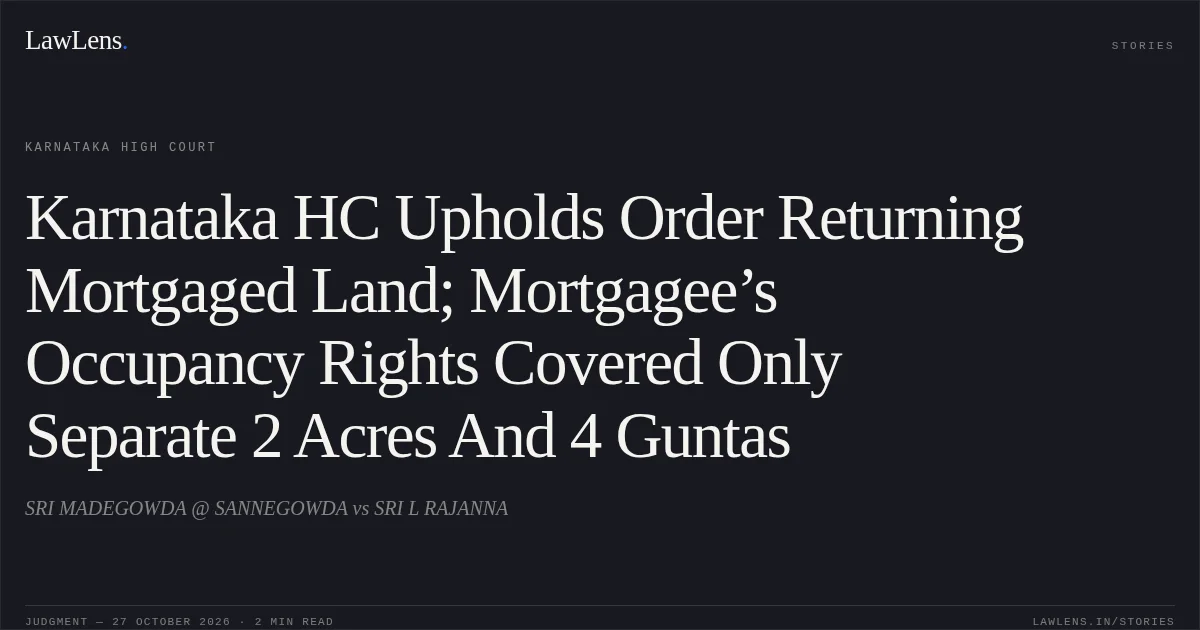
The Court answered the substantial question of law in the affirmative against the appellants, holding that the Land Tribunal proceedings and the occupancy-rights grant over a distinct extent did not render the redemption suit unmaintainable as to the suit land.
¶ 22It dismissed the second appeal and affirmed the concurrent judgments and decrees for redemption and possession.
¶ 23Original Court PDF
SRI MADEGOWDA @ SANNEGOWDAvsSRI L RAJANNA
Click to open original judgment
Original judgment, available to read, download and summarize on LawLens.in