Facts
The petitioner sought to quash Crime No. 384/2020, registered following a private complaint (PCR No. 179/2020) alleging offences under Sections 120B, 200, 404, 419, 420, 421, 423, 424, 426, 464, 467 and 468 of the IPC.
Source reference: p. 2–5The complainant died during the proceedings, and the petitioner did not take steps to bring the complainant’s legal representatives on record despite adjournments.
Source reference: p. 2–5The Trial Court’s order referring the complaint to police for investigation under Section 156(3) CrPC was eventually produced before the High Court.
Source reference: p. 2–5The petitioner’s counsel maintained that no application to bring the legal representatives on record was necessary.
Source reference: p. 3–5Issues
1. Whether the petition to quash the FIR could be considered without bringing the deceased complainant’s legal representatives on record.
Source reference: p. 3–72. Whether the petitioner had established grounds for quashing the FIR registered after a referral under Section 156(3) CrPC.
Source reference: p. 4–5, 9Law Applied
Section 156(3) CrPC empowers a Magistrate, before taking cognizance, to refer a complaint to the police for investigation.
Source reference: p. 5Relying on Chand Devi Daga v. Manju K. Humatani, (2018) 1 SCC 71, and the authorities discussed in that decision—including Jimmy Jahangir Madan v. Bolly Cariyappa Hindley, (2004) 12 SCC 509, and Ashwin Nanubhai Vyas v. State of Maharashtra, AIR 1967 SC 983—the Court stated that legal heirs may continue a prosecution after the complainant’s death, including by seeking permission under Section 302 CrPC.
Source reference: p. 5–8The Court also referred to Harman Singh v. State of Himachal Pradesh, (1973) 3 SCC 343, concerning abatement of criminal proceedings upon an accused’s death.
Source reference: p. 7Reasoning
The Court found that the Trial Court had referred the complaint to the police under Section 156(3) CrPC and that the complaint contained specific allegations against the petitioner, including allegations concerning cognizable offences.
Source reference: p. 4–5Applying Chand Devi Daga and the related authorities, it considered that the complainant’s legal heirs could have a role in continuing the proceedings after his death.
Source reference: p. 6–9As the petitioner did not take steps to bring them on record despite opportunities, the Court declined to consider the quashing petition on its merits, reasoning that the matter should not proceed without giving the legal heirs an opportunity.
Source reference: p. 6–9Holding
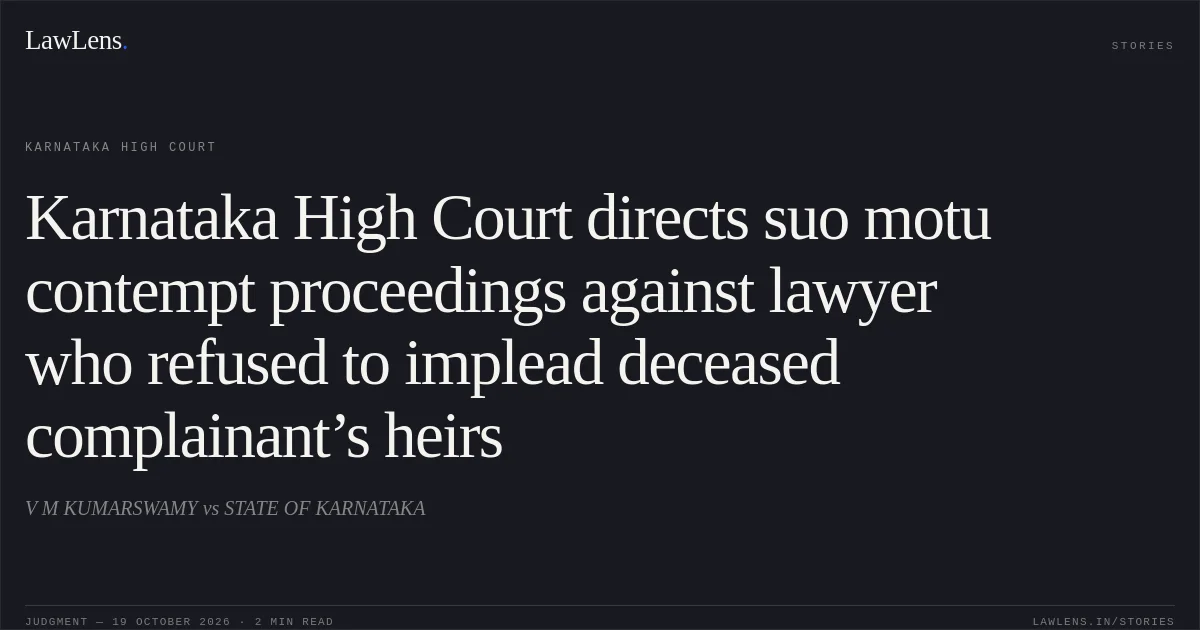
The High Court dismissed the petition to quash the FIR, finding no ground to consider it on the merits without the complainant’s legal heirs being brought on record.
The Court also deprecated the petitioner’s counsel’s conduct and directed the Registrar General to initiate contempt proceedings suo motu.
Source reference: p. 9–10Acts & Sections Cited
17 provisions across 2 statutes referred to in this judgment. Each provision opens on LawLens.
Code of Criminal Procedure, 19733
Original Court PDF
V M KUMARSWAMYvsSTATE OF KARNATAKA
Click to open original judgment
Original judgment, available to read, download and summarize on LawLens.in