Facts
Sathanoor Police registered a case against unknown persons following a complaint and, during investigation, arrested the appellant on 11 February 2022.
Source reference: para. 2–3He remained in judicial custody while facing charges under Sections 302, 201 and 202 read with Section 34 of the IPC and Section 3(2)(v) of the SC/ST (Prevention of Atrocities) Act.
Source reference: para. 2–3The appellant appealed under Section 14A(2) of the SC/ST (POA) Act against the Sessions Court’s rejection of his bail application.
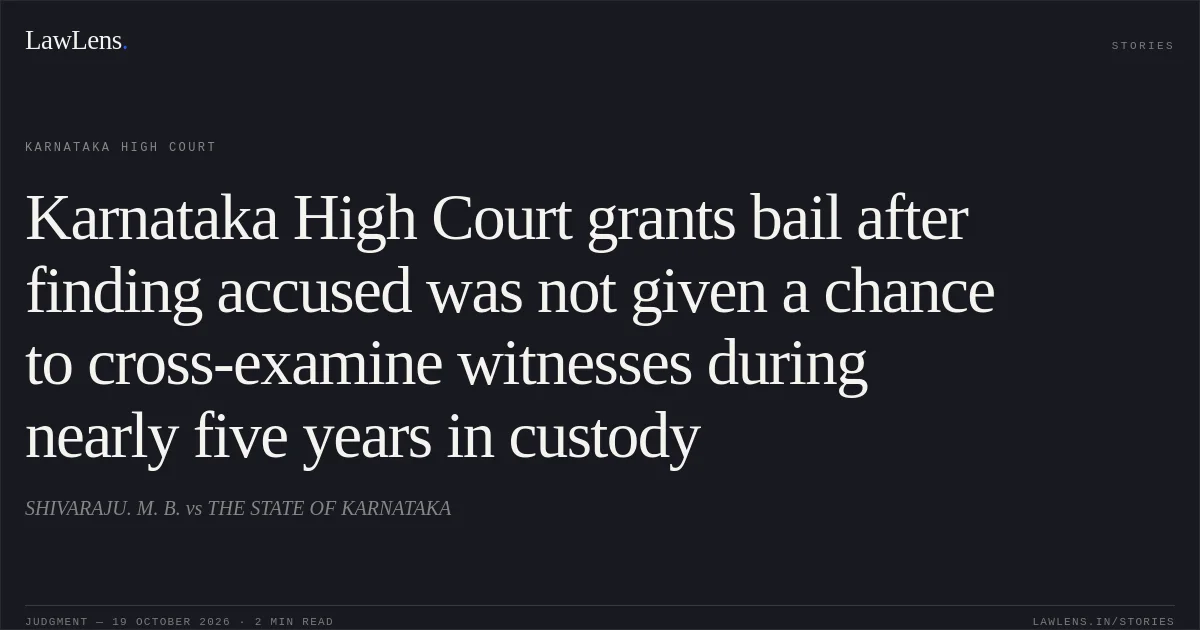
Source reference: para. 1, 3–6He submitted that he had been detained for over four years and eight months, the case rested on circumstantial evidence, and the five witnesses examined had not been made available for cross-examination.
Source reference: para. 1, 3–6The High Court reviewed the deposition records and found that the trial court had recorded the witnesses’ evidence without providing the accused’s counsel an opportunity to cross-examine them.
Source reference: para. 9Issues
Whether the appellant should be granted bail in light of his prolonged pre-trial detention, the circumstantial nature of the prosecution case, and the circumstances of the evidence recorded to date.
Source reference: para. 3–6, 9–10Whether the trial court’s failure to provide the accused’s counsel an opportunity to cross-examine the prosecution witnesses was inconsistent with the applicable Supreme Court guidelines.
Source reference: para. 5–6, 9Law Applied
Section 14A(2) of the SC/ST (POA) Act provides for an appeal against an order concerning bail under the Act.
Source reference: p. 2The High Court considered bail under Section 483 of the BNSS, 2023, and referred to Ashok v. State of Uttar Pradesh, (2025) 2 SCC 381, directing the trial court to comply with the Supreme Court’s guidelines when recording prosecution evidence.
Source reference: para. 5, 10; p. 6In deciding bail, the Court considered the period of detention, the nature and gravity of the offence, and the appellant’s antecedents.
Source reference: para. 10Reasoning
The Court noted that the FIR did not name the appellant and that the prosecution case was circumstantial.
Source reference: para. 9It also found from the deposition copies that five witnesses had been examined without an opportunity for the accused’s counsel to cross-examine them, and concluded that the trial court had not complied with the Ashok guidelines.
Source reference: para. 6, 9Considering this procedural concern alongside the appellant’s detention of more than four years and eight months, and without expressing any opinion on the merits, the Court found it appropriate to grant bail.
Source reference: para. 10Holding
The appeal was allowed, and the order rejecting bail was set aside.
The appellant was ordered released on a self-bond of ₹1,00,000, subject to conditions that he not tamper with or threaten prosecution witnesses and attend every hearing.
Source reference: para. 10; p. 6The trial court was directed to comply with the Ashok guidelines when recording prosecution evidence.
Source reference: para. 10; p. 6Acts & Sections Cited
6 provisions across 3 statutes referred to in this judgment. Each provision opens on LawLens.
Indian Penal Code, 18604
Scheduled Castes and the Scheduled Tribes (Prevention of Atrocities) Act, 19891
Bharatiya Nagarik Suraksha Sanhita, 20231
Original Court PDF
SHIVARAJU. M. B.vsTHE STATE OF KARNATAKA
Click to open original judgment
Original judgment, available to read, download and summarize on LawLens.in